
Glaukos in 2026: Margin Recovery, Pipeline Ambition, and the Commercialization Test in Ophthalmology
Glaukos delivers a sharp rebound in revenue growth and profitability as iDose TR and Epioxa drive volume and margin gains, but the company’s ability to sustain momentum will depend on navigating rising operating costs, pipeline execution, and competitive pressure in ophthalmic therapeutics.
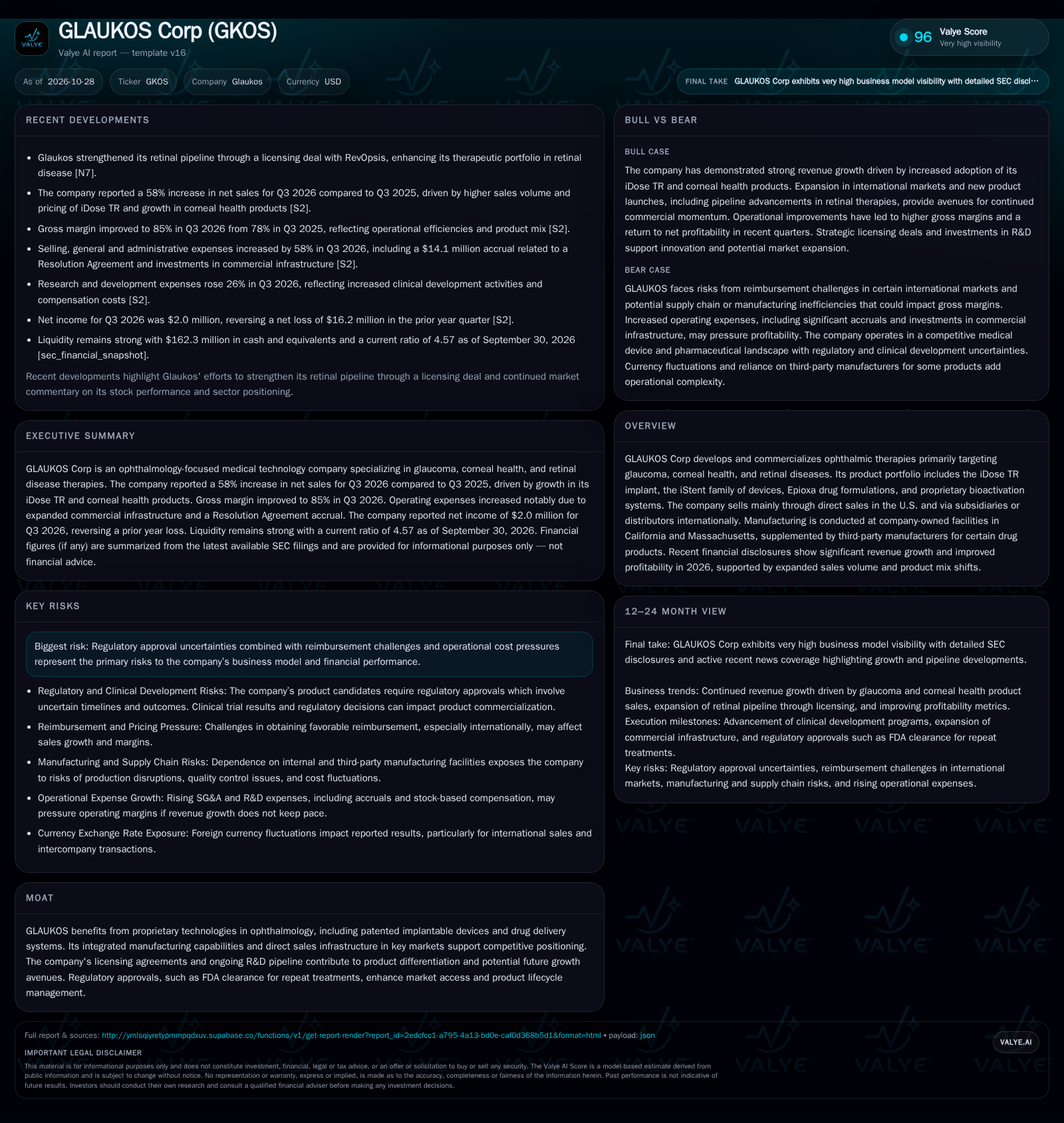
Glaukos reported a 58% year-on-year net sales increase and returned to net profitability in Q3 2026, with gains led by iDose TR and corneal health products. Gross margin surged to 85% on product mix and operational gains. However, SG&A and R&D costs are rising rapidly, and the company faces execution risk as it expands its pipeline and commercial footprint in a competitive, regulatorily complex market. Recent moves to bolster the retinal portfolio highlight the search for new growth avenues, but future margin and market share depend on successful clinical, regulatory, and commercial navigation.[S2] [N7]
Glaukos Corp enters late 2026 in a position of renewed financial strength, having delivered a dramatic revenue and margin rebound on the back of its flagship iDose TR glaucoma implant and growing corneal health product line. The company’s return to profitability and reported cash position suggest operational discipline and successful commercial execution, yet the sharp rise in operating expenses and intensifying R&D activity signal that Glaukos is still in the thick of a high-stakes growth phase. As the company pushes deeper into retinal therapeutics and faces a complex competitive and regulatory environment, the key question becomes whether recent gains are sustainable or merely a prelude to a new set of commercialization and cost-control challenges.
Revenue Acceleration and Margin Expansion Reshape the Financial Backdrop
Glaukos reported a 58% increase in net sales for Q3 2026 compared to the prior year, with growth attributed to higher volume and improved pricing of iDose TR as well as expanded uptake of Epioxa and related corneal health products. This surge was accompanied by a substantial gross margin improvement to 85% (from 78%), reflecting both a favorable shift in product mix and operational efficiencies.[S2]
Operating expenses also climbed sharply: SG&A rose by 58%—including a $14.1 million accrual tied to a Resolution Agreement—while R&D spending increased 26%, driven by expanded clinical development and higher compensation costs. Notably, Glaukos swung to net income of $2.0 million, reversing a $16.2 million net loss in Q3 2025.[S2]
The company ended the quarter with $162.3 million in cash and equivalents, current assets of $579.7 million, and a current ratio of 4.57, indicating a reported liquidity position.[S2]
How iDose TR and Epioxa Shape Glaukos’ Profit Model—and Its Limits
Glaukos’ revenue engine is currently powered by its iDose TR implant and the iStent family—both targeting glaucoma—as well as Epioxa for corneal health. These products are sold primarily through a direct sales force in the U.S. and via subsidiaries/distributors abroad, a structure that can support higher realized prices and tighter customer relationships in a specialty-medtech context.[S2]
The 85% gross margin in Q3 2026 suggests substantial product-level profitability, likely reflecting a high-value mix of proprietary devices and drug-delivery systems. However, the fixed cost base is rising rapidly, with SG&A and R&D both scaling to support pipeline expansion, regulatory submissions, and broader commercial infrastructure. The $14.1 million Resolution Agreement accrual and elevated stock-based compensation highlight the risk of sudden step-changes in operating expense.
Glaukos’ manufacturing model—owning facilities for core products but relying on third-party manufacturers for Epioxa and other drugs—provides flexibility but also exposes the company to variable costs and supply chain risk. Sustained profitability will require that top-line momentum outpaces these growing fixed and semi-variable costs, particularly as the company advances multiple R&D programs across glaucoma, corneal, and retinal indications.[S2]
Defending Share in a Crowded Ophthalmology Landscape
Glaukos operates in an intensely competitive environment, facing established medical device firms, large pharmaceutical companies with ophthalmology portfolios, and emerging startups developing novel drug delivery and surgical technologies. The company’s proprietary iDose TR and iStent devices offer differentiated, minimally invasive solutions for glaucoma—potentially supporting physician adoption and premium pricing, especially as the market shifts toward less invasive, sustained-delivery interventions.
However, barriers to entry in ophthalmology are not insurmountable: new entrants can target specific indications, and larger incumbents have the resources to invest in next-generation implants or combination therapies. The licensing deal with RevOpsis to strengthen the retinal pipeline is a strategic move to diversify and defend share in the face of competitors pursuing similar market expansion.[N7]
Glaukos’ direct sales and established relationships with ambulatory surgery centers and hospitals in the U.S. may help defend share, but international markets present reimbursement and distribution complexities. Regulatory approvals, especially for repeat treatments or novel indications, could be a source of both advantage and delay.
Pipeline Execution and Repeat-Use Approvals Unlock New Growth Levers
A favorable scenario for Glaukos would see continued rapid adoption of iDose TR, further corneal health penetration with Epioxa, and successful expansion into retinal therapies via the RevOpsis partnership. If the company secures regulatory clearance for repeat iDose TR treatments and launches next-generation candidates on schedule, this could materially expand the addressable market and lengthen product lifecycles.
Operational leverage could kick in if revenue growth continues to outpace SG&A and R&D expansion, driving sustained profitability and free cash flow. International expansion, if accompanied by favorable reimbursement wins, would further boost volumes and diversify revenue streams.
Evidence supporting this scenario would include accelerating product adoption metrics (if disclosed), successful regulatory milestones (e.g., FDA clearances for new indications or repeat dosing), and early commercial traction for retinal pipeline launches. Confirmation would also come from sustained gross margin at or above current levels despite sales mix shifts.
Margin Gains Offset by Cost Inflation as Glaukos Pursues Broader Indications
The most plausible near-term trajectory is one where Glaukos maintains healthy top-line growth, but margin expansion is partially offset by continued investment in commercial infrastructure, R&D, and regulatory compliance. As the company advances multiple clinical programs and builds out its international presence, operating expenses are likely to remain elevated.
Gross margins may stabilize at high levels if the product mix remains favorable, but any shift toward lower-margin drug products or increased reliance on third-party manufacturing could apply pressure.
Key evidence for this scenario would include steady, but not accelerating, revenue growth rates, periodic increases in SG&A and R&D, and maintenance of current margin levels. Falsification would come from either a sharp deceleration in top-line growth or a sudden, sustained spike in operating costs that erodes profitability.
Regulatory Delays and Reimbursement Hurdles Derail Commercial Momentum
The primary risk for Glaukos is that regulatory delays—whether for next-generation iDose/Epioxa products or for repeat-use indications—slow product launches and stall revenue growth. In parallel, if international reimbursement becomes more challenging or U.S. payers tighten coverage, volumes and realized prices could decline.
Escalating SG&A and R&D costs, if not matched by revenue, could quickly erode operating margins and return the company to net losses. Disruptions with third-party manufacturers or quality-control issues could also impact product availability and reputation.
Downside evidence would include missed regulatory milestones, product recalls or negative clinical readouts, a reversal in gross margin trends, or a drop in cash reserves without corresponding pipeline or commercial progress.
Milestones That Will Clarify Glaukos’ Growth and Profitability Trajectory
Quarterly iDose TR and Epioxa sales volumes, if disclosed, to gauge core product momentum and market penetration.
Gross margin progression relative to product mix and manufacturing footprint changes.
SG&A and R&D expense growth rates versus revenue growth to assess operating leverage and cost discipline.
Regulatory progress for next-generation iDose and Epioxa products, including timing and outcome of FDA and international approvals.
Updates on the commercial launch and early adoption of retinal pipeline candidates, particularly those sourced via the RevOpsis licensing deal.
Disclosures on reimbursement trends and payer coverage, especially for international markets.
Any signals of manufacturing or supply chain disruptions, including quality or recall events, that could impact product availability or margin.
Cash flow from operations and net change in cash, to test the sustainability of current liquidity levels as investment ramps.
Disclaimer: This is research-only, informational analysis and not investment advice. It may include AI-generated interpretation and general industry context. Always verify important details using primary sources.

Comments