
Porch Group’s Insurance Platform: Acquisition Plans, Catastrophe Exposure, and Multi-Segment Integration Dynamics
Porch Group’s recent performance has been buoyed by underwriting gains and product innovation, but its pending insurance acquisition exposes the business to greater catastrophe risk, integration complexity, and the test of whether its proprietary data and platform advantage can scale into new, more volatile markets.
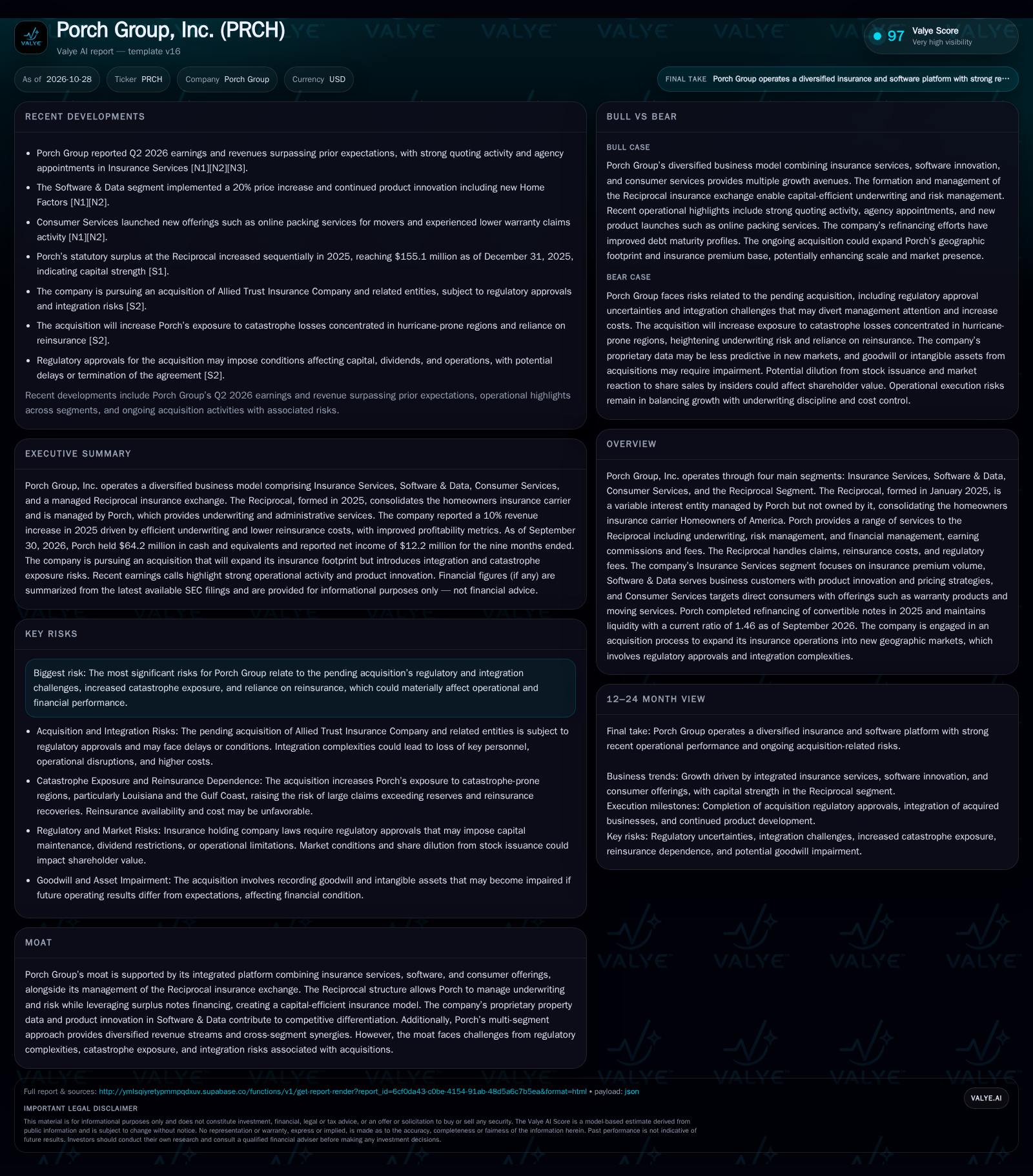
Porch Group reported strong 2025 revenue growth and profitability, aided by lower reinsurance costs and fewer catastrophic events. Expansion plans hinge on acquiring Allied Trust Insurance Company, which would increase catastrophe exposure and operational complexity, raising questions about the scalability of Porch’s data-driven model and risk management in new geographies. Integration execution and regulatory approvals are now pivotal.
Porch Group, Inc. has delivered solid growth and improved profitability on the back of efficient underwriting and innovative cross-segment product launches. Yet with its pending acquisition of Allied Trust Insurance, the company faces a pivotal transition: greater exposure to catastrophe risk, heavier reliance on reinsurance, and the operational challenge of integrating new entities in unfamiliar markets. The question for investors is whether Porch’s platform model, proprietary property data, and diversified offerings can deliver the same margin and risk outcomes as the business expands into more volatile, hurricane-prone regions.
Recent Performance and Strategic Focus on Catastrophe-Exposed Markets
Porch Group reported $482.4 million in consolidated revenue for 2025, a 10% increase over 2024, largely attributed to lower external reinsurance costs and more effective underwriting at the Reciprocal segment. Cost of revenue declined by 40%, benefiting from fewer catastrophic weather events. For the first nine months of 2026, revenue was $143.9 million with net income of $12.2 million, reflecting positive operating leverage and margin improvement [S1] [S2].
Porch is pursuing the acquisition of Allied Trust Insurance Company and related entities, which will expand its insurance operations into catastrophe-exposed regions like Louisiana and the Gulf Coast. This move introduces new operational and regulatory complexity, along with increased exposure to large, weather-driven claims and heavier reliance on reinsurance [S2].
The company reported cash and liquidity metrics for the period; these figures do not by themselves establish operating runway, investment capacity, financial flexibility, or financing capacity. [S2]
Revenue Streams and Risk Profiles Across Porch’s Business Segments
Porch’s business model is built on four segments: Insurance Services (premium volume-focused), Software & Data (B2B software, pricing, and data solutions), Consumer Services (direct-to-consumer home-related offerings), and the managed Reciprocal segment (insurance exchange). The company earns commissions and fees for managing the Reciprocal, handling underwriting, renewals, risk management, and investment guidance, while the Reciprocal itself pays claims, reinsurance, and agency commissions [S1].
Insurance economics hinge on premium growth, claims frequency/severity, reinsurance cost, and the ability to underwrite profitably in volatile markets. The 2025 results suggest Porch’s underwriting and risk selection (aided by proprietary data) delivered outsized benefit in a year with lower catastrophic activity. However, as Porch expands into hurricane-prone regions via the Allied Trust acquisition, the volatility of claims and reinsurance costs may rise sharply—potentially compressing margins and increasing the risk of large, one-off losses.
The Software & Data segment’s recent 20% price increase and continued product innovation indicate pricing power and a path to higher-margin, recurring revenue streams if customer retention holds. Consumer Services’ new offerings (such as online packing for movers) may drive incremental growth, but the overall profit contribution of these segments versus insurance remains to be demonstrated [N1] [N2].
Capital needs are most acute in insurance, where regulatory capital, catastrophe reserves, and surplus are critical. Porch’s ability to manage the Reciprocal with surplus notes helps limit direct capital requirements, but as the business takes on more risk-heavy books, capital adequacy and reinsurance availability become increasingly central to sustainable growth.
Porch’s Competitive Strengths and Constraints in Regional Risk Integration
Porch’s competitive positioning rests on its integrated platform—combining insurance, proprietary property data, software-driven risk assessment, and consumer services—to provide a differentiated value proposition for homebuyers and policyholders. The Reciprocal structure enables capital-lite growth and aligns incentives for efficient risk management.
However, the expansion into new geographies like the Gulf Coast introduces counterforces. Regional carriers and large national insurers with deep catastrophe modeling capabilities already compete aggressively in these markets. Porch’s proprietary data, developed for its historic footprint, may be less predictive in new regions, potentially eroding underwriting advantage and increasing loss volatility [S2].
Switching costs in insurance are modest for consumers, especially in catastrophe-prone areas where price and claims experience drive shopping behavior. Software & Data’s pricing power and customer stickiness are harder to gauge without disclosed churn or retention metrics, but integration with insurance products may provide cross-selling leverage if execution is strong.
Ultimately, Porch’s edge will be tested by its ability to adapt data-driven underwriting to new risk environments, maintain cost discipline, and realize cross-segment synergies faster than competitors can replicate its platform.
Potential Gains from Proprietary Data Use and Platform Synergies
A favorable scenario for Porch sees the Allied Trust acquisition closing smoothly, with regulatory approvals secured and integration executed without major disruption or loss of key talent. Porch successfully adapts its proprietary data models to new regions, maintaining underwriting discipline and avoiding outsized catastrophe losses—even in active storm years.
In this case, premium growth accelerates, and Porch secures favorable reinsurance terms due to strong risk selection and credible loss history, supporting margin expansion. Software & Data continues to command premium pricing, with low churn and high attach rates for new products, while Consumer Services’ offerings deepen customer engagement and cross-sell opportunities.
Evidence that would confirm this scenario includes: above-industry loss ratios in acquired books, stable or improved reinsurance costs, disclosed retention/churn rates showing sticky Software & Data customers, rapid statutory surplus growth, and positive integration updates from management.
Growth Prospects Tempered by Volatility and Integration Complexities
The most plausible outcome is that Porch completes its acquisition, expands its insurance premium base, and grows revenues across segments. However, the new exposure to catastrophe-prone markets leads to higher loss volatility and potential spikes in reinsurance costs. Underwriting margins compress in years with adverse weather, but are offset in quieter periods.
Integration of Allied Trust and related entities proceeds with some friction—operational complexity, system harmonization, or regulatory adjustments slow full realization of synergies. Porch’s proprietary data models require adaptation, resulting in a period of elevated loss ratios until new risk factors are calibrated. Software & Data and Consumer Services provide diversified revenue, but insurance remains the primary driver of both risk and reward.
This scenario would be confirmed by: increased but volatile top-line growth, periodic margin swings tied to catastrophe seasons, incremental integration costs, and management commentary focused on risk model recalibration and reinsurance negotiations.
Impact of Catastrophic Events on Integration and Profit Margins
In an adverse scenario, Porch’s acquisition faces regulatory delays or costly approval conditions, and the integration of Allied Trust is marred by operational disruption or loss of key personnel. The acquired insurance books experience outsized catastrophe losses early, exposing weaknesses in proprietary data models and resulting in higher-than-expected claims.
Reinsurance becomes more expensive or less available due to adverse loss history, forcing Porch to retain more risk on its balance sheet or accept lower margins. Goodwill or intangible assets from the acquisition may be impaired if performance falls short of forecasts. Dilution from stock issuance and negative market reaction weigh on the share price, while Consumer and Software segments are unable to offset insurance-driven losses.
Evidence confirming this scenario includes: delayed or failed acquisition close, adverse regulatory findings, reported integration setbacks, sharp increases in loss and combined ratios, reinsurance cost spikes, or impairment charges related to the acquisition.
Benchmarks for Assessing Porch’s Capacity to Manage Catastrophe Risk
Progress and terms of regulatory approval for the Allied Trust acquisition, including any capital, dividend, or operational restrictions imposed as conditions [S2].
Reported loss and combined ratios for both legacy and newly acquired insurance businesses, especially in the first major storm season post-acquisition, would help test underwriting discipline and data model adaptability.
Trends in reinsurance costs and availability, as disclosed in future filings or earnings calls—critical for assessing risk transfer capacity and margin sustainability.
Integration updates: system harmonization, retention of key personnel, and timeline to unified operations. Management commentary or disclosed integration milestones would be useful.
Statutory surplus and risk-based capital ratios at the Reciprocal and acquired insurance entities, particularly after absorbing initial catastrophe losses, if disclosed.
Software & Data segment churn, retention, and attach rates for new products—metrics that would clarify recurring revenue durability and cross-segment leverage.
Impact of new consumer offerings (like online packing) on segment growth and margins, if segment profitability is separately disclosed.
Disclaimer: This is research-only, informational analysis and not investment advice. It may include AI-generated interpretation and general industry context. Always verify important details using primary sources.

Comments