
Truist’s Strategic Refocus: Divestitures, Capital Returns, and the Shifting Economics of Diversified Banking
Truist Financial’s recent loan sales and capital return surge signal a deliberate move to streamline its balance sheet and sharpen its focus on core business lines. The challenge: whether portfolio reshaping and risk management advances can offset noninterest income volatility and execution risks as the financial landscape evolves.
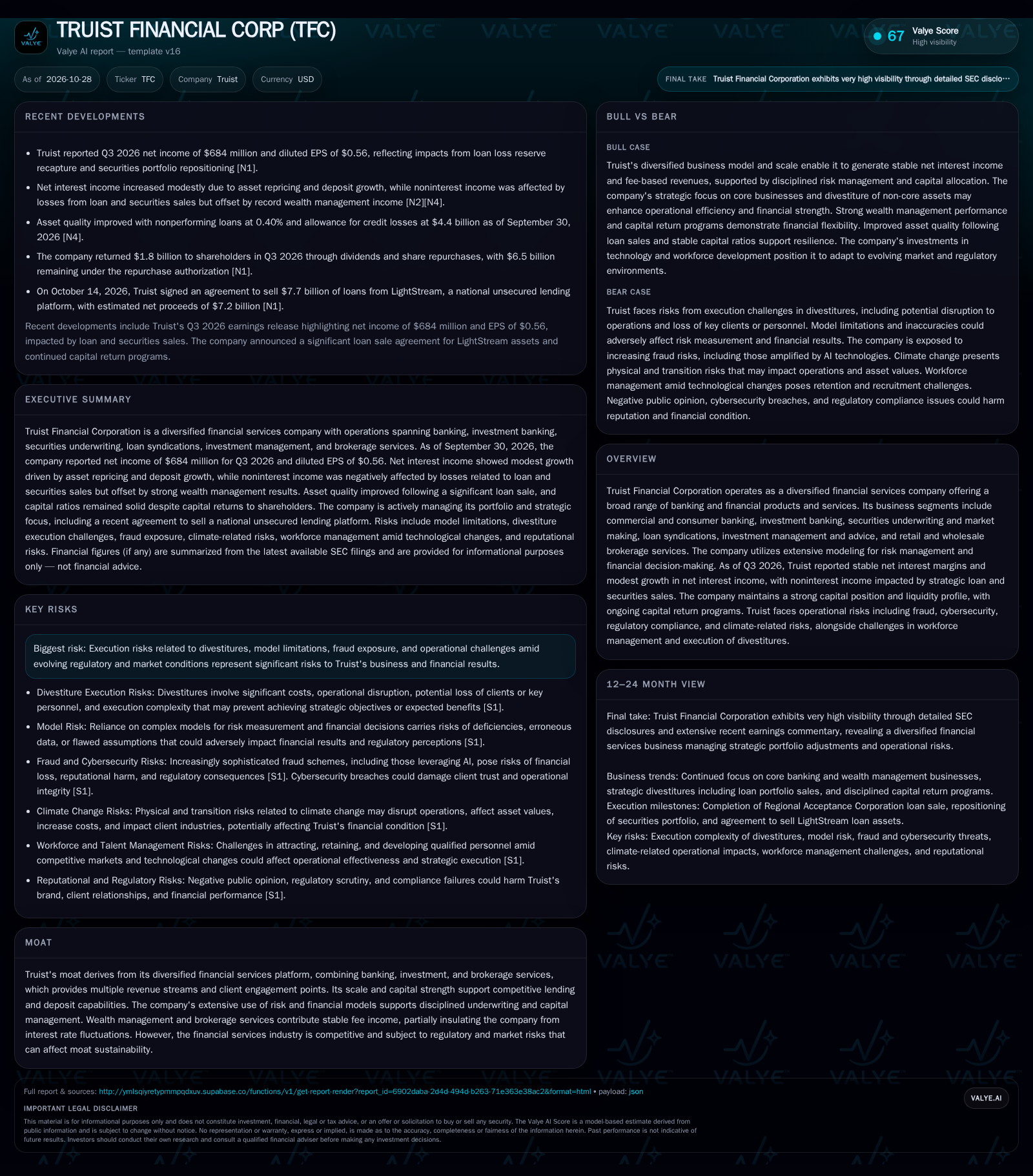
Truist Financial is actively reshaping its business through major loan portfolio divestitures and robust capital return initiatives. While net interest income remains stable and asset quality has improved, noninterest income has been pressured by losses on loan and securities sales. The company’s near-term trajectory depends on successful execution of its strategic refocus, maintaining credit discipline, and navigating operational risks—including divestiture complexity, model risk, and fraud threats. The next phase will test Truist’s ability to grow fee-based revenue and sustain competitive advantages amid regulatory and technological headwinds. [N1] [N4]
Truist Financial Corporation is at an inflection point, accelerating its portfolio reshaping by divesting non-core assets such as its LightStream unsecured lending platform while maintaining strong capital return programs. Recent results highlight stable net interest income and improved asset quality, but also underscore ongoing pressures on noninterest income and the operational challenges of a large-scale financial institution in transition. As Truist pivots toward its core banking and wealth management businesses, its ability to execute divestitures cleanly and harness operational leverage will be critical to sustaining returns in a competitive, risk-laden environment. The next 12-24 months will test whether Truist’s strategic bets can deliver durable shareholder value—or expose new vulnerabilities as industry dynamics shift.
Recent Loan Sales and Capital Actions Reshape Truist’s Strategic Posture
Truist Financial’s Q3 2026 marks a period of significant portfolio transition. The company signed an agreement to sell $7.7 billion in loans from LightStream, its national unsecured lending platform, with estimated net proceeds of $7.2 billion. This move signals an intentional retreat from non-core consumer finance and a refocus on core commercial and wealth management businesses. Concurrently, Truist returned $1.8 billion to shareholders in the quarter through dividends and buybacks, leaving $6.5 billion in authorized repurchases, reflecting both robust capital strength and a commitment to capital return. Asset quality metrics also improved, with nonperforming loans at 0.40% and an allowance for credit losses totaling $4.4 billion as of September 30, 2026. These facts collectively suggest a company actively managing its risk profile, capital allocation, and business mix in response to evolving market and regulatory conditions. [N1] [N4] [S2]
How Truist’s Business Mix and Strategic Moves Shape Its Earnings Power
Truist’s economics rest on a diversified foundation: net interest income (NII) from lending and deposit-taking, complemented by fee-based revenues from wealth management, investment banking, and brokerage. As of Q3 2026, NII showed modest growth, benefiting from asset repricing and deposit inflows—a dynamic often seen when banks can pass higher rates to borrowers faster than to depositors. However, noninterest income remains volatile, due to realized losses from loan and securities sales. The LightStream loan sale, while improving asset quality and liquidity, will reduce future consumer loan interest income, placing greater pressure on core commercial banking and fee-generating segments to offset the lost yield. [N2] [N4] [S2]
Truist’s cost structure includes a mix of fixed (branch network, technology infrastructure, regulatory compliance) and variable (compensation, transaction processing) expenses. Scale helps absorb regulatory and technology costs, but noninterest expense management becomes more critical as fee and lending income face headwinds. The capital return program—$1.8 billion in Q3 alone—reflects surplus capital but also raises questions about the sustainability of such returns if future earnings or asset sales lag. The strategic divestiture of non-core assets could free up capital, but execution risks and potential stranded costs must be managed to avoid margin dilution. In sum, Truist’s ability to drive operating leverage will depend on cost discipline, successful portfolio repositioning, and fee-revenue growth amid secular shifts in banking economics. [S2]
Diversification, Scale, and Technology Investment: Where Truist Stands Among Peers
Truist’s competitive position is anchored by its diversified business model—spanning commercial banking, investment banking, wealth management, and brokerage—allowing it to serve a broad client base and generate multiple revenue streams. Its scale affords cost advantages in compliance, technology, and product delivery, supporting competitive pricing in lending and deposit gathering. However, Truist operates in a fiercely competitive landscape, with regional banks, national money-center banks, and digital-native fintechs all vying for market share. The recent LightStream divestiture reflects a strategic retreat from high-risk, commoditized consumer lending, focusing instead on areas with stronger relationship depth and cross-sell opportunities. [S1] [S2]
Technology investment is increasingly a battleground: Truist’s extensive risk modeling and digital platforms are critical for client retention and operational efficiency, but also expose the company to model risk and cyber threats. The challenge is to leverage data and digital channels to enhance client stickiness and drive fee income, while managing regulatory and reputational risks. Wealth management and investment banking offer some insulation from interest rate swings, but these segments also face competitive fee compression and shifting client preferences. Ultimately, Truist’s ability to sustain a moat will depend on deepening client relationships, executing on technology transformation, and maintaining credit discipline as industry dynamics continue to evolve. [S1] [S2]
If Portfolio Repositioning Unlocks Efficiency and Fee Growth
A favorable scenario unfolds if Truist’s strategic exit from non-core lending—exemplified by the LightStream sale—enables the company to redeploy capital into higher-return, lower-risk core businesses. Successful divestitures could streamline operations, reduce credit risk, and free resources for technology and relationship banking investments. If Truist can accelerate fee-based revenue growth (particularly in wealth management and advisory), while containing noninterest expense inflation, the company could deliver improved operating leverage even as interest margins normalize.
Confirmation would come from post-divestiture revenue stability (or growth) in core segments, rising wealth management and investment banking fees, and further improvement in asset quality metrics. Evidence of successful cost takeout—such as a declining efficiency ratio—and retention of key clients and talent through the transition would further bolster the upside case. Sustained or increased capital return, without impairing capital ratios, would also validate the effectiveness of the portfolio repositioning strategy. [S2]
Managing Through Transition: Steady Core, Volatile Noninterest Income
The most plausible outcome is that Truist’s core banking and wealth management businesses continue to provide stable, if unspectacular, earnings, while noninterest income remains choppy due to ongoing portfolio reshaping. Net interest income may face mild pressure as the benefits of asset repricing wane and the impact of loan sales reduces interest-earning assets. Fee-based segments—wealth management, investment banking—offset some of this pressure but are themselves subject to market volatility and competitive pricing. [S2]
Execution risks around divestitures, cost control, and technology investments persist, but do not materially impair the franchise. Asset quality remains sound, supported by conservative credit provisioning, and capital ratios stay within regulatory comfort zones, enabling continued—if potentially slower—capital return to shareholders. This scenario would be confirmed by modest revenue growth, stable or improving credit metrics, and an efficiency ratio that does not deteriorate meaningfully post-divestiture. Failure to grow fee income or control expenses, or a spike in credit costs, would challenge this base case. [S2]
Execution Missteps or External Shocks Expose New Vulnerabilities
A negative outcome could emerge if Truist faces major execution challenges in its divestiture program—such as higher-than-expected stranded costs, loss of key clients or personnel, or operational disruptions. If realized losses from loan or securities sales persist, and fee-based revenue fails to fill the gap, overall profitability could suffer. The risk is compounded if macroeconomic headwinds trigger a spike in credit losses or if Truist’s risk models fail to anticipate emerging threats, such as fraud schemes or climate-related asset impairments. [S1] [S2]
Cybersecurity incidents or regulatory infractions could inflict reputational and financial damage, while workforce attrition due to technological change could hamper operational resilience. The downside would be confirmed by rising nonperforming assets, a deteriorating efficiency ratio, declining capital ratios, or a sudden slowdown in capital return. Early warning signs would include missed divestiture milestones, negative operating leverage, or evidence of client attrition in key business lines. [S1] [S2]
Milestones That Will Determine Whether Truist’s Strategic Shift Pays Off
Progress and terms of the LightStream loan sale closing, and any additional divestiture announcements or completions.
Quarterly trends in noninterest income, especially in wealth management, investment banking, and brokerage (a useful metric would be segment-level fee growth post-divestiture).
Changes in the efficiency ratio (noninterest expense/revenue), especially as stranded costs from exited businesses are addressed.
Asset quality evolution, including nonperforming loan ratios and the adequacy of the allowance for credit losses.
Capital return cadence: pace of share repurchases and dividends relative to capital ratios and earnings generation.
Evidence of client or personnel attrition in divested or core businesses (if disclosed), as a proxy for franchise health.
Incidence or financial impact of cybersecurity events, model failures, or large-scale fraud (if disclosed).
Updates on regulatory or compliance matters that could materially affect capital, operations, or reputation.
Disclaimer: This is research-only, informational analysis and not investment advice. It may include AI-generated interpretation and general industry context. Always verify important details using primary sources.

Comments