
CoStar Group’s Expansion Playbook: Data, Acquisitions, and the Challenge of Platform Integration
CoStar Group is leveraging a wave of acquisitions—including Vexcel and Matterport—to deepen its data advantage across commercial and residential real estate. But as the company pivots from a predominantly subscription-driven model to a more complex mix of transactional and listing-based revenues, integration risks and margin pressures loom.
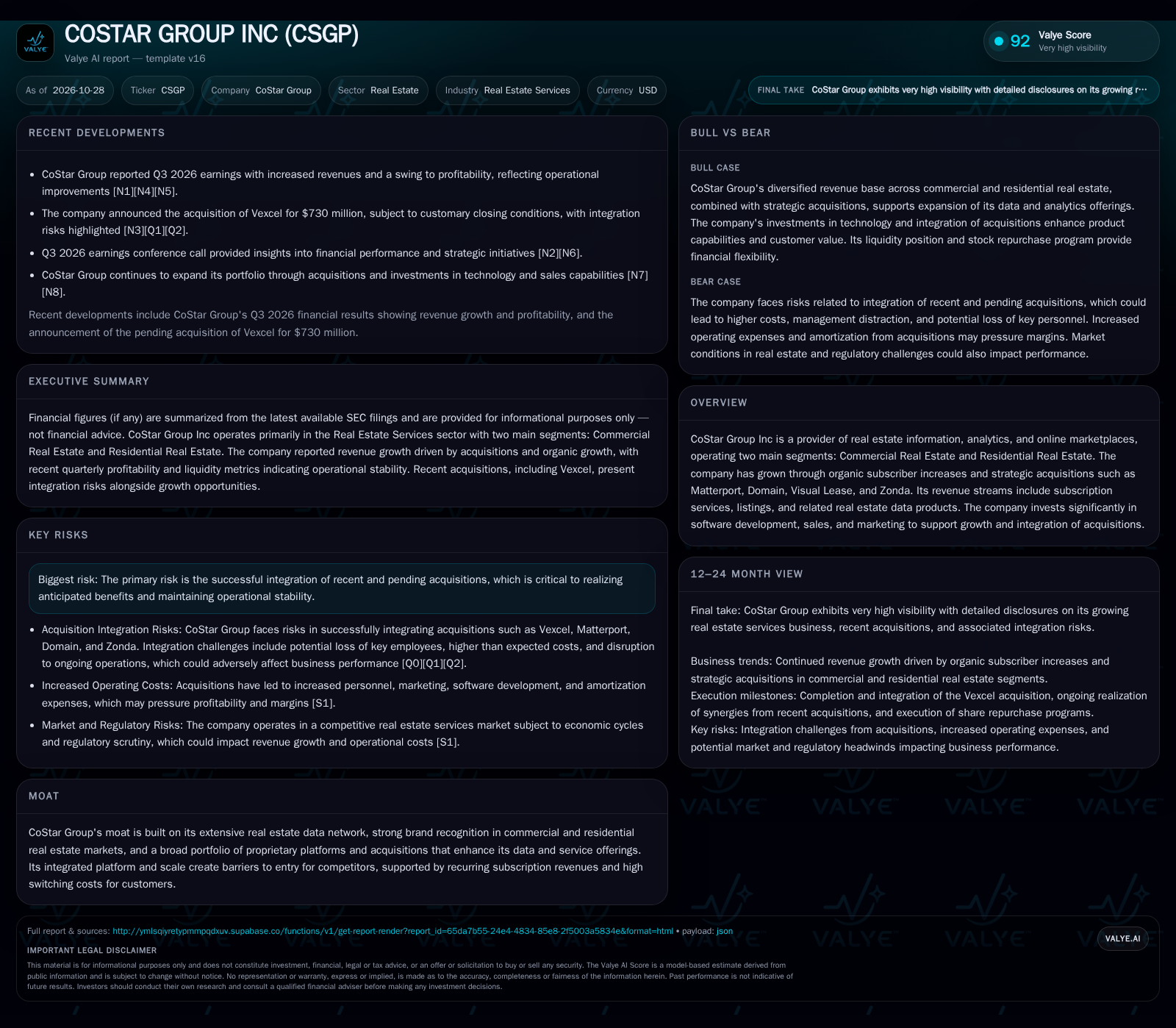
CoStar Group’s Q3 2026 results show continued revenue growth and a return to profitability, powered by organic subscriber additions and recent acquisitions such as Vexcel and Matterport. The company is now integrating a wider spectrum of business models, with subscription-based revenues slipping as a percentage of the total, and faces higher operating costs and integration risk as it extends its data and marketplace reach. Recurring revenue, high switching costs, and a broad platform provide competitive insulation, but execution on integration and sales force expansion will determine whether CoStar can sustain its growth trajectory and margin profile. [S2] [N1] [N3]
CoStar Group is at a pivotal juncture in its evolution from a dominant provider of commercial real estate data to a diversified, tech-enabled real estate platform. Recent results confirm that acquisitions and organic growth are driving top-line gains and a return to profitability, but the company’s pivot toward more transactional and listing-based revenues—alongside a wave of high-profile acquisitions—introduces new operational and strategic risks. The coming quarters will test whether CoStar’s data-driven moat and recurring revenue engine can absorb these changes, or whether integration complexity and rising costs will erode its advantage.
Acquisitions and Revenue Mix: What’s Changing Right Now for CoStar Group
CoStar Group reported increased revenues and a swing to profitability in Q3 2026, with performance attributed to both organic subscriber growth and a series of strategic acquisitions, notably Vexcel for $730 million and previously, Matterport and Domain. These deals expand the company’s portfolio into geospatial imagery, 3D digital twins, and new listing platforms, broadening its data and product set across commercial and residential real estate. [N1] [N3] [S2]
However, the share of subscription-based revenue fell to 89% from 92% year-over-year, as transactional and listing-based products gained weight in the mix—largely due to the integration of Domain’s premium listings and Matterport’s services. Annualized net new bookings for subscription-based services dropped sharply from $84 million to $37 million, reflecting both economic headwinds and slower-than-expected sales force expansion. [S2]
The contract renewal rate for company-wide subscription-based services remained high at 88% over the trailing 12 months, supporting revenue visibility even as the business model diversifies. [S2]
How CoStar Makes Money: Subscription Stability Meets Transactional Experimentation
Historically, CoStar’s core economics have been anchored by subscription-based contracts for access to proprietary real estate data, analytics, and online marketplaces—providing recurring, high-margin revenue with low churn. This model enables substantial operating leverage, as incremental data customers add little marginal cost beyond initial platform investments.
With the acquisitions of Domain and Matterport, CoStar is layering on more transactional and listing-based revenue streams, which tend to be less predictable and may carry lower margins due to higher sales and fulfillment costs. The company continues to invest heavily in software development, sales, and marketing—not only to integrate new assets but also to drive cross-platform adoption and up-sell opportunities. [S2]
The shift toward a more mixed revenue model could dilute margins in the near term, as integration costs, increased personnel, and amortization from acquisitions weigh on profitability. However, if CoStar can successfully cross-sell and embed new data and marketing tools into its subscription platforms, it could deepen customer lock-in and ultimately restore operating leverage as scale grows.
Data Depth and Platform Breadth: CoStar’s Competitive Defenses and Emerging Threats
CoStar’s primary moat is its extensive proprietary database of real estate listings, transactions, and analytics, which is difficult and costly for new entrants to replicate. Its strong brand recognition in both commercial (via CoStar and LoopNet) and residential (via Homes.com, Apartments.com, Domain) markets, combined with high switching costs for enterprise customers, insulates it from most direct competitors.
The recent expansion into 3D modeling, geospatial data, and international listings further strengthens the company’s network effects and platform breadth. However, this strategy also brings CoStar into more direct competition with specialized data providers, listing platforms, and technology-first disruptors, especially in the residential and property technology (proptech) spaces.
The question is whether CoStar can maintain its data advantage and customer loyalty as it integrates new business models and faces pressure from both traditional brokerage software providers and emerging digital-first competitors.
Unlocking Synergies: When Acquisitions Power Sustainable Growth
In the most favorable scenario, CoStar rapidly and seamlessly integrates Vexcel, Matterport, Domain, and other recent acquisitions, enabling the company to offer a unified data and marketplace platform that delivers unique value to both commercial and residential clients. Expanded data capabilities—such as AI-powered analytics, 3D property visualization, and international listings—could attract new customer segments and increase average revenue per user.
If sales force productivity rebounds and cross-selling accelerates, subscription-based revenues could resume their growth trajectory, offsetting dilution from transactional streams. Evidence for this scenario would include a return to higher net new subscription bookings, stable or rising renewal rates, and margin expansion driven by scale efficiencies from the integrated platform.
Confirmation would come from a reversal of the recent bookings slowdown, sustained high renewal rates, and disclosure of meaningful cross-platform adoption or up-sell metrics in future earnings reports.
Managing Integration Complexity While Sustaining Core Growth
The most plausible outcome is a period of slower subscription growth and some margin compression as CoStar absorbs its new acquisitions. The company continues to grow revenue at a moderate pace, with organic subscriber additions in core platforms partially offset by lower net new bookings and the drag of increased operating expenses.
Integration risks—such as employee turnover, system incompatibilities, or delayed cross-selling—lead to some operational friction, but do not fundamentally erode CoStar’s competitive position. The recurring revenue base, high renewal rates, and broad platform limit downside, while the company invests in sales, marketing, and product development to reignite growth.
This scenario would be confirmed by stabilization (but not rapid recovery) in net new subscription bookings, steady renewal rates, and gradual margin improvement as integration progresses. Evidence to the contrary would include a sustained decline in renewal rates, major integration delays, or rising customer churn.
Integration Stumbles and Margin Pressure: The Adverse Case for CoStar
The risk scenario materializes if CoStar encounters significant integration challenges with Vexcel, Matterport, Domain, and other acquisitions—resulting in higher-than-expected costs, management distraction, and loss of key personnel. If the company fails to realize anticipated synergies or cross-selling opportunities, margins could compress further as transactional and listing-based revenues outpace subscription growth.
A continued slowdown in net new subscription bookings, coupled with declining renewal rates or increased customer churn, would undermine revenue visibility. This could be exacerbated if economic or real estate market conditions weaken further, depressing demand for premium listings and data services.
Confirmation of this downside would include persistent negative trends in bookings and renewals, rising operating costs without corresponding revenue gains, and evidence of customer or talent attrition linked to integration missteps.
Evidence That Will Test CoStar’s Platform Ambitions and Integration Strategy
The pace and cost of integrating Vexcel, Matterport, Domain, and Zonda—especially evidence of cross-platform product launches or operational synergies—will be critical to monitor.
Net new subscription-based bookings in upcoming quarters: a sustained recovery or further decline would provide an early read on sales force productivity and demand.
Trends in the percentage of revenue from subscription-based versus transactional and listing-based streams: a reversal or stabilization would indicate successful integration of new business lines.
Renewal and cancellation rates for subscription-based services, particularly among large enterprise customers, will reveal whether core customer loyalty is holding up.
Gross and operating margin trends: improvement would suggest successful cost control and integration, while continued compression may indicate ongoing challenges.
Evidence of cross-sell or up-sell adoption rates across the expanded product portfolio—if disclosed—would help test whether the acquisition thesis is playing out.
Any signals of talent retention or loss, especially among key employees from acquired companies, would affect integration risk.
Product development milestones, such as the rollout of AI-enabled features or international expansion initiatives, will serve as leading indicators of execution progress.
Disclaimer: This is research-only, informational analysis and not investment advice. It may include AI-generated interpretation and general industry context. Always verify important details using primary sources.

Comments