
Aurora Innovation’s Autonomous Trucking Ambition: Scaling Technology, Partnerships, and Business Model Transformation
Aurora Innovation is advancing its self-driving technology platform with a focus on commercial trucking, targeting ambitious fleet and revenue milestones by 2030. The company’s path depends on the transition from asset-heavy pilots to a scalable, asset-light Driver as a Service model, leveraging proprietary sensing, AI, and deep industry partnerships—but faces formidable technical, regulatory, and economic hurdles.
Aurora Innovation is pushing forward with its autonomous trucking platform, reporting continued losses as it invests in scaling and commercial pilots. The company aims for 200 driverless trucks in 2026 and 30,000 by 2030, targeting $5 billion in revenue. Its strategy relies on transitioning from fleet operation to a Driver as a Service model, underpinned by proprietary technology and partnerships with major OEMs and logistics players. Success will hinge on execution, regulatory adaptation, and the pace of market adoption.
Aurora Innovation, Inc. stands at the intersection of advanced hardware, AI-driven software, and logistics partnerships in the race to commercialize autonomous trucking. Despite heavy ongoing losses, the company is setting aggressive milestones: 200 driverless trucks in 2026 and a leap to 30,000 by 2030, with an aspirational $5 billion revenue target. Aurora’s approach hinges on transitioning from capital-intensive pilot operations to an asset-light Driver as a Service model, leveraging major industry partnerships and proprietary sensor and AI technology. The next phases will test whether Aurora’s technical edge and ecosystem can overcome the formidable barriers of cost, regulation, and market adoption.
Aurora’s 2026 Snapshot: Losses, Liquidity, and Commercialization Targets
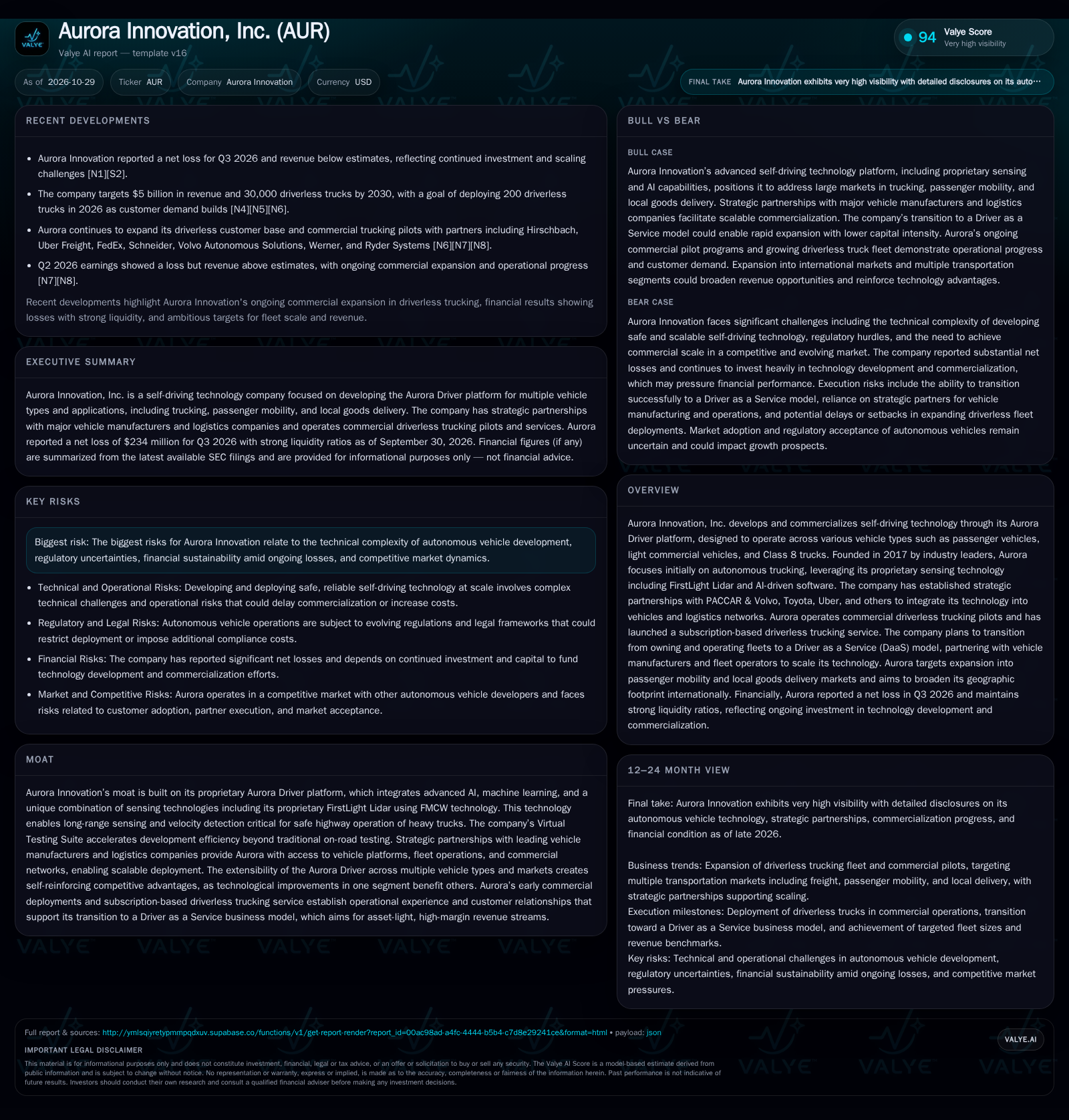
Aurora Innovation reported a net loss of $234 million for Q3 2026, with basic and diluted EPS of -$0.12, reflecting the company’s ongoing investment in R&D, commercial pilots, and scaling efforts [S2] [N1]. The company reported a current ratio of 9.68 for the period. [S2] The company’s near-term operational focus is the deployment of 200 driverless trucks in 2026, aiming to expand to 30,000 trucks and $5 billion in revenue by 2030 [N4] [N5] [N6]. Aurora continues to expand its commercial trucking pilots through partnerships with leading logistics and OEM players, including Hirschbach, Uber Freight, FedEx, Schneider, Volvo Autonomous Solutions, Werner, and Ryder Systems [N6] [N7] [N8].
How Aurora Aims to Monetize Self-Driving: From Fleet Ops to Driver as a Service
Aurora’s monetization strategy is designed to evolve through two distinct phases. Initially, the company operates or leases its own fleet of trucks to demonstrate capability, build operational data, and establish early customer relationships. This phase is capital-intensive, with high fixed costs for fleet procurement, integration, and maintenance, and variable costs tied to pilot operations and technology support. The economics here are challenging: revenue is constrained by Aurora’s own fleet size, while R&D and operational investments remain high.
The long-term vision is to transition to a Driver as a Service (DaaS) model, wherein Aurora supplies its self-driving technology to OEM and fleet partners and collects a fee on a per-mile or per-trip basis [S1]. This asset-light approach could dramatically improve margins and scalability, as Aurora would no longer bear the capital burden of truck ownership and operations. In this model, recurring revenue streams may emerge if fleet operators adopt Aurora’s technology at scale, and software economics would support high operating leverage. However, the transition’s pace and the structure of commercial contracts—such as minimum volume commitments, pricing tiers, and support obligations—will ultimately determine the realized unit economics.
Aurora’s business requires significant up-front investment in proprietary hardware (notably FirstLight Lidar) and AI-driven software, but variable costs could decline as deployments scale and data-driven automation reduces the need for human oversight. The question is whether Aurora can achieve sufficient deployment density and customer retention to offset high fixed costs before competitors or substitutes erode its pricing power.
Technology, Partnerships, and the Race for Autonomous Trucking Scale
Aurora’s competitive position is built on a proprietary technology stack—most notably its FirstLight Lidar (FMCW-based long-range sensing) and a 'Verifiable AI' approach to autonomous driving—combined with a strong network of industry partners [S1]. Integration with PACCAR, Volvo, and Toyota provides access to leading truck platforms, while partnerships with Uber, FedEx, and other logistics players offer commercial channels and operational testbeds.
The company’s Virtual Testing Suite is designed to accelerate software validation, potentially shortening development cycles compared to pure on-road testing. If effective, this could allow Aurora to iterate faster and deploy safer, more reliable systems.
Despite these strengths, Aurora faces intense competition from other autonomous trucking developers, vertically integrated OEMs with their own autonomy programs, and alternative automation solutions. Substitutes—such as advanced driver-assistance systems (ADAS), platooning, or incremental automation—may slow full autonomy adoption. Moreover, regulatory frameworks for commercial driverless trucks remain fragmented, and customer switching frictions will depend on the integration complexity, reliability, and support structure of Aurora’s offering relative to alternatives.
What Could Unlock Aurora’s Flywheel: Rapid DaaS Adoption and Margin Expansion
A favorable scenario for Aurora would see the company successfully transitioning its initial fleet operations into wide-scale Driver as a Service deployments by 2027–2028. This would require: (1) technical validation of safety and reliability in commercial settings, (2) regulatory approvals that permit driverless operations at scale on key freight corridors, and (3) strong partner uptake, with OEMs and fleets integrating Aurora Driver as a preferred autonomy solution.
If Aurora’s per-mile fee structure proves competitive and delivers tangible cost or service advantages to fleet customers, the company could attain high-margin, recurring software revenue as adoption ramps. Early customer pilots converting to multi-year commercial contracts would be a key signpost, as would evidence of positive unit economics (gross margin expansion, declining cost per mile, and increasing fleet utilization).
Upside confirmation would include rapid growth in trucks deployed under the DaaS model, expanding international operations, and Aurora’s ability to leverage operational data into further technology improvements—creating a self-reinforcing flywheel of adoption and margin leverage.
Testing Commercialization: Gradual Rollout and Persistent Investment Needs
The most plausible path is a measured expansion: Aurora continues to operate and refine its own fleet through 2026–2027, with gradual transitions to DaaS contracts as regulatory and customer readiness permits. Revenue growth is likely to be lumpy, reflecting the pilot-to-contract conversion cycle and the pace of new corridor openings.
The company remains in a heavy investment phase, with ongoing net losses as it balances R&D, commercial support, and customer acquisition costs. Strategic partnerships help de-risk some go-to-market challenges, but Aurora’s operational and financial performance continues to hinge on both external adoption rates and internal execution.
Base case confirmation would be the steady increase in trucks operated or enabled by Aurora technology, incremental improvement in gross margin (if disclosed), and announcements of new corridor launches or regulatory approvals. Conversely, persistent delays in DaaS transition, weak customer conversion, or inability to demonstrate cost advantages would challenge the thesis.
Where Aurora Could Stumble: Delays, Competition, and Funding Constraints
The adverse scenario centers on Aurora failing to scale DaaS deployments or secure sufficient customer commitments, resulting in continued reliance on direct fleet operations and sustained negative cash flows. Key risk vectors include technical setbacks (such as safety incidents or system failures), regulatory reversals or delays, and the emergence of competing solutions that erode Aurora’s perceived value or pricing power.
A protracted pilot phase without conversion to recurring DaaS contracts would pressure liquidity, potentially forcing the company to raise dilutive capital or scale back R&D and commercial expansion. If partners or customers opt for alternative autonomy providers or internal solutions, Aurora’s addressable market could shrink materially.
Downside confirmation would be repeated guidance cuts, high customer churn (if disclosed), or evidence of stalled fleet growth and capital constraints limiting further development.
Milestones That Will Define Aurora’s Transition to Scalable Autonomy
The number of driverless trucks deployed in commercial operation, both Aurora-owned and under DaaS contracts, versus stated targets.
Conversion rate of pilot customers to full commercial contracts and retention/churn rates—if disclosed.
Gross margin and per-mile economics as Aurora transitions from fleet operations to DaaS; a useful metric would be margin improvement or cost per mile.
Regulatory milestones: approvals for driverless operation on new corridors or in new states/countries.
Cash burn rate and any new capital raises, as persistent negative cash flow could impact technology investment and runway.
Expansion of partnerships with OEMs and logistics firms, especially announcements of exclusive or large-scale integration deals.
Evidence of software or hardware reliability improvements, such as safety metrics, incident rates, or reductions in remote intervention.
International expansion progress, including pilots or commercial launches outside the US, which would test the portability of Aurora’s business model.
Disclaimer: This is research-only, informational analysis and not investment advice. It may include AI-generated interpretation and general industry context. Always verify important details using primary sources.

Comments