
FedEx’s Restructuring Moment: Asset Sales, Digital Ambitions, and the Challenge of a Complex Freight Future
FedEx’s $1.4 billion supply chain sale, expanded digital infrastructure partnership, and new CFO appointment mark a pivotal phase in its transformation. As the company raises its 2026 outlook despite a profit slip, the strategic question is whether operational realignment and technology initiatives can offset rising regulatory, sustainability, and disruption risks in global logistics.
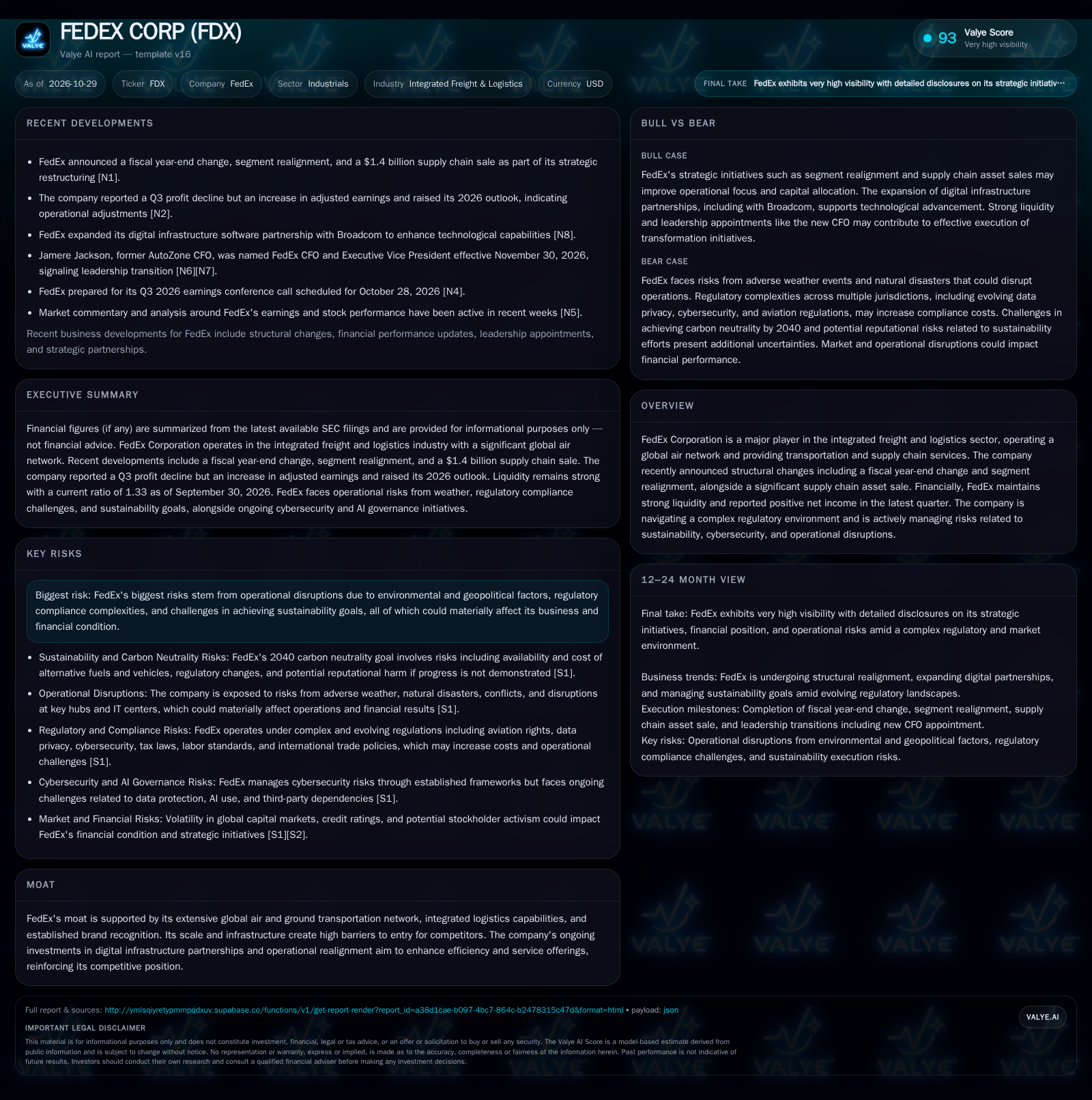
FedEx is undergoing major structural changes, including a $1.4 billion supply chain asset sale, segment realignment, and a fiscal year-end shift. While Q3 profit declined, adjusted earnings improved and the company raised its 2026 outlook. The durability of these moves will hinge on execution and the ability to manage operational and compliance headwinds in a fast-evolving logistics landscape. [N1] [N2] [S2] [N8] [N7]
FedEx is at a strategic crossroads as it pursues a sweeping transformation of its business model. The recent $1.4 billion supply chain sale, segment realignment, and fiscal year-end change mark a decisive pivot toward operational focus and efficiency. These moves are paired with a raised 2026 outlook—despite a Q3 profit dip—and a deepening partnership with Broadcom to boost FedEx’s digital infrastructure. [N1] [N2] [S2] [N8] [N7]
Restructuring, Asset Sale, and a Leadership Shift: What’s New at FedEx
FedEx has initiated a significant restructuring, highlighted by the sale of $1.4 billion in supply chain assets, a change in fiscal year-end, and a segment realignment. These moves are designed to sharpen operational focus and potentially unlock capital for strategic initiatives or balance sheet strengthening. The company reported a Q3 profit slip but managed to raise its 2026 outlook, suggesting that underlying operational improvements or cost management are expected to offset recent margin pressures. As of September 30, 2026, FedEx reported $7.961 billion in cash and equivalents, short-term investments of $3.254 billion, current assets of $25.003 billion, and current liabilities of $18.84 billion, resulting in a current ratio of 1.33 and a cash ratio of 0.6. The expansion of its digital infrastructure partnership with Broadcom points to a push for greater technology leverage. Finally, the appointment of Jamere Jackson as CFO marks a leadership transition that could influence capital allocation and execution discipline going forward. [N1] [N2] [S2] [N8] [N7]
How FedEx’s Business Model Could Evolve with Realignment and Technology
FedEx’s core economics rest on high fixed-cost infrastructure—aircraft, hubs, and IT systems—leveraged across a vast global network. Revenue is driven by shipment volume, mix (express, ground, freight, supply chain), and pricing power, all of which are sensitive to macroeconomic cycles, fuel prices, and competitive dynamics. The supply chain asset sale suggests a move to streamline operations and focus capital on higher-return segments or digital upgrades. If asset-light strategies and digital optimization reduce overhead, FedEx could see improved margins and capital efficiency.
The expanded Broadcom partnership signals a deeper investment in digital infrastructure, which—if implemented effectively—could enable more dynamic pricing, route optimization, and automation. This could reduce variable costs per package and potentially allow for differentiated service offerings or premium pricing in certain segments. However, technology investments are capital-intensive, and the payback depends on adoption rates, integration success, and whether cost savings outpace the ongoing need for physical asset renewal.
Operating leverage is a double-edged sword: incremental volume can drive outsized profit gains in strong demand environments, but underutilization during downturns can quickly erode margins. The segment realignment may be an attempt to clarify accountability, better match cost structures to revenue streams, and support more nimble resource allocation in a volatile freight environment.
Barriers, Counterforces, and the Shifting Landscape of Global Logistics
FedEx enjoys significant scale advantages and brand recognition, with a global air and ground network that is difficult for new entrants to replicate. Its integrated logistics offering and established relationships with enterprise customers provide switching frictions, especially for time-critical or complex shipments. However, the competitive environment is evolving: global integrators, regional carriers, digital-first logistics platforms, and even large e-commerce players are all vying for share.
The asset sale and realignment could help FedEx focus on segments where it has the greatest pricing power or operational differentiation. Yet, the company faces counterforces from aggressive competitors that may operate with lower legacy costs or more flexible technology stacks. Substitution risks are also rising, as some shippers diversify away from single-carrier reliance or experiment with in-house logistics.
Regulatory and sustainability pressures are a wildcard: compliance costs, carbon mandates, and evolving aviation rules could disproportionately affect incumbents with large physical networks. FedEx’s moat is real but not immune—its ability to sustain above-average returns will depend on how well it adapts its network, digital capabilities, and cost structure to new realities.
If Realignment and Digital Upgrades Deliver: The Bullish Chain of Events
The most favorable outcome for FedEx hinges on three reinforcing levers: successful operational realignment, rapid digital adoption, and disciplined capital allocation. If the $1.4 billion asset sale is redeployed into high-ROI technology or network enhancements, and the Broadcom partnership accelerates automation and analytics, FedEx could achieve meaningful cost reductions and service improvements.
In this scenario, the new CFO brings heightened financial discipline, ensuring that restructuring benefits flow through to margins and free cash flow. Enhanced digital capabilities support dynamic pricing and more resilient routing, allowing FedEx to capture share from less technologically advanced competitors. Regulatory compliance costs are offset by efficiency gains, and the company demonstrates credible progress toward sustainability targets, mitigating reputational risk.
Evidence that would confirm this scenario includes: sustained improvement in adjusted operating margins, above-peer revenue growth in targeted segments, and regular disclosures of technology-driven efficiency wins or customer wins attributable to new capabilities.
A Measured Transformation: Incremental Gains Amid Persistent Headwinds
The most plausible path is one of gradual improvement, where FedEx’s structural changes yield efficiency gains, but these are partially offset by ongoing operational headwinds and compliance costs. The asset sale and segment realignment clarify focus and free up some capital, but legacy cost structures and the sheer scale of the global network limit the pace of margin expansion.
Digital infrastructure upgrades from the Broadcom partnership improve reliability and data visibility, but full benefits are realized slowly due to integration complexity and the need to retrain or redeploy the workforce. The new CFO implements tighter capital controls, but external shocks—such as weather disruptions, labor negotiations, or regulatory changes—continue to create earnings volatility.
Performance in this scenario is marked by modest improvement in adjusted earnings, stable to slightly rising margins, and progress toward sustainability goals that tracks with broader industry timelines. Confirmation would come from sequential improvement in operating metrics, but with periodic setbacks from external factors.
When Disruptions Outpace Execution: How Risks Could Overwhelm the Thesis
The bear case for FedEx materializes if operational disruptions, compliance costs, or sustainability mandates erode the benefits of restructuring and digital investments. If the asset sale leads to revenue loss or operational complexity, and technology upgrades run over budget or fail to deliver expected efficiencies, margin pressures could intensify.
A sharp increase in regulatory scrutiny, combined with adverse weather or geopolitical events, could disrupt critical hubs or routes, leading to service failures and reputational harm. If key customers diversify away or new entrants undercut pricing, FedEx could lose share in its most profitable segments. Failure to make credible progress towards the 2040 carbon neutrality goal could invite regulatory penalties or investor activism.
Evidence for this scenario would include deteriorating operating margins, negative operational surprises (e.g., major hub disruptions), rising compliance costs, and public setbacks in sustainability or technology initiatives.
Milestones That Will Determine Whether FedEx’s Restructuring Pays Off
Progress on completing the $1.4 billion supply chain asset sale and the redeployment of proceeds—watch for updates on capital allocation and whether divestitures lead to improved segment profitability. [N1]
Evidence of margin improvement or cost reductions attributable to segment realignment—quarterly segment disclosures or management commentary would help test this thesis.
Adoption rates and tangible outcomes from the expanded Broadcom digital infrastructure partnership—look for technology-driven gains in efficiency, reliability, or customer satisfaction. [N8]
Transition and early impact of Jamere Jackson as CFO—monitor for changes in capital discipline, cost management, or financial guidance. [N7]
Progress reports on sustainability initiatives and milestones toward the 2040 carbon neutrality goal—both disclosures and third-party validation would be informative.
Incidence and impact of operational disruptions, especially at critical hubs like the Memphis World Hub—major service interruptions or resilience improvements would be key signals.
Updates on regulatory compliance costs and evolving legal requirements—especially in aviation, cybersecurity, and labor, as these could materially sway cost structure and risk profile.
If disclosed, customer retention rates or contract renewals in key enterprise accounts—would help assess competitive stickiness and the impact of service improvements.
Disclaimer: This is research-only, informational analysis and not investment advice. It may include AI-generated interpretation and general industry context. Always verify important details using primary sources.

Comments