
Luxfer Holdings: Navigating Profitability Amid Regulatory Scrutiny and Industrial Materials Complexity
Luxfer Holdings PLC’s steady industrial materials business is shaped by regulatory investigations, niche technical expertise, and the persistent drag of modest profitability.
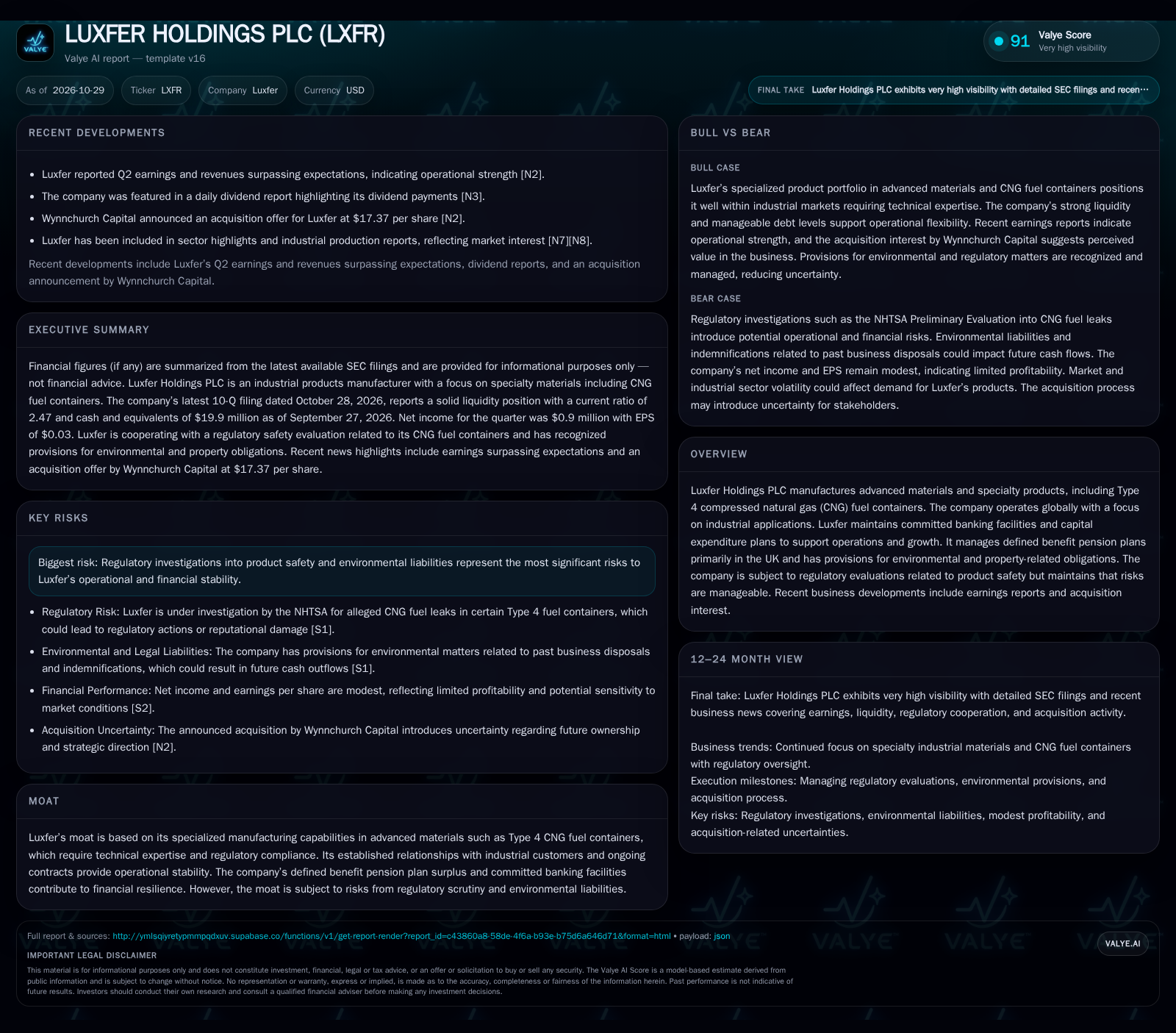
Luxfer Holdings PLC manufactures advanced materials and CNG fuel containers, reporting modest recent profitability and a current ratio of 2.47. The company faces an ongoing NHTSA regulatory evaluation for alleged fuel leaks, but maintains that no unreasonable safety risk exists. With committed banking facilities and manageable capex obligations, Luxfer’s financial structure supports operational continuity, yet persistent regulatory and environmental liabilities constrain the upside. The company’s path forward likely depends on its ability to manage these risks while extracting higher margins from its specialized product base. [S1] [S2]
Luxfer Holdings PLC, a manufacturer of advanced materials and specialty CNG fuel containers, is at a crossroads defined by its modest profitability, reported liquidity position, and heightened regulatory attention. While the company’s technical capabilities and banking flexibility support ongoing operations, the dual overhang of an NHTSA product safety evaluation and legacy environmental liabilities tempers the outlook. Investors are left weighing whether Luxfer’s specialized niche can deliver margin expansion or whether regulatory and cost headwinds will continue to constrain returns.
Recent Earnings, Regulatory Pressures, and Potential Financial Flexibility
Luxfer Holdings reported net income of $0.9 million for the quarter ended September 27, 2026, with basic and diluted earnings per share of $0.03. This modest profitability follows a period of operational stability but underscores the challenge of generating substantial returns in highly specialized industrial markets. [S2]
The company reported cash and liquidity metrics for the period; these figures do not by themselves establish operating runway, investment capacity, financial flexibility, or financing capacity. [S2]
Luxfer is subject to a National Highway Traffic Safety Administration (NHTSA) Preliminary Evaluation regarding alleged fuel leaks in certain Type 4 CNG containers. The company asserts that these do not pose an unreasonable safety risk, but such regulatory scrutiny introduces uncertainty around potential future costs, product recalls, or reputational impacts. [S1]
The company maintains $125 million in committed banking facilities, with only $15.3 million drawn as of the last annual period, providing credit headroom for both operations and potential contingencies. [S1]
How Luxfer’s Specialty Materials Portfolio Drives Profit Potential—and Its Limits
Luxfer’s business model centers on the manufacture and sale of advanced materials and specialty products, notably CNG fuel containers and engineered components for industrial customers. The economics of this segment are typically characterized by a high proportion of fixed costs—driven by specialized manufacturing assets, compliance requirements, and technical labor—paired with variable materials and distribution costs.
Pricing power in niche industrial segments depends on both technical differentiation and regulatory approval, which can create barriers to entry but also expose the company to step-change risks if a product line comes under scrutiny, as seen with the NHTSA evaluation. Volume growth is likely constrained by the overall pace of industrial adoption for CNG technologies and customer capital cycles.
Operating leverage exists if Luxfer can increase utilization of its specialized facilities, but the modest net income suggests that either gross margins are thin or overhead absorption remains a challenge. The company’s capital expenditure commitments are relatively modest at $2.2 million, indicating limited near-term expansion but also low risk of overextension. [S1]
Potential financial flexibility is further supported by undrawn banking facilities, but persistent environmental and legal liabilities from past business disposals could create episodic cash flow demands, limiting the ability to reinvest or return capital to shareholders in the absence of improved earnings power.
Technical Differentiation vs. Industry Pressures: Where Luxfer Stands
Luxfer’s competitive position is rooted in its capability to produce advanced specialty materials and Type 4 CNG containers—products that require compliance with stringent safety and performance standards. This technical differentiation may provide some insulation from low-cost commodity producers, as switching suppliers for critical safety components is typically onerous for customers.
However, the company operates in a sector where peer manufacturers—often with greater scale or broader product portfolios—compete aggressively on price and delivery timelines. Substitute technologies, such as electric vehicle powertrains or alternative industrial gases, pose a long-term threat to CNG container demand, especially if regulatory or market sentiment shifts away from natural gas as a transitional fuel.
Customer relationships in industrial materials are often long-standing, but contract structures are not always multi-year or recurring, making order visibility and volume stability dependent on macroeconomic and sector-specific investment cycles. The company’s recent inclusion in sector highlights and industrial production reports suggests ongoing market relevance, but not necessarily dominance. [N8]
Margin Expansion Through Operational Efficiency and Regulatory Resolution
A favorable scenario for Luxfer would involve a swift and positive resolution of the NHTSA investigation, removing overhangs that might otherwise deter customers or limit new contract wins. If the company can demonstrate that its Type 4 CNG containers meet or exceed all relevant safety standards, this could reinforce its technical credibility and could support premium pricing.
Operationally, Luxfer could benefit from greater plant utilization as industrial demand recovers or as CNG adoption accelerates in select markets. If management can drive incremental margin improvement through cost discipline, process automation, or better procurement, modest revenue growth could translate into outsized gains in operating income given the fixed-cost base.
Evidence supporting this scenario would include: regulatory clearance from the NHTSA without material remediation costs; sequential improvement in gross and operating margins; new customer wins or long-term contracts for CNG containers; and a visible reduction in environmental and legal provisioning.
Steady Operations, Continued Overhangs, and Incremental Progress
The most plausible outcome is that Luxfer continues to operate with modest profitability, balancing technical strengths with ongoing regulatory and environmental liabilities. The NHTSA evaluation may drag on without immediate adverse findings, but also without a clear exoneration, sustaining a cloud over the CNG container business segment.
Order volumes and pricing may remain stable, with revenue and net income fluctuating in a narrow band as industrial customers manage their own capex cycles. The company reported profitability for the period.
Regulatory Escalation and Legacy Liabilities Erode Value
A negative scenario would unfold if the NHTSA investigation uncovers substantive safety issues, leading to mandatory recalls, significant remediation costs, or restrictions on the sale of affected CNG containers. Such an outcome could not only strain near-term cash flow, but also damage customer confidence and impede future contract wins.
If environmental or property-related liabilities from past business disposals escalate—whether due to regulatory enforcement, new findings, or cost inflation—Luxfer could face additional cash outflows, further limiting its ability to invest or weather operational downturns.
Indicators of this scenario would include: formal NHTSA enforcement actions or costly settlements; sharp increases in legal or environmental provisions; drawdowns on credit facilities to fund non-operating costs; and a material decline in net income or EPS.
What Will Define Luxfer’s Next Phase: Areas to Track
Resolution status and outcome of the NHTSA Preliminary Evaluation into Type 4 CNG fuel container safety concerns.
Sequential changes in gross and operating margins, which would signal either cost discipline or margin erosion in the core business—if disclosed.
Magnitude and trend in environmental and legal provisions related to past business disposals and indemnifications.
Utilization rate and revenue growth specifically attributable to CNG fuel container products—a useful metric if disclosed.
Level of undrawn banking facilities and any changes in credit terms or covenants.
Quarterly net income and EPS trends, especially any deviation from the current modest trajectory.
Dividend continuity and payout ratio in the context of net income and cash flow stability.
Updates on capex commitments and the company’s ability to invest in process improvements or new product lines.
Disclaimer: This is research-only, informational analysis and not investment advice. It may include AI-generated interpretation and general industry context. Always verify important details using primary sources.

Comments