
RenaissanceRe in 2026: Regulatory Headwinds, Tax Shifts, and the Resilience Test for Global Reinsurers
RenaissanceRe, a Bermuda-based reinsurance specialist, faces a pivotal period as heightened regulatory scrutiny, new tax regimes, and evolving climate and capital challenges reshape industry economics.
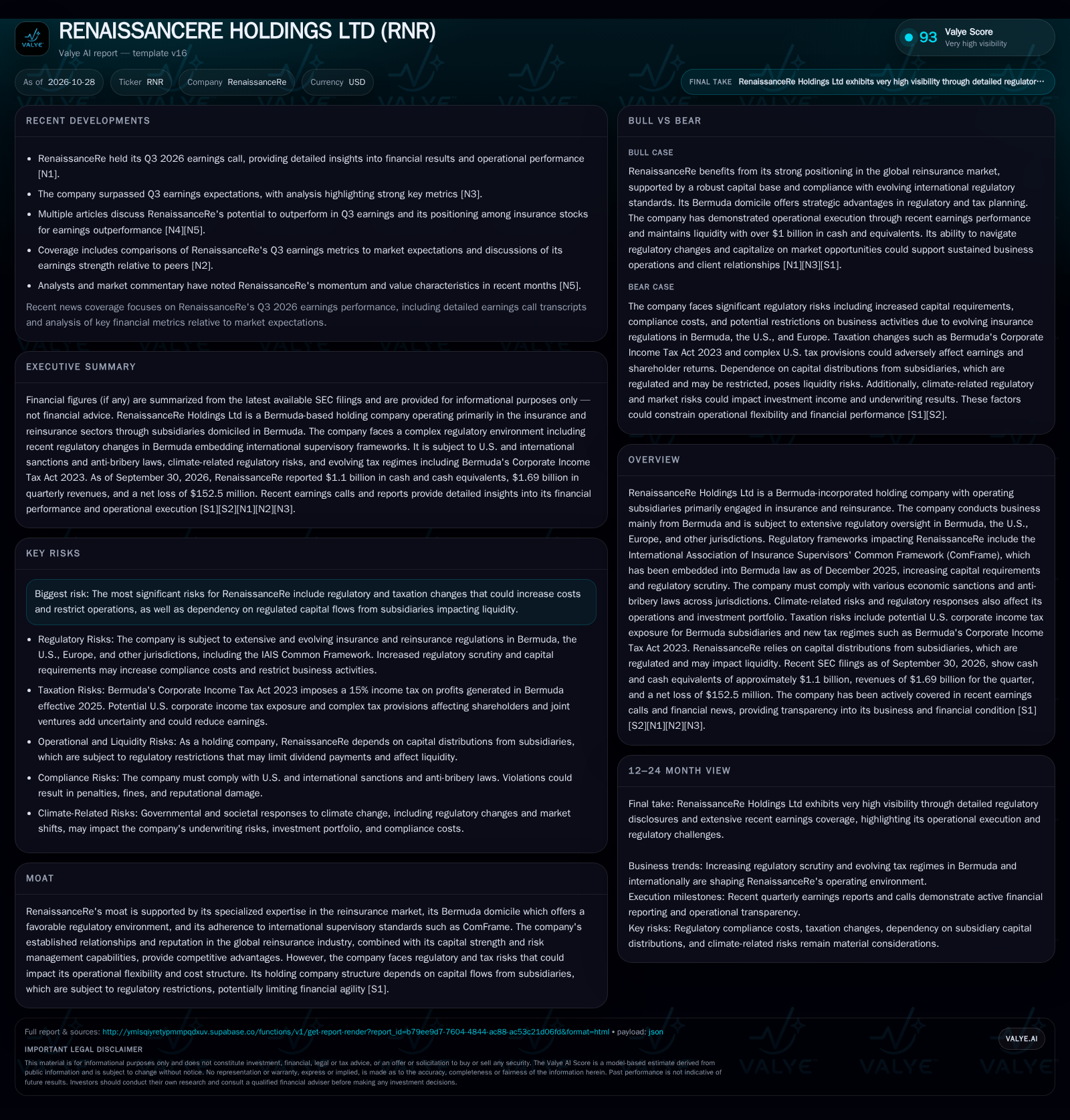
RenaissanceRe Holdings Ltd enters late 2026 at the intersection of increased regulatory and tax burdens, climate-related risks, and the enduring search for underwriting profitability. With $1.1 billion in cash and a reported net loss in Q3 2026, the company’s ability to adapt its risk selection, capital management, and fee-based initiatives will determine whether it can sustain value creation amid tightening external constraints. [S2] [N1] [N3]
RenaissanceRe Holdings Ltd enters a period of heightened uncertainty and structural change, driven by the convergence of stricter regulatory frameworks, significant new tax obligations in its Bermuda base, and the ever-present risks of underwriting volatility and climate-driven loss events. The company’s latest results—a net loss despite solid top-line revenue and a reported cash position—underscore the tension between its operational strengths and mounting external pressures. As the reinsurance industry faces tighter capital requirements and shifting economics, RenaissanceRe’s ability to leverage its risk selection expertise, manage capital efficiently, and innovate in fee-based ventures will be critical in determining whether it can maintain its historical value proposition or will be forced into a more defensive, lower-return posture.
2026 Snapshot: Regulatory, Financial, and Structural Pressures Take Hold
As of September 30, 2026, RenaissanceRe reported $1.69 billion in quarterly revenue but a net loss of $152.5 million, indicating that underwriting or investment headwinds outpaced premium growth for the period. The company reported cash and liquidity metrics for the period; these figures do not by themselves establish operating runway, investment capacity, financial flexibility, or financing capacity. [S2] [N1] [N3]
The Bermuda Corporate Income Tax Act 2023, effective January 2025, will subject RenaissanceRe’s Bermuda-generated profits to a 15% tax rate—an abrupt shift from the historically tax-advantaged Bermuda environment. Combined with the embedding of the IAIS ComFrame into Bermuda law (late 2025), these developments impose higher direct costs and capital requirements, reducing after-tax earnings and potentially constraining risk appetite and capital deployment. [S1] [S2]
Recent earnings calls and analyst coverage have emphasized RenaissanceRe’s operational transparency and the growing market focus on its ability to navigate these external shifts. The interplay between regulatory/tax headwinds and the company’s core profit engines sets the stage for a critical test of its business model resilience. [N1] [N3]
How the Business Makes—and Risks Losing—Money in a New Era
RenaissanceRe’s economics are built on three primary profit streams: underwriting income (from reinsurance and insurance premiums less claims and expenses), fee income (from managing third-party capital and joint ventures), and investment income (returns on float and shareholder capital). Underwriting is the core, but fee-based and investment earnings provide crucial diversification and capital efficiency. [S2]
The company’s ability to generate superior returns has historically hinged on matching risk with efficient capital—leveraging advanced analytics, portfolio construction, and selective risk-taking. However, the new Bermuda 15% corporate tax directly reduces net income from Bermuda-based operations, compressing return on equity and reducing the historical advantage of offshore reinsurance platforms. [S1] [S2]
Heightened regulatory capital requirements (via ComFrame) increase the amount of capital that must be held against written risks, raising the cost of growth and potentially reducing operating leverage. Fee income from managing third-party capital may become increasingly important as a lower-capital-intensity profit stream, but competitive pressure and structural changes in the alternative capital market could cap its upside.
Reinsurance Advantage Under Pressure: Moat and Counterforces
RenaissanceRe’s competitive position has traditionally rested on its specialized expertise in property catastrophe and specialty reinsurance, a strong brand, and a reputation for disciplined underwriting and capital management. The Bermuda domicile historically provided regulatory and tax flexibility, supporting superior returns versus many global peers.
However, the new Bermuda tax regime erodes one of the company’s structural advantages, bringing its effective tax rate closer to onshore competitors and potentially narrowing the gap in after-tax returns. Stricter group supervision and capital requirements (ComFrame) further level the playing field, particularly as global reinsurers and alternative capital vehicles (such as insurance-linked securities funds) compete for the same risk pools.
Switching costs in reinsurance are moderate: while client relationships and underwriting track records matter, pricing and risk capacity are highly cyclical and subject to market competition. The company’s managed joint ventures and fee-based models offer some insulation, but face growing competition from both traditional reinsurers and capital markets. The sector’s vulnerability to climate risk and capital market volatility increases the importance of nimble risk selection and capital allocation.
If Regulatory and Tax Headwinds Are Absorbed: Pathways to Outperformance
A favorable scenario for RenaissanceRe would see the company successfully reprice its underwriting portfolio to reflect higher capital and tax costs, preserving margins and return on equity. This would require robust risk-adjusted pricing discipline, effective client communication, and the ability to shift capital to the most attractive risk segments as market cycles evolve.
Fee income from managing third-party capital could expand if alternative investors remain attracted to reinsurance-linked returns—especially if RenaissanceRe can offer differentiated structures or risk access that others cannot. If investment income rebounds (via rising rates or improved capital market conditions), the total earnings mix could become more resilient.
Confirmation would come from a return to consistent underwriting profitability (combined ratios sustainably below 100%), stable or rising fee income, and evidence that the company is able to grow book value per share despite higher tax drag. If disclosed, improvements in risk-adjusted returns and segment-level profitability would further validate the upside thesis.
Navigating the Squeeze: Likely Stabilization Amid Margin Compression
The most probable outcome is that RenaissanceRe absorbs a meaningful portion of the new regulatory and tax costs, but is unable to fully offset them through higher pricing or efficiency gains. Earnings volatility remains elevated due to the inherent risks of catastrophe underwriting and the possibility of climate-driven loss events.
Fee income and investment returns provide some diversification, but cannot fully compensate for lower underwriting margins and higher capital intensity.
This thesis would be confirmed by moderate growth in gross premiums written, continued but less robust book value per share growth, and combined ratios hovering near or slightly above historical averages. Watch for any signs that capital or regulatory constraints force a retrenchment from certain lines or geographies.
When Headwinds Compound: The Case for Prolonged Underperformance
The adverse scenario envisions RenaissanceRe unable to reprice risk adequately or diversify income fast enough to offset the drag from higher taxes, capital requirements, and climate-related claims. If regulatory restrictions tighten further—limiting capital flows or increasing compliance costs—liquidity and operational flexibility could deteriorate.
Potential triggers include large catastrophe losses, sustained investment underperformance, or capital market withdrawals from joint ventures and managed funds. The company could face negative book value growth, forced asset sales, or even rating pressure if capital ratios fall below regulatory or market expectations.
Evidence of this scenario would include continued net losses, a rising combined ratio, material declines in book value per share, or disclosures of restricted subsidiary dividends that impair holding company liquidity. If disclosed, any regulatory interventions or downgrades would be strong confirmation.
What Will Prove RenaissanceRe’s Resilience—or Reveal Its Limits?
Quarterly combined ratio trends: Sustained improvement below 100% would indicate effective risk repricing; persistent elevation would signal margin compression or underwriting missteps.
Fee income growth (if disclosed): Acceleration in third-party capital management fees would suggest successful expansion of lower-capital-intensity profit streams.
Net investment income trajectory: Rising or stable investment returns would help buffer underwriting volatility, while declines could amplify downside risks.
Book value per share growth: This remains the single best measure of long-term value creation or erosion—watch for inflections, especially post-2025 tax implementation.
Subsidiary dividend capacity (if disclosed): Restrictions or reductions here would directly limit holding company agility and capital deployment options.
Regulatory capital ratio disclosures: Any tightening or breach of required capital levels could trigger rating actions or limit business growth.
Gross premiums written and renewal pricing: Evidence of effective risk repricing or market share shifts will illuminate management’s ability to adapt to new external costs.
Climate-related loss disclosures: Frequency and severity of large event losses will test the company’s risk selection and capital management discipline.
Disclaimer: This is research-only, informational analysis and not investment advice. It may include AI-generated interpretation and general industry context. Always verify important details using primary sources.

Comments