
Ventas and the Senior Housing Pivot: Growth Dynamics, Earnings Pressure, and the Real Estate Value Chain
Ventas, Inc. is navigating a period of strong top-line expansion in its senior housing operating portfolio, even as earnings per share remain pressured and disclosure gaps limit full financial transparency. The question for investors is whether operational scale and sector specialization can overcome industry cyclicality and incomplete visibility.
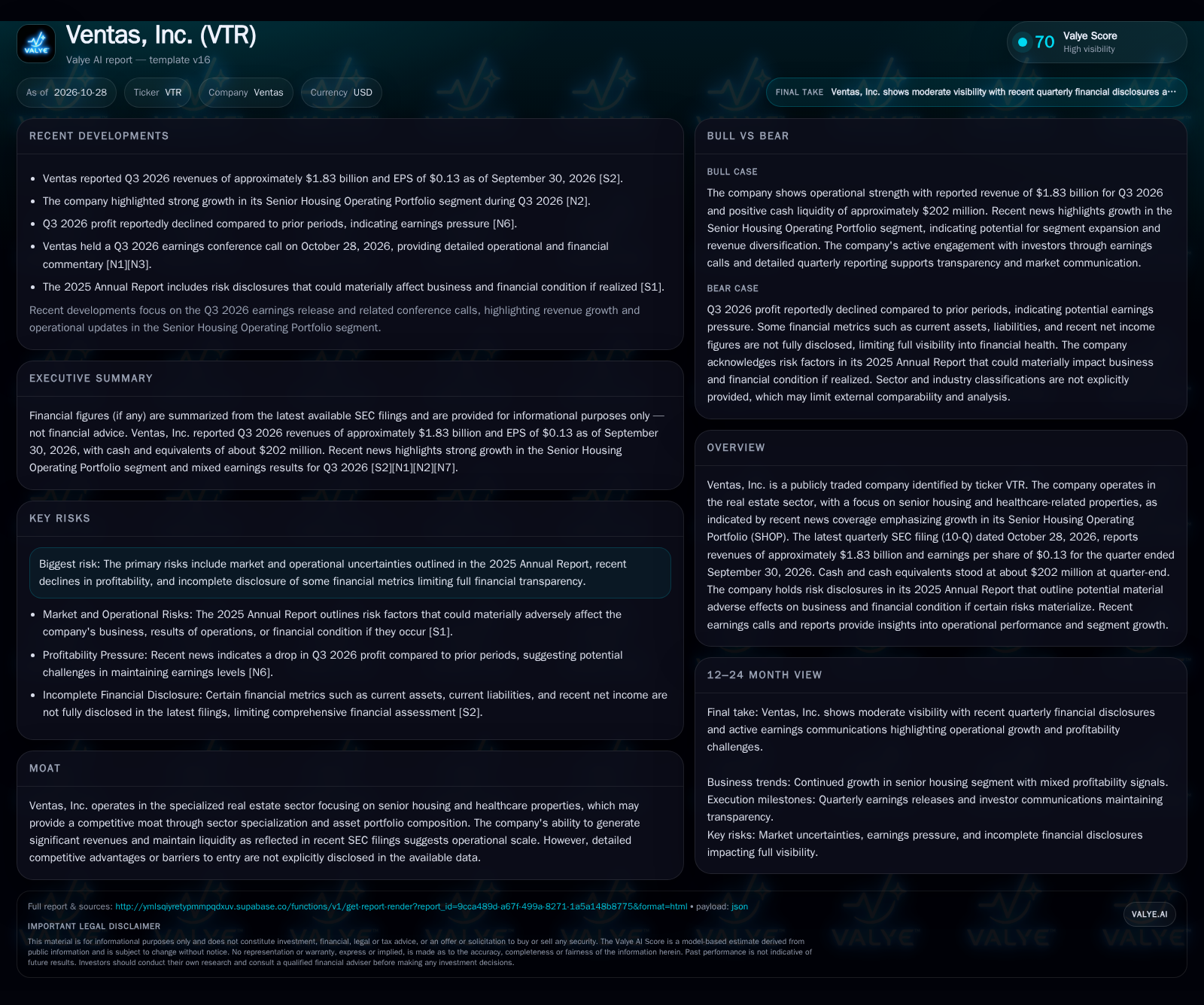
Ventas reported Q3 2026 revenues of $1.83 billion and highlighted robust growth in its Senior Housing Operating Portfolio (SHOP), but earnings per share landed at just $0.13, and profit declined from prior periods. The central issue is whether SHOP growth and real estate specialization can translate into sustainable profitability amid broader market and operational risks. [S2] [N2] [N6]
Ventas, Inc. stands at a crossroads, with its senior housing operating portfolio (SHOP) delivering strong growth in the latest quarter even as earnings per share and overall profit show signs of strain. As the senior housing and healthcare real estate market faces both demographic tailwinds and cyclical headwinds, Ventas’s ability to convert portfolio growth into sustainable returns will be a central test for the business. [S2] [N2] [N6] [S1]
Ventas’s Latest Quarter: SHOP Growth Meets Profit Pressure
For the quarter ended September 30, 2026, Ventas reported revenues of approximately $1.83 billion, supported by particularly strong growth in its Senior Housing Operating Portfolio (SHOP) segment. This segmental outperformance is noteworthy because it aligns with long-term demographic trends, yet the quarter also revealed a decline in overall profit and a modest earnings per share figure of $0.13. The company reported cash and liquidity metrics for the period; these figures do not by themselves establish operating runway, investment capacity, financial flexibility, or financing capacity. Risk disclosures in the 2025 Annual Report underscore the possibility of material adverse effects on results if certain uncertainties materialize. The combination of robust SHOP growth and earnings pressure frames the company’s current operating dilemma: can Ventas convert top-line momentum into sustainable bottom-line results amid incomplete visibility into its full financial condition? [S2] [N2] [N6] [S1]
How Ventas’s Real Estate Model Generates Value—and Where Leverage Emerges
Ventas operates as a real estate investment trust (REIT) focused on senior housing and healthcare properties. The core economics of this model are driven by the ability to acquire, develop, lease, and operate a diversified portfolio of income-generating assets. Revenue is typically generated through rent from triple-net leases or, in the case of the SHOP segment, through direct operating income from managed senior housing facilities. The SHOP model introduces higher revenue potential but also greater exposure to operating expenses, labor costs, and occupancy fluctuations—making margins more variable compared to traditional lease-based segments.
Fixed costs in the form of property ownership and maintenance are significant, which means operating leverage can amplify both gains and losses as occupancy and pricing shift. In periods of rising demand—such as those driven by aging populations—Ventas stands to benefit from higher occupancy rates and potential rent increases. However, the capital-intensive nature of real estate, combined with debt service obligations (not disclosed in detail here), means that cash flow stability is highly sensitive to occupancy trends, expense control, and interest rate environments.
As a REIT, Ventas is also required to distribute a significant portion of taxable income as dividends, which may constrain reinvestment capacity if earnings remain pressured.
Specialization in Senior Housing: Moat Potential and Competitive Frictions
Ventas’s focus on senior housing and healthcare real estate provides a degree of sector specialization, which can create barriers to entry through relationships with operators, expertise in regulatory navigation, and portfolio scale. The SHOP segment, in particular, may offer a differentiated value proposition in markets where demand for premium senior living solutions is growing. However, the competitive landscape includes other large REITs, private equity-backed platforms, and regional operators, many of whom are aggressively expanding portfolios and pursuing similar demographic-driven strategies.
Switching costs for tenants or operators are moderate—relocation or operator change incurs friction, but not insurmountable barriers. Alternative real estate uses, evolving care models (such as home-based care), and macroeconomic factors like interest rates and labor shortages act as ongoing counterforces. The potential for higher returns in SHOP must be balanced against the segment’s greater earnings volatility and operational demands. Without concrete evidence of superior unit economics or structural cost advantages relative to peers, Ventas’s moat is best characterized as one of scale and sector expertise rather than unassailable competitive dominance.
If SHOP Growth Converts to Margin Expansion: What a Bullish Chain Would Require
A favorable scenario for Ventas would see continued robust growth in the SHOP portfolio translating into higher occupancy rates, improved pricing power, and operating efficiencies that drive margin expansion. This outcome could be catalyzed by a combination of demographic trends (aging population, increased demand for senior living), effective cost management, and strategic capital deployment—such as targeted acquisitions or asset repositioning.
Confirmation of this scenario would require disclosure of rising same-store NOI (net operating income) in the SHOP segment, sustained occupancy gains, and evidence that earnings per share are rebounding in tandem with revenue growth. A reduction in profit pressure, coupled with expanded operating margins and disciplined capital allocation, would further validate the bull case. Falsification would come from persistent margin compression, inability to control labor or operating costs, or a stall in occupancy improvement despite top-line momentum.
Mixed Signals: Revenue Momentum Offset by Persistent Margin and Disclosure Challenges
The most plausible near-term trajectory for Ventas is one of continued revenue expansion in the SHOP segment, driven by demographic tailwinds, but offset by ongoing earnings pressure and incomplete financial visibility. In this scenario, the company may achieve modest improvements in operating metrics—such as occupancy or revenue per available unit—without a corresponding acceleration in earnings per share or overall profitability.
This middle path would likely be confirmed by sequential revenue growth, stable or slightly improved EPS, and ongoing references to SHOP outperformance in earnings commentary. However, persistent gaps in the disclosure of current assets, liabilities, and detailed net income figures would limit the ability of investors to fully assess financial resilience or vulnerability. Falsification would be signaled by either a decisive reversal in SHOP growth, a material improvement in EPS and profit margins, or the provision of more comprehensive financial disclosures.
Earnings Pressure Intensifies: When Revenue Growth Can’t Overcome Cost and Debt Headwinds
An adverse scenario would see continued or accelerating declines in profitability, with SHOP growth failing to offset rising labor, operating, or financing costs. This could occur if occupancy rates plateau or fall, wage inflation outpaces revenue gains, or the company faces higher interest expenses on debt (details not disclosed here).
Risk factors from the 2025 Annual Report highlight the potential for material adverse effects if market or operational uncertainties materialize. Confirmation of this scenario would include further declines in EPS, negative net income, or the need to raise capital under unfavorable terms. Persistent incomplete financial disclosure would exacerbate investor concerns, limiting confidence in the company’s ability to weather cyclical or sector-specific shocks.
What Will Prove Whether Ventas’s SHOP Growth Is Sustainable—and Profitable?
Quarterly trends in SHOP segment occupancy rates, if disclosed, to confirm that top-line growth is translating into higher utilization.
Changes in same-store net operating income (NOI) for both SHOP and other segments, which would clarify margin dynamics and operating leverage.
Sequential movement in earnings per share and net income, providing a direct read on profitability trends.
Disclosure of current assets, current liabilities, and debt maturities, which would illuminate near-term potential financial flexibility and risk.
Updates on labor costs and expense management, as labor is a major driver of senior housing operating margins.
Evidence of new acquisitions, asset sales, or capital recycling initiatives and their impact on portfolio composition and returns.
Any regulatory changes or reimbursement shifts affecting healthcare real estate and senior housing economics.
Disclaimer: This is research-only, informational analysis and not investment advice. It may include AI-generated interpretation and general industry context. Always verify important details using primary sources.

Comments