
Brinker International in 2026: Menu Value, Digital Leverage, and the Tightrope of Cash Flow
Brinker International’s strategy hinges on value-driven menu offerings and digital enhancements to sustain guest traffic in a fiercely competitive casual dining market. With modest new openings, operational streamlining, and a sharp focus on franchise expansion, the company must balance guest engagement and brand revitalization against thin short-term liquidity and evolving consumer habits.
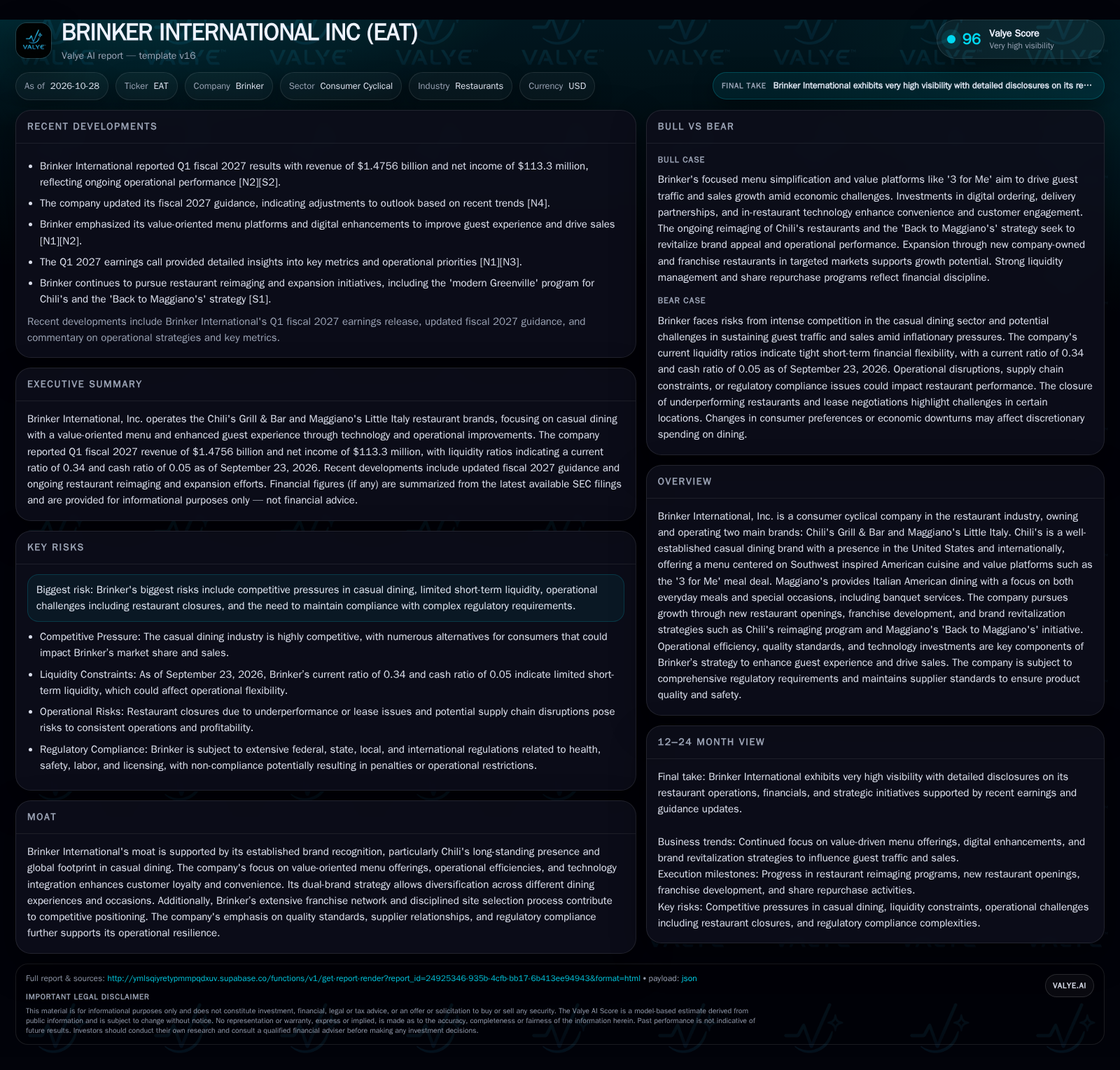
Brinker International, the parent of Chili’s and Maggiano’s, reported Q1 2027 revenue of $1.48 billion and net income of $113 million, reflecting steady core operations and ongoing brand investments. The company’s growth levers include value menus, digital innovation, and franchise expansion, but execution risk remains high in a shifting consumer environment. [S2]
Brinker International, best known for Chili’s and Maggiano’s, is navigating a pivotal moment in casual dining. The company’s latest results show stable revenues and ongoing investment in menu value, digital ordering, and restaurant reimaging. But with short-term liquidity stretched and the competitive dining landscape evolving, Brinker’s ability to grow traffic, improve margins, and deliver on its brand revitalization strategies will be tested over the coming quarters. The focus on value, technology, and selective expansion may drive upside, but execution and consumer resilience remain central variables.
Recent Performance and Cash Position: Tight Margins, Focused Growth
Brinker International reported Q1 fiscal 2027 revenue of $1.4756 billion and net income of $113.3 million, with basic EPS of $2.69 and diluted EPS of $2.64 [S2]. These results reflect steady operating performance across its Chili’s and Maggiano’s brands. The company reported cash and liquidity metrics for the period; these figures do not by themselves establish operating runway, investment capacity, financial flexibility, or financing capacity. [S2] In this context, Brinker repurchased shares and increased its authorized buyback program to $750 million, even as it faces ongoing competitive and operational pressures [S2]. The company continues to emphasize value menu offerings, digital enhancements, and restaurant reimaging as levers to attract and retain guests [N1] [N2] [S1].
How Brinker's Menu Model Translates to Unit Economics and Margin Structure
Brinker’s revenue engine is built on high-volume, moderate-check casual dining, with Chili’s averaging $5.0 million in annual sales per company-owned unit and an average meal ticket of $23.12 including alcohol [S1]. Maggiano’s units generate $9.5 million per restaurant, with a higher check average of $41.36—reflecting more special-occasion and banquet business [S1]. The company’s economics hinge on balancing traffic-driving value platforms (like Chili’s ‘3 for Me’ starting at $10.99) with upsell opportunities (alcohol, add-ons) and operational efficiency.
Variable costs—food, labor, and occupancy—dominate the cost structure, but Brinker’s scale supports some purchasing leverage, especially as it negotiates directly with suppliers and uses purchase agreements for commodity price stability [S1]. Fixed costs are significant at the unit level (property, equipment, management), so operating leverage can amplify both gains and losses as traffic fluctuates. Technology investments and digital ordering platforms add to overhead but may lower labor intensity and drive higher check averages if digital upselling succeeds. Franchising changes the revenue and cost mix; actual segment margins depend on the company's disclosed economics. Capital needs are moderate, with 6 new company-owned units and 27 franchise openings in fiscal 2026, and a continued emphasis on asset-light franchising to reduce capital intensity going forward [S1].
Brand Strength, Value Perception, and the Casual Dining Chessboard
Brinker’s competitive position is anchored by Chili’s established brand recognition, global reach, and a value orientation that resonates in a price-sensitive environment. The ‘3 for Me’ platform and menu simplification are tactical responses to consumer demand for affordable, consistent dining experiences [S1]. Maggiano’s diversifies the portfolio with a differentiated Italian-American offering and banquet capabilities, appealing to both families and special-event diners.
However, Brinker faces intense competition from other casual dining chains, fast-casual entrants, and a growing array of delivery/takeout options. Competitor categories include other national full-service brands, regional concepts, and digitally native delivery platforms. Consumer switching costs are low, and differentiation increasingly relies on perceived value, digital convenience, and guest experience. The risk of technology-driven substitution is real, as third-party delivery, ghost kitchens, and meal kits continue to fragment market share. Franchise expansion offers some insulation through diversified revenue streams and international growth, but also introduces brand consistency and quality control risks.
If Value and Digital Drive Traffic: The Path to Margin Reacceleration
A favorable scenario sees Brinker’s focus on value platforms (such as ‘3 for Me’) and digital ordering translating into sustained guest traffic and higher average checks. If menu simplification and operational streamlining reduce kitchen complexity and improve throughput, unit-level margins could recover despite commodity and labor cost pressures. Digital investments could further boost off-premise sales, with mobile ordering and delivery partnerships expanding the guest base and smoothing demand volatility.
Franchise growth—especially internationally—could deliver high-margin royalty streams, supporting overall profitability without significant capital outlay. Share repurchases, if funded from excess cash flow rather than incremental leverage, may enhance EPS accretion. Evidence supporting this scenario would include reported gains in same-store sales, improved restaurant-level margins, rising off-premise mix, and expanded franchise openings with stable brand metrics. Confirmation would also come from management’s ability to maintain or grow traffic while holding promotional intensity in check.
A Realistic Trajectory: Incremental Growth Amid Operational Constraints
The most plausible outcome is a period of moderate growth, with new restaurant openings (both company-owned and franchised) contributing incrementally to the top line. Value-driven menu platforms and digital enhancements help Brinker defend its share of the casual dining wallet, but guest traffic remains sensitive to consumer confidence and macroeconomic trends. Restaurant-level margin recovery is gradual, as wage and commodity inflation offset some efficiency gains.
The share repurchase program may provide some support to EPS, but only if core operations remain healthy. Evidence for this scenario includes modest same-store sales growth, flat to mildly expanding margins, and steady but unspectacular franchise development. Adverse surprises in labor or food costs, or a sharp downturn in discretionary spending, would challenge even this middle-ground outcome.
What Could Go Wrong: Liquidity Squeeze and Shifting Consumer Preferences
If consumer demand weakens due to economic headwinds or changing dining habits, Brinker may be forced to increase promotions or discounting to maintain traffic, eroding margins. Restaurant closures—already evident in the past year—could accelerate if underperformance persists or lease negotiations sour [S1].
Supply chain disruptions or persistent cost inflation could further compress profits, while regulatory or compliance missteps might lead to fines or operational setbacks. If digital investments fail to deliver the expected uplift in guest engagement or if franchise partners underperform, the company’s brand equity and revenue base could erode. Evidence of this downside would include declining same-store sales, rising closure rates, margin compression, or any indication that the company is forced to slow or suspend its buyback program to preserve cash.
Signals That Will Clarify Brinker's Value Proposition and Resilience
Same-store sales growth trends for both Chili’s and Maggiano’s, broken out by dine-in versus off-premise mix, if disclosed, would provide vital insight into traffic and pricing dynamics.
Restaurant-level operating margin progression, especially in the face of wage and commodity inflation, will help test whether cost controls and menu simplification are translating into profit improvement.
Unit growth pace—both company-owned and franchised—and any changes to new opening guidance may signal management’s confidence in demand and capital allocation priorities.
Closure rates and reasons for restaurant shutdowns (underperformance vs. lease issues) will illuminate the underlying health of the store base.
Guest engagement metrics, such as digital ordering penetration, app downloads, or loyalty program participation, if disclosed, would help validate the digital investment thesis.
Promotional intensity and menu pricing actions, as discussed in earnings calls or filings, will indicate whether value platforms are sustainable or margin-dilutive under competitive pressure.
Disclaimer: This is research-only, informational analysis and not investment advice. It may include AI-generated interpretation and general industry context. Always verify important details using primary sources.

Comments