
Fresh Del Monte: Brand Consolidation, Portfolio Diversification, and the Profitability Test for a Vertically Integrated Produce Giant
Fresh Del Monte’s 2026 acquisition of Del Monte Foods assets unifies global brand ownership and expands its prepared foods reach, but the company now faces a complex integration challenge amid evolving consumer trends, commodity volatility, and disease threats in its core banana business.
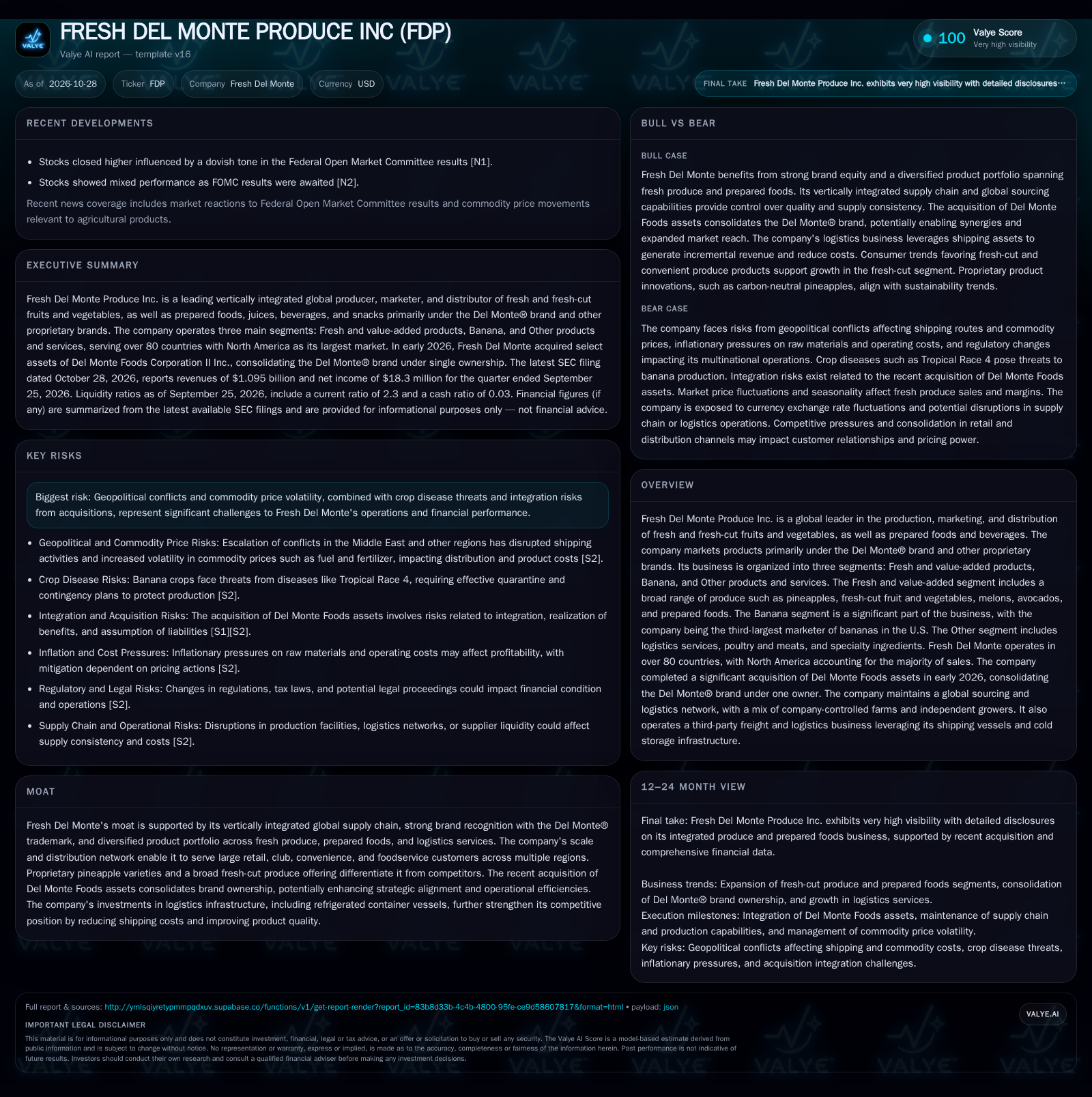
Fresh Del Monte’s recent acquisition consolidates global Del Monte® brand rights and boosts its prepared foods segment, giving the company more leverage in branded produce and packaged goods. However, with bananas and pineapples still core to its economics and exposed to commodity and disease risks, the company’s ability to grow margins will hinge on integration execution, supply chain resilience, and the success of its value-added and logistics businesses. The next year will test whether Fresh Del Monte can translate scale and portfolio breadth into improved profitability and risk-adjusted returns. [S1] [S2]
Fresh Del Monte’s latest chapter is defined by the strategic acquisition of Del Monte Foods assets, unifying global rights to the Del Monte® brand and bringing prepared foods under one roof for the first time in nearly 40 years. This move creates new opportunities in branded packaged goods and value-added produce, but also layers on complexity at a time when the company’s traditional banana and pineapple segments face mounting disease, cost, and geopolitical risks. The company’s ability to capture synergies, protect margins, and sustain growth across a diversified portfolio will shape its risk/return profile over the next several years.
Brand Unification and Segment Realignment: What’s Changed in 2026?
The most material development for Fresh Del Monte in 2026 is its acquisition of select assets of Del Monte Foods Corporation II Inc., giving it unified global control of the Del Monte® brand and bringing the prepared foods business under single ownership for the first time in nearly four decades. This strategic shift is reflected in a new segment structure: Fresh and value-added products, Bananas, Prepared Foods, and Other Products and Services, with the newly acquired assets integrated into Prepared Foods. [S1] [S2]
In the quarter ended September 25, 2026, Fresh Del Monte reported $1.095 billion in revenue and $18.3 million in net income, with basic and diluted EPS of $0.39. As of the same date, the company held $21.1 million in cash and cash equivalents, a current ratio of 2.3, and a cash ratio of 0.03. [S2]
Bananas and pineapples continue to anchor the business: in 2025, bananas accounted for 34% and pineapples 16% of total net sales, while fresh-cut produce (a key growth area) contributed 20%. The prepared foods segment, now newly expanded, made up 7% of net sales in 2025, but this figure is expected to rise with the acquired assets. [S1]
These developments matter because they reshape the company’s revenue mix, expand the addressable market in branded and prepared foods, and introduce integration and execution risks that could affect both profitability and operational stability.
How Fresh Del Monte’s Integrated Model Drives (and Constrains) Profitability
Fresh Del Monte’s economics are fundamentally shaped by its vertical integration: it owns or controls much of its production (especially in bananas and pineapples), manages global logistics (including a proprietary fleet of refrigerated vessels), and sells through a diversified set of channels. This structure gives the company some control over quality, supply, and cost—potentially reducing margin volatility compared to pure traders or spot buyers.
The recent acquisition bolsters the prepared foods segment, which likely carries higher gross margins and less seasonality than raw produce. However, fresh produce remains inherently low-margin, capital-intensive, and sensitive to weather, disease, and commodity swings. Bananas, for example, are exposed to both crop disease (notably Tropical Race 4) and global price fluctuations, making cost control and supply-chain agility critical.
The company’s ability to extract value from its brand portfolio will hinge on leveraging Del Monte® for premiumization, product extensions (e.g., proprietary pineapple varieties, carbon-neutral offerings), and cross-selling into new geographies. Meanwhile, the logistics business provides incremental revenue and helps absorb fixed costs, but is itself exposed to shipping fuel prices and global trade disruption.
Operating leverage is present but asymmetric: fixed costs in shipping, farming, and logistics can amplify profits in strong markets but also magnify losses if volumes fall or costs spike. The addition of prepared foods could help smooth earnings, but only if integration costs and brand investments are contained.
Brand, Scale, and Product Breadth: Competitive Advantages and Their Limits
Fresh Del Monte’s core advantages stem from its globally recognized Del Monte® brand, vertically integrated supply chain, and broad product portfolio spanning fresh, value-added, and prepared categories. The company’s scale enables it to serve large customers (retailers, club stores, foodservice) in over 80 countries, while proprietary pineapple varieties and branded fresh-cut offerings provide some differentiation.
However, the produce industry remains highly competitive and fragmented, with low switching costs for retailers and foodservice buyers, and private-label penetration a constant threat. In bananas, Fresh Del Monte is the third-largest U.S. marketer but faces global rivals and local producers, all vulnerable to the same disease and price risks.
The acquisition of Del Monte Foods assets gives Fresh Del Monte a more integrated brand platform, potentially increasing bargaining power with retailers and enabling cross-segment promotions. Yet, the success of this strategy depends on effective integration, innovation in prepared and value-added products, and resilience against supply chain or commodity shocks.
Substitution risk is ever-present: consumer preferences could shift toward local produce, alternative snacks, or private-label brands, especially if branded products fail to command a premium or deliver clear quality advantages.
If Brand Consolidation Unlocks Synergies and Value-Added Growth
The bullish scenario hinges on Fresh Del Monte successfully integrating the Del Monte Foods assets, leveraging unified brand ownership to expand shelf space, launch new prepared and packaged products, and cross-sell across regions. If the company can capture procurement, logistics, and marketing synergies, prepared foods could grow as a profit engine and reduce the company’s exposure to commodity swings in fresh produce.
Accelerated growth in fresh-cut and convenience categories—already at 20% of net sales—could further boost margins if the company leverages its logistics infrastructure and proprietary varieties to command a premium. Expansion into sustainable and differentiated offerings (e.g., carbon-neutral pineapples) could create new revenue streams and strengthen retailer relationships.
Evidence that would confirm this scenario includes sustained expansion of prepared foods gross profit, improved segment margins, successful product launches under the Del Monte® brand, and stable or rising overall profitability despite external cost pressures.
Integrated Produce and Prepared Foods: A Diversified but Exposed Portfolio
The most plausible outcome is that Fresh Del Monte operates as a diversified, brand-driven food company with a balanced mix of fresh produce, value-added, and prepared foods. The company captures some integration synergies from the acquisition, but the process is gradual and requires incremental investment in systems, marketing, and supply chain harmonization.
Bananas and pineapples remain vital but continue to expose the company to disease and commodity risk, limiting overall margin expansion. The logistics business provides a buffer but is not immune to shipping cost volatility. Prepared foods and fresh-cut produce grow as a share of sales, but competition and private-label pressure keep pricing power in check.
This scenario would be confirmed by steady, modest improvement in segment gross profit, stable (but not surging) overall margins, and evidence of incremental rather than transformational gains from the brand consolidation.
Disease, Cost Shocks, and Integration Missteps: How the Wheels Could Come Off
The bear case unfolds if the company encounters major setbacks in one or more areas: a severe outbreak of Tropical Race 4 or another banana disease, sharp increases in fuel or fertilizer prices driven by geopolitical conflict, or significant operational disruption from the integration of Del Monte Foods assets.
If costs spike and the company is unable to pass them through to customers, margins could compress sharply, especially in low-margin produce segments. Integration challenges—such as supply chain mismatches, IT failures, or brand confusion—could erode the anticipated benefits of the acquisition and lead to goodwill impairment or restructuring costs.
Confirmation of this scenario would come from declining segment gross profit, persistent or widening losses in core segments (especially bananas), rising integration expenses, or negative operating cash flow over multiple quarters.
Milestones and Metrics That Will Determine Fresh Del Monte’s Next Phase
Prepared foods segment gross profit trajectory: Is the acquired business accretive, and are there visible synergies in sourcing, production, or distribution?
Fresh-cut produce sales mix and margin: Does this category continue to grow, and does it deliver higher profitability relative to commodity produce?
Banana segment gross profit and disease incidence: Are there signs of margin pressure or production disruption due to Tropical Race 4 or other crop threats?
Integration-related expenses and realized synergies: Are integration costs tracking as planned, and are there quantifiable benefits from unified brand management?
Logistics business revenue and margin: Is third-party freight contributing positively, and does it help buffer against volatility in core produce segments?
Commodity input cost trends (fuel, fertilizer, packaging): Are inflation and supply shocks being managed through procurement or pricing actions?
Net working capital and operating cash flow: Is the company maintaining operational flexibility and funding integration without liquidity stress?
If disclosed, customer retention and private-label share in key retail accounts: Are branded products gaining or losing ground versus private-label and local competitors?
Disclaimer: This is research-only, informational analysis and not investment advice. It may include AI-generated interpretation and general industry context. Always verify important details using primary sources.

Comments