
Industrial Logistics Properties Trust: Leverage, Tenant Concentration, and the Fragility of Industrial REIT Economics
ILPT’s high debt load, dependence on a handful of major tenants, and restrictive covenants create a delicate balance between stable income and significant downside risk. The company’s ability to refinance, retain key tenants, and navigate evolving market conditions will determine whether it can sustain dividends and asset values—or face operational and financial stress.
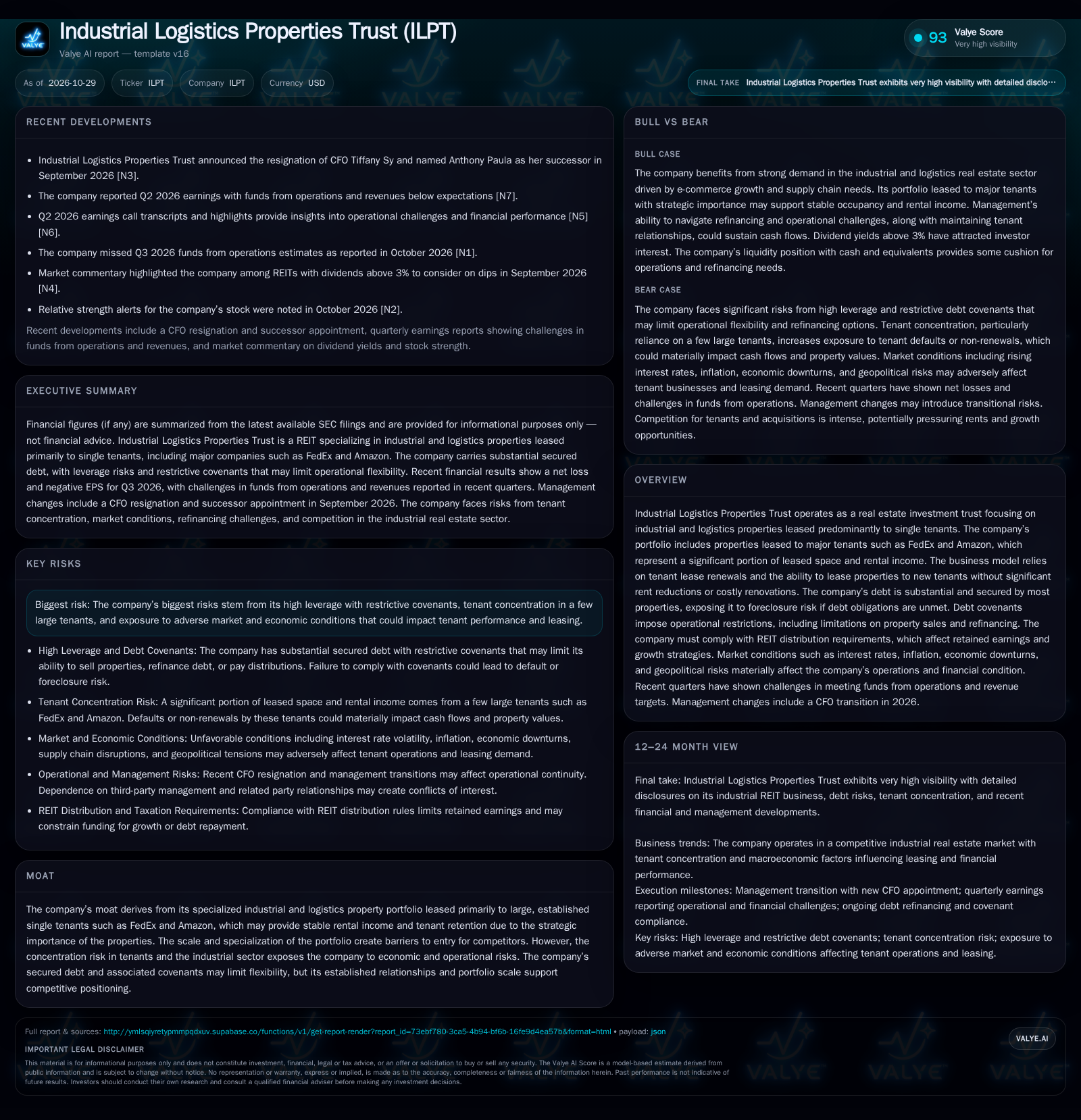
Industrial Logistics Properties Trust (ILPT) operates a portfolio of industrial and logistics assets primarily leased to single tenants like FedEx and Amazon. While these relationships can stabilize near-term cash flows, the company’s 69% net debt-to-gross-assets ratio and restrictive covenants amplify refinancing and default risk if market or tenant conditions deteriorate. Missed FFO estimates and recent management turnover highlight execution challenges. The next phase hinges on successful debt management and tenant retention amid a changing macro environment. [S2] [N1] [N3]
Industrial Logistics Properties Trust (ILPT) stands at a crossroads shaped by high leverage, tenant concentration, and shifting industrial real estate dynamics. The appeal of long-term leases with major tenants offers stability, but the company’s 69% net debt-to-gross-assets ratio and restrictive covenants leave little room for error if conditions sour. Recent earnings misses and management changes add to the uncertainty. The company’s ability to proactively manage refinancing risk, retain key tenants, and adapt to market headwinds will determine whether it can preserve dividend payouts and property values—or face more acute financial stress in the quarters ahead. [S2] [N1] [N3]
Leverage, Tenant Dependence, and Recent Financial Setbacks Define ILPT’s Current Posture
As of December 31, 2025, Industrial Logistics Properties Trust reported approximately $4.2 billion in consolidated principal debt, resulting in a net debt to total gross assets ratio of 69%. This high leverage is structurally significant because the debt is secured by most of ILPT’s properties, meaning default could trigger foreclosure on a substantial portion of the company’s asset base. [S1] [S2]
ILPT’s tenant roster is highly concentrated: major firms such as FedEx and Amazon account for a substantial share of leased square footage and rental income, creating exposure to any changes in the financial health or leasing appetite of these counterparties. [S1]
Recent operational challenges have surfaced, including missing Q3 2026 funds from operations (FFO) estimates and a CFO transition in September 2026, with Anthony Paula replacing Tiffany Sy. These changes underscore both financial pressure and potential uncertainty in strategic execution. [N1] [N3]
How ILPT’s Business Model Translates Leased Square Footage into Cash—and Where the Model Is Most Vulnerable
ILPT’s economics are fundamentally driven by rental income from long-term leases to single tenants. This structure typically provides predictable cash flows and a degree of operating leverage, as many property-level costs are fixed or semi-fixed. However, a heavy reliance on a small number of large tenants means that even a single vacancy or renegotiation can disproportionately affect revenues and margins.
The company’s high leverage amplifies both upside and downside. If market rents rise and tenants renew at higher rates, incremental rental income drops largely to the bottom line after debt service. Conversely, in a downturn, fixed debt service obligations persist even if rental income falls, increasing the risk of covenant breaches or liquidity shortfalls.
REIT distribution requirements further constrain retained earnings, limiting ILPT’s ability to de-lever organically or fund growth from internal sources. Refinancing maturing debt—especially in a higher interest rate environment—may require asset sales or dilutive capital raises, both of which could erode shareholder value if executed under stress. [S2]
Where ILPT Sits in the Industrial Real Estate Landscape—and the Nature of Its Competitive Risks
ILPT’s portfolio of specialized industrial and logistics properties leased to blue-chip tenants provides some strategic ballast, as these assets are mission-critical for distribution and supply chain operations. This specialization and scale may deter some competitors and help maintain occupancy.
However, the industrial REIT sector is highly competitive, with both public and private players aggressively seeking to acquire, develop, and lease similar properties. Competition can drive up acquisition prices and compress yields, while also giving tenants bargaining power in lease negotiations—especially as large tenants like Amazon or FedEx can exert leverage based on their size and options.
Alternative forms of logistics infrastructure (such as last-mile urban warehouses or multi-tenant flex spaces) also present substitution risk, particularly if tenant requirements evolve. ILPT’s ability to adapt its portfolio mix and maintain relevance in the face of shifting tenant preferences and technological change will be tested over the next cycle.
A Path to Stability: What Would Need to Go Right for ILPT to Deliver on Its Dividend and Asset Value Promise
The most favorable scenario for ILPT hinges on a stable or improving industrial real estate market, where demand for logistics space remains robust and major tenants renew leases at or above current rates. If interest rates stabilize or decline, ILPT could refinance maturing debt at manageable costs, avoiding forced asset sales or covenant breaches.
Tenant retention is critical: renewals by FedEx, Amazon, and other large occupants would anchor rental income and minimize costly downtime or re-tenanting expenses. If ILPT can also selectively dispose of non-core assets at favorable prices, it may be able to reduce leverage and improve its credit profile.
Conversely, unexpected tenant departures, refinancing at punitive rates, or further earnings disappointments would challenge the upside case.
Debt Burden Meets Market Reality: The Most Likely Trajectory for ILPT Absent Major Shocks
The most plausible trajectory for ILPT is one of incremental progress but continued constraint. The company is likely to retain its major tenants in the near term, but may need to offer concessions or accept lower renewal rents given the competitive landscape and tenant leverage. Asset sales or joint ventures could be used to manage leverage, though likely at modest premiums or even discounts depending on market conditions.
Refinancing risk remains elevated, especially if interest rates stay high or credit markets tighten. ILPT may be able to refinance some debt, but could face higher interest expense, reducing FFO and pressuring dividend coverage. Operational flexibility will remain limited by debt covenants.
Confirmation of the base case would come from steady occupancy, moderate FFO volatility, and incremental improvement in leverage metrics. Falsification would be signaled by material tenant losses, covenant breaches, or significant forced asset sales.
What If the Leverage Trap Springs? Tenant Losses, Refinancing Stress, and the Risk Cascade
A negative scenario for ILPT could unfold if one or more major tenants default, downsize, or fail to renew, resulting in sudden vacancy and revenue loss. Given the specialized nature of ILPT’s assets, re-leasing may require substantial capital investment or rent concessions, further eroding cash flow.
If this coincides with a challenging refinancing environment—higher rates, tighter credit, or falling asset values—the company could face difficulty meeting debt obligations. Restrictive covenants could limit asset sales or recapitalization options, potentially leading to technical defaults or even foreclosure on key properties.
Evidence supporting this scenario would include unexpected tenant departures, rising vacancy, unsuccessful refinancing attempts, asset sales at distressed values, or public disclosure of covenant breaches. A dividend cut or suspension would likely follow such adverse developments.
Milestones and Metrics That Will Reveal ILPT’s True Resilience
Tenant renewal and retention rates—especially for FedEx, Amazon, and other anchor tenants—would help test the stability of rental income.
Progress on refinancing upcoming debt maturities, including terms, pricing, and any need for asset sales or covenant waivers.
Occupancy trends and rent spreads on re-leased or renewed properties, if disclosed, to gauge the health of core operations.
FFO per share and dividend coverage ratios, as reported in future earnings, as leading indicators of cash flow sustainability.
Leverage metrics such as net debt to gross assets and interest coverage, with particular attention to any material changes.
Asset sale activity and realized pricing, which would indicate market demand for ILPT’s properties and potential for de-leveraging.
Management commentary and guidance on tenant pipeline, refinancing strategy, and capital allocation priorities.
Disclaimer: This is research-only, informational analysis and not investment advice. It may include AI-generated interpretation and general industry context. Always verify important details using primary sources.

Comments