
Bausch & Lomb: Profitability Returns, Regulatory Milestones, and the Eye Health Innovation Race
Bausch & Lomb’s swing to profitability and raised guidance in Q3 2026 coincide with regulatory wins in surgical devices, but the company faces capital commitments, litigation, and intensifying competition in both branded and generic eye health markets.
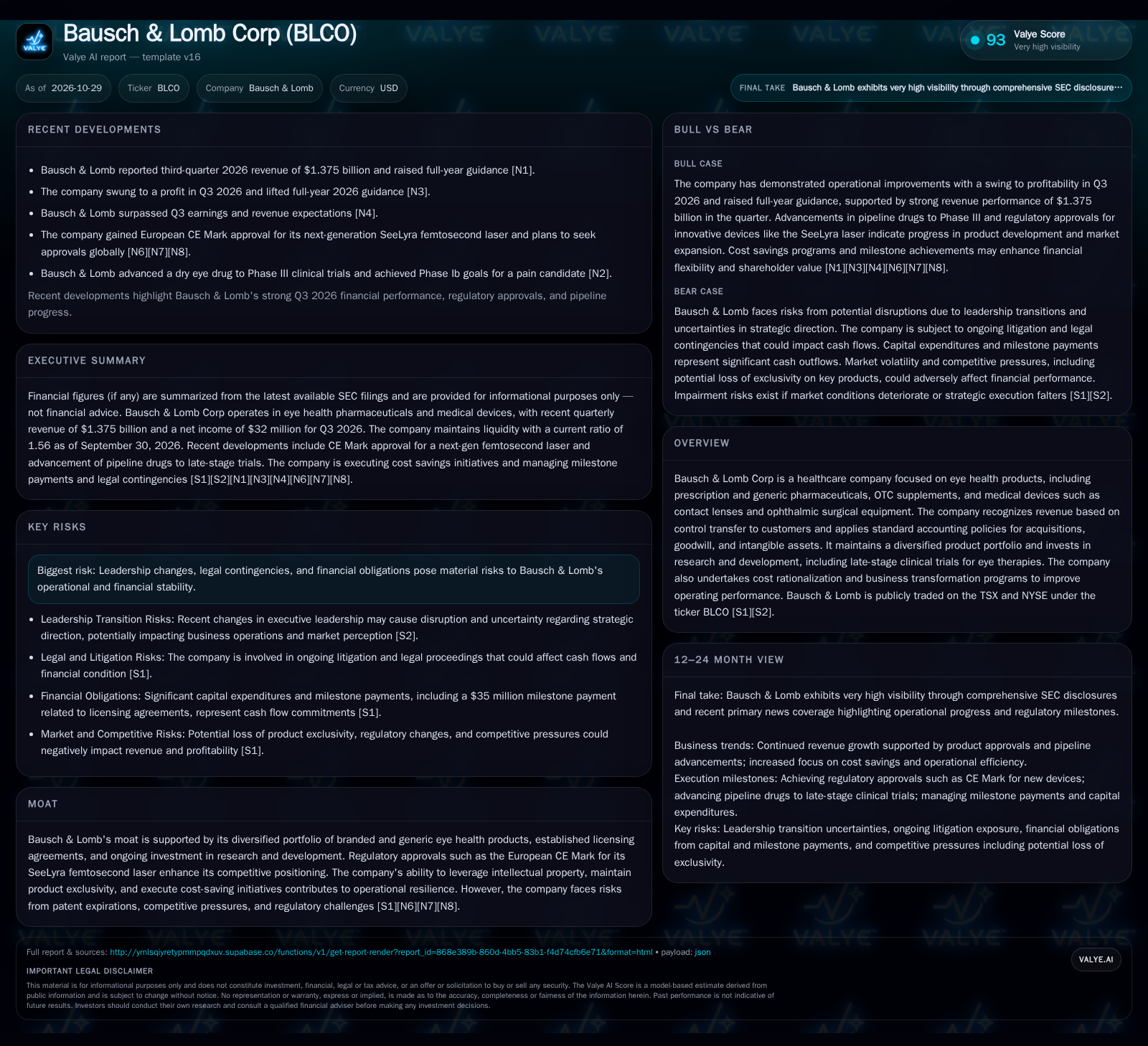
Bausch & Lomb reported Q3 2026 revenue of $1.375 billion and net income of $32 million, surpassing expectations and prompting raised full-year guidance. The company gained European CE Mark approval for its SeeLyra femtosecond laser, signaling momentum in device innovation. However, large capital expenditures, milestone payments, and ongoing legal exposures present material financial obligations, while competitive and patent risks remain persistent challenges. The key question is whether operational improvements and new product launches can sustainably offset these headwinds as the eye health market evolves. [S1] [S2] [N1] [N3] [N4] [N6] [N7] [N8]
Bausch & Lomb’s third-quarter 2026 results mark a notable inflection: the company returned to profitability, exceeded market expectations, and raised its full-year outlook. This financial turnaround is accompanied by a major regulatory milestone—the European CE Mark approval for its SeeLyra femtosecond laser, which could open new revenue channels in the ophthalmic surgical device segment. Yet, beneath these headline wins, Bausch & Lomb must navigate substantial capital outlays, milestone payments, ongoing litigation, and the relentless pace of competition and patent expiry across global eye health markets. The next phase will test whether operational gains and pipeline momentum are enough to drive durable value.
Profitability Returns and Innovation Milestones Define the Current Landscape
Bausch & Lomb achieved a $32 million net profit on $1.375 billion in Q3 2026 revenue, outperforming expectations and leading management to raise full-year guidance. This marks a reversal from prior periods and signals operational improvement. The company also secured European CE Mark approval for its next-generation SeeLyra femtosecond laser, a significant step in its medical device strategy and a potential catalyst for international sales expansion. However, these advances coincide with substantial cash outflows: $285 million in planned capital expenditures for 2026 and an accrued $35 million milestone payment tied to a licensing agreement with Novaliq GmbH. The company reported cash and liquidity metrics for the period; these figures do not by themselves establish operating runway, investment capacity, financial flexibility, or financing capacity. Ongoing cost-saving initiatives and legal contingencies remain active factors shaping near-term performance. [S1] [S2] [N1] [N3] [N4] [N6] [N7] [N8]
Revenue Streams, Cost Structure, and the Levers for Margin Expansion
Bausch & Lomb’s business model spans branded and generic prescription drugs, OTC supplements, and a broad array of medical devices—including contact lenses and surgical tools. Revenue is recognized on the transfer of control to customers, which in practice means a mix of distributor sales, direct hospital and clinic contracts, and retail pharmacy channels. Pricing power is historically strongest in branded pharmaceuticals and specialized devices, but both segments are subject to regulatory pricing pressure and competition from generics and device alternatives.
The device segment, especially with innovations like the SeeLyra femtosecond laser, can command premium pricing and contribute to margin expansion if adoption scales. However, device development is capital-intensive, and commercial success depends on both regulatory approval and clinical adoption. Pharmaceuticals, especially generics, are more volume-driven and subject to price competition, but benefit from high recurring demand. The company’s ongoing capital expenditures and milestone/licensing payments reflect the need to continually invest in R&D and new product launches to offset patent expirations and pricing erosion.
Fixed costs in manufacturing, R&D, and SG&A are significant, but Bausch & Lomb’s ongoing cost transformation initiatives—such as headcount reductions and real estate rationalization—are intended to improve contribution margins and operating leverage. The extent to which these savings translate into sustainable margin gains will depend on revenue mix, pricing discipline, and the ability to defend or grow share in contested markets.
Defending Share in a Fragmented and Fast-Evolving Eye Health Market
Bausch & Lomb operates in a highly fragmented global market. In pharmaceuticals, it faces competition from both large established players and generics manufacturers, which puts constant pressure on pricing and exclusivity—especially as major product patents expire. In devices, the landscape includes global device giants, niche innovators, and regional players, all competing for hospital and clinic adoption. The recent CE Mark for SeeLyra demonstrates Bausch & Lomb’s capacity to innovate, but the challenge will be converting regulatory wins into commercial adoption against entrenched competitors.
Switching costs in medical devices can be moderate to high due to physician training, capital investment, and clinical workflow integration. However, in pharmaceuticals and OTC products, switching costs are low, and customers are price-sensitive. The company’s diversified portfolio and established brand provide some resilience, but not immunity, to competitive substitution. Regulatory hurdles, intellectual property, and established distribution channels remain partial moats, but these are susceptible to erosion as biosimilars, new technologies, and alternative therapies gain traction.
Pipeline Execution and Device Adoption Drive Sustainable Value Creation
In a favorable scenario, Bausch & Lomb leverages the CE Mark approval to secure further regulatory clearances for the SeeLyra femtosecond laser in key global markets, driving accelerated adoption in ophthalmic surgery centers. Successful commercialization of this and other pipeline devices could improve revenue mix toward higher-margin segments and reinforce the company’s innovation credentials. The company reported profitability for the period.
On the pharmaceutical side, late-stage pipeline drugs reach approval and launch, offsetting revenue lost to generic competition and patent expirations. The company’s ability to manage milestone payments and capital expenditures without liquidity stress would support further R&D investment and possibly shareholder returns.
Confirmation of this scenario would come from continued revenue outperformance versus guidance, sequential margin improvement, robust device order growth (especially for SeeLyra), and regulatory approvals in additional jurisdictions. Conversely, delays in regulatory approvals, weak device adoption, or failure to launch new drugs would challenge the upside case.
Incremental Progress Amid Capital Commitments and Industry Headwinds
The most plausible outcome is that Bausch & Lomb delivers steady, but not dramatic, revenue and earnings growth. Cost initiatives yield moderate margin improvement, but are partially offset by ongoing litigation costs, milestone payments, and high capital expenditures. The SeeLyra laser and other device innovations achieve some commercial traction, but broader adoption is gradual due to market inertia and hospital procurement cycles. Pharmaceutical revenues remain pressured by generic competition, with new launches offsetting some, but not all, erosion from patent expiries.
Litigation and regulatory risks remain persistent, occasionally impacting results. Evidence supporting this scenario would include revenue growth in line with raised guidance, stable or modestly expanding margins, and a manageable balance between cash outflows (capex, milestones, litigation) and recurring cash generation.
Margin Compression and Strategic Execution Risks Undermine Momentum
A negative scenario could emerge if competitive pressures accelerate—such as a wave of generic entrants or a new device technology gaining rapid adoption—leading to revenue declines and margin compression. Failure to achieve anticipated cost savings, delays in new product launches, or setbacks in regulatory approvals (especially for SeeLyra or late-stage drugs) would exacerbate financial strain. Large capital and milestone payments could squeeze liquidity, and adverse litigation outcomes may further pressure cash flows.
In this scenario, Bausch & Lomb could be forced to slow R&D investment, cut back on pipeline development, or seek additional external funding—potentially diluting shareholders or raising borrowing costs. Indicators of downside risk would include revenue or margin misses versus guidance, unexpected litigation charges, negative working capital trends, or evidence of delayed product launches and regulatory setbacks.
What Will Reveal Whether Bausch & Lomb’s Transformation Sticks
Sustained revenue growth above updated full-year guidance, particularly in device and branded pharmaceutical segments, would help test the durability of the current momentum.
Gross and operating margin trends, if disclosed by segment, will clarify whether cost savings and product mix shifts are translating into real profitability gains.
Device order growth and adoption rates for the SeeLyra femtosecond laser in Europe and other markets would provide visibility into the commercial impact of recent regulatory wins.
The cadence and success rate of new product launches, especially late-stage pipeline drugs, will be key to offsetting erosion from patent expirations.
Cash flow from operations versus capital expenditures and milestone payments will indicate whether liquidity remains sufficient to fund growth and R&D without external financing.
Updates on major litigation and legal contingencies, including any material settlements or adverse rulings, would impact both cash flows and risk perception.
Progress on business transformation initiatives—such as headcount reductions, real estate savings, or improvements in contribution margin—should be monitored for tangible impact on operating leverage.
Disclaimer: This is research-only, informational analysis and not investment advice. It may include AI-generated interpretation and general industry context. Always verify important details using primary sources.

Comments