
NeoVolta in 2026: Scaling Ambition, Financial Strain, and the Utility-Scale Manufacturing Pivot
NeoVolta’s aggressive expansion into utility-scale battery manufacturing and new sales channels is driving rapid revenue growth—but also deepening losses and raising fresh questions about execution, funding, and supply chain resilience as the company chases a larger share of the energy storage market.
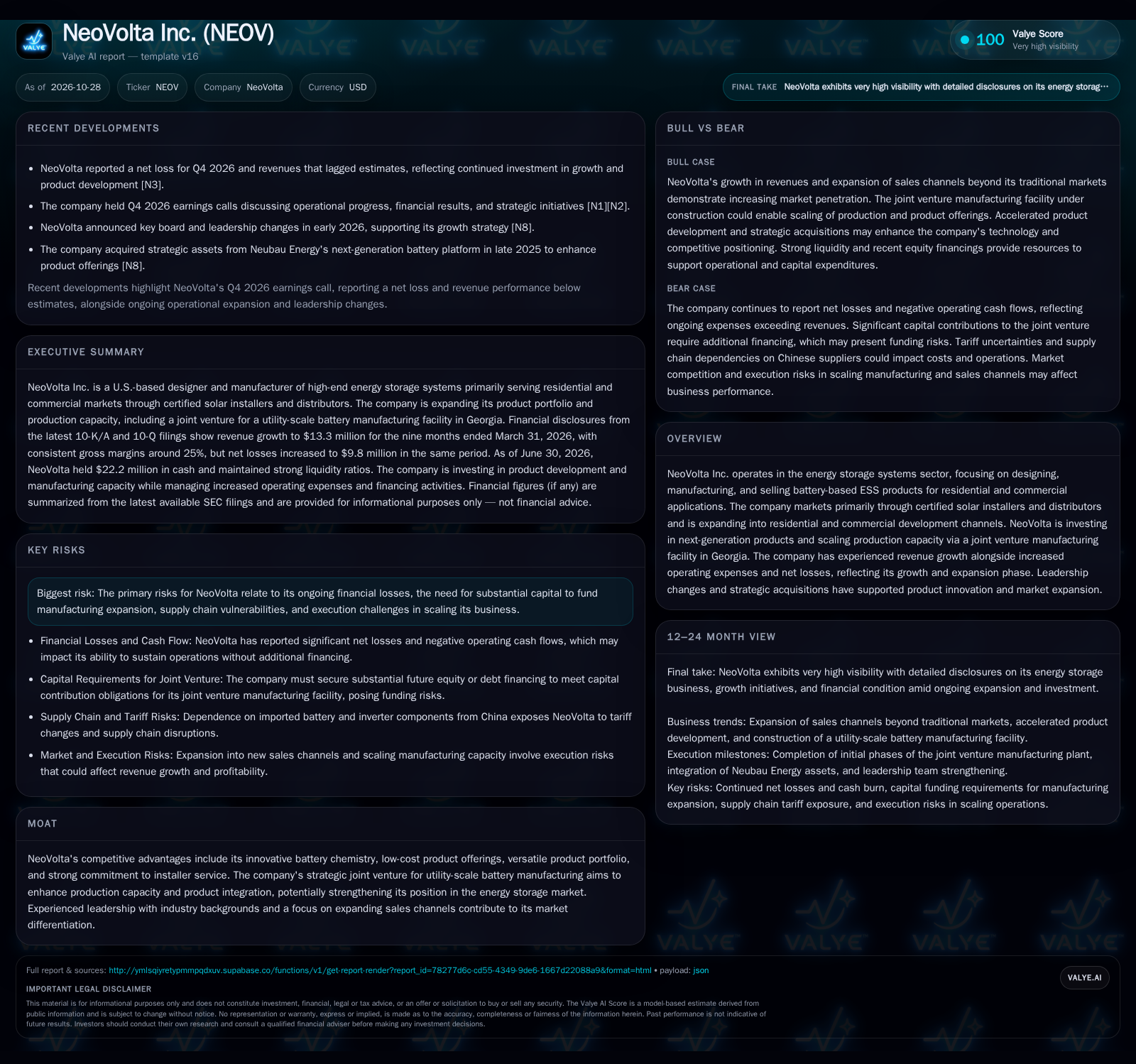
NeoVolta is growing quickly, with revenues for the nine months ended March 2026 up to $13.3 million, but losses have widened alongside ambitious investments in a Georgia utility-scale battery facility. Gross margins remain stable at 25%, but negative operating cash flow and large capital needs for the joint venture mean execution and funding risks are high as NeoVolta seeks to scale beyond its core Southern California market. [S1] [S2] [N3]
NeoVolta is at a strategic crossroads in 2026, leveraging rapid revenue growth and a bold manufacturing expansion to stake out a bigger role in the U.S. energy storage sector. The company’s shift from a regional player to a national contender is marked by the construction of a utility-scale battery plant in Georgia and an aggressive push into new sales channels. Yet, this ambition is matched by deepening financial losses, persistent negative cash flow, and a substantial need for fresh capital. As NeoVolta navigates execution risks and supply chain vulnerabilities, its ability to translate top-line momentum into sustainable, profitable scale is now the central question for investors and industry observers alike. [S1] [S2] [N3]
Rapid Expansion Meets Intensifying Financial Pressure
NeoVolta’s top-line growth is accelerating, with revenues for the nine months ended March 31, 2026, reaching $13.3 million—more than triple the $3.7 million from the prior-year period. This surge reflects successful expansion into new sales channels outside Southern California and the ramp-up of direct sales to installers and distributors. However, the company’s strategy has also driven operating expenses sharply higher, with general and administrative costs and R&D both rising substantially. Net losses for the same period widened to $9.8 million, and operating cash flow was negative $8.2 million, highlighting the tension between scaling and profitability. [S2]
Strategically, NeoVolta has committed to a utility-scale battery joint venture in Georgia, holding an 80% stake and contributing $7 million in initial capital as of January 2026. The project demands up to $25 million in total contributions through mid-2027, signaling ongoing reliance on capital markets.As of June 30, 2026, the company reported $22.2 million in cash and a reported current ratio, but its continued cash burn and the scale of upcoming investment obligations make additional financing a near-term necessity. [S1] [S2]
How NeoVolta’s Model Could Scale—and Where the Economics Get Challenging
NeoVolta’s business model is anchored in the sale of high-end energy storage systems (ESS) to certified solar installers and distributors, with a growing push toward residential and commercial developers. The economics are driven by a mix of hardware sales (batteries and inverters), integration services, and potentially value-added features. Reported gross margins of 25% are robust for the hardware-centric segment, but the company is not yet achieving economies of scale sufficient to offset the burden of higher SG&A and R&D—a common challenge for growth-stage cleantech manufacturers. [S2]
Scaling to utility-grade manufacturing via the Georgia joint venture could, if successful, unlock improved unit economics by spreading fixed costs over larger volumes and leveraging local production for supply chain resilience. However, such scale-ups are capital-intensive and often expose companies to unforeseen manufacturing, logistics, and working capital stresses. NeoVolta’s negative operating cash flow and ongoing net losses underscore that its current cost structure is not yet sustainable without continued external funding. The path to operating leverage depends on (1) successfully ramping production, (2) maintaining or improving gross margins as volume grows, and (3) controlling SG&A escalation relative to revenue growth.
Capital needs remain substantial: the joint venture alone requires up to $25 million more in equity or debt by June 2027. Even with a healthy cash balance, this means NeoVolta’s funding model remains dependent on new capital raises or non-dilutive financing solutions—raising potential dilution or leverage concerns if market conditions tighten.
Competitive Dynamics: Installer Relationships, Product Breadth, and the Threat of Global Players
NeoVolta’s core advantages are rooted in its installer-friendly service model, innovative battery chemistry, and a versatile portfolio that addresses both residential and commercial segments. By focusing on certified installer channels and expanding into developer partnerships, the company aims to capture a broader swath of the U.S. ESS market, where customer acquisition costs and channel access are critical levers.
However, the competitive landscape is intense. NeoVolta faces incumbent global battery manufacturers, integrated solar-plus-storage providers, and lower-cost Asian entrants. Larger players may benefit from greater purchasing power, stronger brand recognition, and more diversified product lines—including software and grid-integration services that create customer lock-in and potential recurring revenue streams. NeoVolta’s ability to differentiate on product performance, installer support, and cost-to-value will be tested as it scales.
Supply chain dependencies on Chinese component suppliers also expose NeoVolta to tariff, logistics, and technology risks. While inventory stockpiling and tariff monitoring can mitigate short-term shocks, longer-term resilience may require further vertical integration or diversification of sourcing—a challenge for any mid-sized player in the capital-heavy energy storage value chain. [S1]
Unlocking Operating Leverage Through Successful Plant Ramp and Channel Expansion
A favorable scenario for NeoVolta hinges on the smooth and timely ramp-up of its Georgia utility-scale battery facility. If the plant achieves initial production targets by summer 2026 and scales efficiently, NeoVolta could realize lower per-unit manufacturing costs, improved gross margins, and increased capacity to support both existing and new sales channels. This, in turn, would allow the company to spread fixed costs and SG&A over a larger revenue base, driving operating leverage.
Success in expanding partnerships with residential and commercial developers could further accelerate top-line growth, while next-generation product launches might open higher-margin segments or enable premium pricing. Confirmation of this scenario would include: (1) evidence of on-time facility commissioning, (2) sequential improvement in gross margin and positive operating cash flow trends, (3) new developer contracts or channel wins, and (4) capital raises at favorable terms or the ability to fund growth with internally generated cash.
Falsification would come from construction or ramp delays, persistent margin compression, inability to convert sales pipeline into actual contracts, or continued reliance on dilutive capital raises to fund basic operations.
Growth Outpaces Profitability as NeoVolta Grapples with Execution and Funding Demands
The most plausible near-term outcome is that NeoVolta continues to grow revenues at a healthy clip, but operating losses and negative cash flow persist as expansion and investment outpace immediate margin gains. The phased construction of the Georgia plant proceeds, but initial production may face typical manufacturing ramp-up hiccups—preventing rapid margin improvement.
Sales channel expansion beyond Southern California drives incremental revenue, but competitive pricing pressure and rising SG&A dilute the impact on bottom-line results. NeoVolta likely secures additional funding—either via equity, convertible debt, or project financing—to meet joint venture capital calls and working capital needs, but at the cost of some dilution or higher leverage. Gross margins remain in the mid-20% range, but fixed costs and R&D continue to weigh on profitability.
Confirmation of this scenario would show: (1) steady revenue growth with gross margins holding near current levels, (2) ongoing net losses and negative operating cash flow, (3) periodic capital raises, and (4) gradual progress on facility construction milestones. A sharp break from this pattern—either via an unexpectedly rapid move to profitability or a funding shortfall—would signal a shift from the base expectation.
Funding Shortfalls or Ramp Delays Could Disrupt the Expansion Thesis
The adverse scenario centers on execution risk and capital market vulnerability. If NeoVolta encounters delays or cost overruns in the Georgia facility, the company may face a cash crunch—especially if capital markets become less receptive to new equity or debt offerings. Supply chain disruptions, such as component shortages or tariff spikes, could further squeeze gross margins or halt production.
In this scenario, revenue growth would stall or reverse, net losses would widen as fixed costs remain high, and the company could be forced to curtail R&D or marketing investments—weakening its competitive position. Failure to meet joint venture capital calls could jeopardize NeoVolta’s 80% stake or delay the facility’s completion, undermining the scale-up thesis.
Confirmation would include: (1) missed or delayed facility milestones, (2) inability to raise sufficient capital on acceptable terms, (3) deteriorating gross margins or revenue contraction, and (4) signs of forced cost-cutting or retrenchment in channel expansion plans.
Milestones That Will Clarify NeoVolta’s Path to Scalable Profitability
Quarterly updates on Georgia facility construction progress and any disclosed production ramp timelines will be crucial for assessing the scale-up thesis.
Gross margin trends: sequential improvement—especially as new production comes online—would support the case for operating leverage; stagnation or decline would signal cost pressures.
Cash flow from operations: movement toward break-even or positive territory would validate the sustainability of the business model.
Capital raise disclosures: the terms, structure, and frequency of new financings will indicate both market confidence and dilution risk.
Sales channel and contract wins: new developer agreements, installer partnerships, or geographic expansion milestones would help confirm demand-side traction.
R&D pipeline updates: progress on next-generation product launches, if disclosed, would shed light on NeoVolta’s ability to sustain differentiation.
Supply chain disclosures: updates on tariff impacts, inventory management, or sourcing diversification would clarify operational resilience.
Board and executive turnover: any further leadership changes could signal either strengthening or instability in execution capability.
Disclaimer: This is research-only, informational analysis and not investment advice. It may include AI-generated interpretation and general industry context. Always verify important details using primary sources.

Comments