
Tyler Technologies: Recurring Revenue Power, Public Sector Stickiness, and the Next SaaS Growth Phase
Tyler Technologies’ expansion in SaaS and transaction-based services has reinforced its recurring revenue base and increased ARR to over $2 billion, while recent acquisitions deepen its public sector integration. The durability of this model will hinge on continued government IT modernization, successful integration of acquired platforms, and Tyler’s ability to defend pricing and retention in a competitive, budget-sensitive environment.
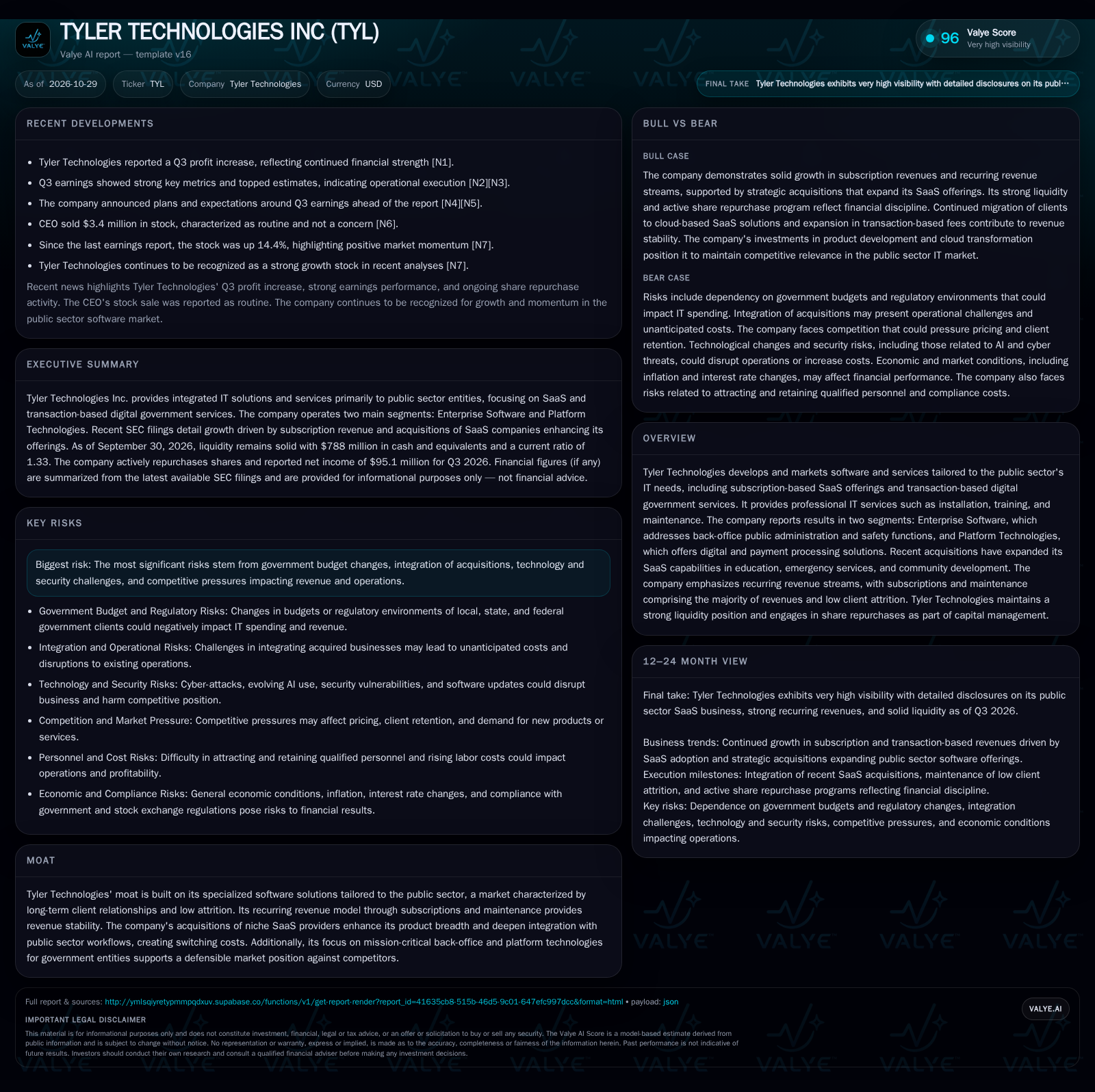
Tyler Technologies’ Q3 2026 results show strong recurring revenue growth and robust profitability, with ARR up 11% to $2.06B and net income of $95.1M. The business is anchored by public sector SaaS, low client attrition, and recent acquisitions that expand its addressable market. Key questions for the next phase include integration execution, the pace of government digital adoption, and resilience to budget and regulatory shifts. [S1] [S2]
Tyler Technologies’ evolution into a dominant public sector SaaS provider is now reflected in its financial architecture: an overwhelming majority of recurring revenues, low client attrition, and a surging ARR base. The company’s recent Q3 2026 results confirm the momentum from both organic SaaS growth and targeted acquisitions in adjacent government IT domains. Yet with government clients, the real test remains the company’s ability to maintain pricing power, integrate new platforms, and weather the uncertainties of public budgeting cycles. For investors, the next phase will be defined by execution in integration, continued SaaS migration, and Tyler’s resilience to sector-specific risks.
Q3 2026: Recurring Revenue Dominance and Strategic Acquisitions Shape Tyler’s Trajectory
Tyler Technologies’ current operating snapshot is defined by four material developments. First, annualized recurring revenues (ARR) climbed 11% year-over-year to $2.06 billion in 2025, as subscription-based SaaS and transaction services accelerated [S1]. Second, recurring revenue (subscriptions plus maintenance) made up 87% of total 2025 revenues, with client attrition at just 2%, underscoring deep client stickiness [S1]. Third, the company executed multiple acquisitions in 2025 to expand its SaaS portfolio into education, cloud-based warrant management, emergency services, and community development, directly contributing to the Enterprise Software segment [S1]. Finally, Q3 2026 net income was $95.1 million, with reported liquidity position—$788 million in cash/equivalents and a current ratio of 1.33—while $379 million in shares were repurchased and $1.33 billion remains authorized [S2]. Collectively, these facts highlight a business model with high revenue visibility, ongoing capital deployment for growth and shareholder returns, and a strategic push to deepen integration across public sector IT domains.
How Tyler Makes Money: Subscription Engines, Transaction Fees, and Margin Structure
Tyler Technologies’ economics are powered by a recurring revenue engine. The company’s SaaS and transaction-based services provide predictable, multi-year revenue streams that contrast with traditional perpetual-license or project-based government IT contracts. Subscription pricing likely reflects a mix of per-user, per-entity, and transaction-volume models, with government clients attracted by lower upfront costs and ongoing software updates. Transaction-based fees—especially in digital government services and payment processing—create incremental revenue that scales with constituent engagement and government digitalization.
With 87% of revenue recurring and client attrition at 2% [S1], Tyler’s model supports high gross margin potential, although cost structure is influenced by hosting/merchant fees and personnel costs for implementation and support. The expansion in R&D headcount from 870 to 1,368 in 2025 [S1] signals ongoing investment in product development, which may pressure near-term margins but is crucial for platform defensibility and innovation. Operating leverage is plausible as SaaS scale increases, particularly if Tyler can streamline implementation and support processes across its expanding platform portfolio.
Capital requirements remain moderate for a SaaS business, with most investment directed at R&D, selective acquisitions, and incremental hosting infrastructure. The company reported cash and liquidity metrics for the period; these figures do not by themselves establish operating runway, investment capacity, financial flexibility, or financing capacity.
Defensibility in Public Sector IT: Switching Costs, Integration Depth, and Market Structure
Tyler’s moat is fundamentally built on public sector specialization, complex integration, and long-term relationships. Government clients face high switching costs due to regulatory compliance, data migration complexity, and mission-critical reliance on Tyler’s systems for core functions such as tax, public safety, courts, and education. The 2% attrition rate in 2025 [S1] is a direct manifestation of this stickiness.
Recent acquisitions have extended Tyler’s integration into adjacent domains (education, emergency services, community development), potentially increasing cross-sell opportunities and embedding the company further in client workflows. This breadth may also create network effects if Tyler becomes the default platform for inter-agency collaboration or data sharing.
However, the company faces competition from other public sector software and IT service providers, as well as the risk of government clients considering in-house development or shifting to emerging cloud-native or AI-driven competitors. Pricing pressure is plausible as procurement cycles remain budget-sensitive and competitors pursue aggressive bids. The durability of Tyler’s advantage will depend on continued investment in product relevance and the ability to manage integration complexity as the platform expands.
Unlocking the Next Growth Leg: SaaS Penetration, Acquisition Synergy, and Government Digitalization
A favorable scenario for Tyler would see accelerated migration of public sector clients to its SaaS platforms, driving double-digit ARR growth and enhanced margin leverage. Successful integration of 2025 acquisitions could yield both cross-sell and up-sell opportunities, expanding Tyler’s share of wallet within existing accounts and opening new verticals. Broader government digital transformation—spurred by federal or state funding, regulatory mandates, or constituent demand—could increase transaction volumes and adoption of Tyler’s payment and workflow solutions.
Confirmation of this scenario would involve a further acceleration in ARR and subscription revenue growth, rising gross and operating margins (as SaaS scale offsets incremental R&D and hosting costs), and evidence of new multi-product wins or expanded contract scopes in key government segments. A sustained decline in attrition below the already-low 2% level, or public disclosures of major new client wins, would also support the upside narrative.
Sustaining High-Visibility Growth Amid Integration and Budget Dynamics
The most plausible outlook is steady high-single-digit revenue growth driven by continued SaaS adoption, stable transaction-based revenue, and incremental contributions from recent acquisitions. Tyler’s core recurring revenue stream should remain resilient, with low attrition and gradual margin expansion as integration synergies are realized and hosting/merchant costs scale more efficiently.
Execution risks center on integrating acquired platforms without service disruption or cost overruns, and maintaining product leadership as government IT priorities evolve. The stability of government IT budgets is a watchpoint—while digital transformation is a secular tailwind, cyclical or political pressures could delay new projects or contract expansions.
This scenario would be confirmed by continued ARR growth in the 8–11% range, stable or improving margins, and consistent low attrition. Any material rise in churn, margin pressure from integration, or slowdown in new SaaS bookings would challenge the base case.
Budget Shocks, Integration Missteps, and Competitive Displacement: Where the Model Could Falter
The primary downside risks for Tyler include abrupt government budget cuts, regulatory delays, or economic shocks that stall IT modernization and reduce new contract flow. Integration missteps following the 2025 acquisitions—manifesting as customer disruption, cost overruns, or platform incompatibility—could erode Tyler’s reputation and compress margins. Heightened competition from vertical SaaS upstarts or large tech players could trigger pricing concessions or higher churn, particularly if government clients prioritize price over platform breadth.
Evidence for this scenario would include a sudden drop in ARR growth, rising attrition, margin compression due to higher support or integration costs, or loss of major clients to competitors. Any public sector IT spending freeze or unexpected regulatory shift impacting procurement cycles would also stress the model.
Milestones and Data Points That Will Validate or Challenge Tyler’s Public Sector SaaS Thesis
ARR and subscription revenue growth rates: Sustained or accelerating growth would confirm ongoing SaaS penetration; deceleration may signal market saturation or competitive headwinds.
Client attrition rates: A useful metric would be quarterly updates on churn, especially post-acquisition integration periods, to test the stickiness of the expanded platform.
Gross and operating margin trends: Monitoring for improvement as SaaS scale increases, or for pressures from R&D and integration costs, will indicate model leverage or stress.
Integration progress and synergy realization: Any disclosed updates on cross-sell, up-sell, or operational synergies from 2025 acquisitions would help test the value-add from M&A.
New contract wins or expanded deployments: Publicly announced deals, especially multi-product or multi-agency wins, would signal competitive strength and market expansion.
Government IT budget signals: External indicators, such as legislative funding cycles or procurement delays, could materially affect Tyler’s near-term growth outlook.
Competitive displacement or new entrants: If disclosed, any high-profile client losses or pricing concessions due to new competitors would be an early warning sign.
Disclaimer: This is research-only, informational analysis and not investment advice. It may include AI-generated interpretation and general industry context. Always verify important details using primary sources.

Comments