
Jersey Mike’s Subs: Liquidity Strength Versus the Challenge of Scaling Franchise Profitability
Despite a robust reported cash balance and an expansive franchise network, Jersey Mike’s faces a profitability dilemma as it seeks to balance growth with sustainable unit-level economics. The company’s financial disclosures highlight both operational resilience and the pressing need to convert brand momentum into consistent earnings.
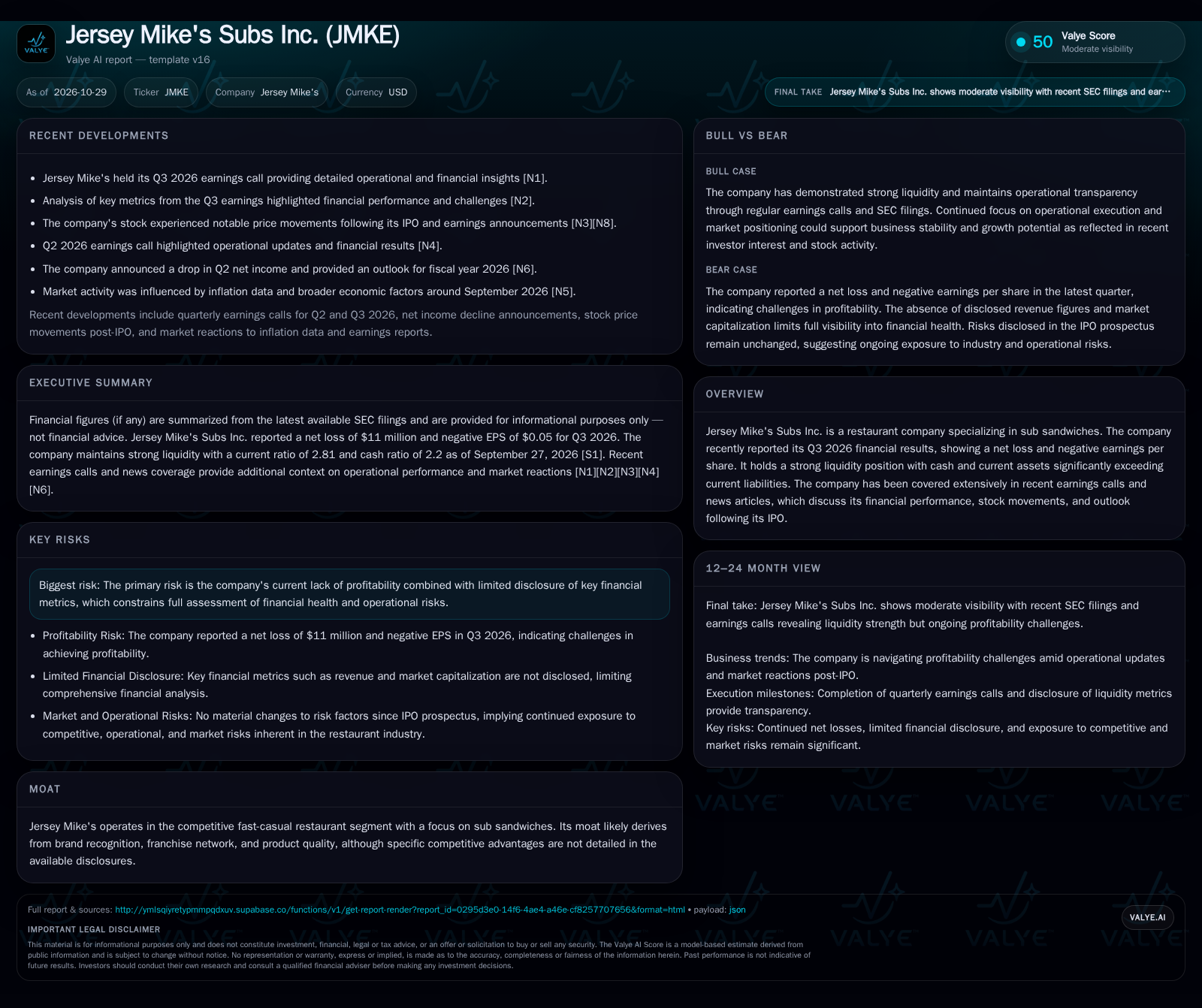
With over 3,400 franchised locations and a platform designed to support unit-level economics, the brand’s future hinges on translating scale and operating discipline into positive earnings. The lack of detailed revenue disclosure and continued negative EPS underscore the need for improved margins or cost control as the competitive fast-casual market tests the limits of its growth model. [S1]
Jersey Mike’s Subs, one of the largest and fastest-growing sub sandwich brands in North America, enters Q4 2026 at a crossroads. The company boasts an extensive franchised store network and a substantial liquidity reserve, but its latest quarterly filing reveals persistent net losses and negative earnings per share. As the fast-casual restaurant sector faces intensifying competition, Jersey Mike’s must demonstrate that its scale, brand equity, and franchise platform can deliver the margin improvement and earnings consistency required to justify its growth ambitions and investor expectations. [S1]
Q3 Financials Reveal Liquidity Strength But Underscore Profitability Hurdles
Jersey Mike’s reported a net loss of $11 million for Q3 2026, with basic and diluted EPS at -$0.05, reinforcing the narrative of ongoing profitability challenges despite the brand’s scale [S1]. [S1] With 3,456 franchised locations across the U.S. and Canada, the company’s operational footprint is broad, yet the lack of disclosed revenue figures and persistent negative earnings highlight the tension between growth and sustainable profitability [S1]. No material changes to risk factors since the IPO suggest that core challenges—competitive intensity, operational leverage, and margin pressure—remain as relevant as ever.
How Jersey Mike’s Franchise Model Shapes Its Economic Engine
Jersey Mike’s operates primarily as a franchisor, collecting royalties and fees from franchisees who operate nearly all of its 3,456 locations [S1]. This model typically offers high gross margins at the corporate level, as direct food, labor, and occupancy costs are borne by franchisees, not the parent. However, the company’s reported net loss suggests that either systemwide sales growth is not translating into sufficient royalty revenue, or that corporate overhead, marketing, and support costs are outpacing income. The absence of revenue disclosure makes it difficult to pinpoint the precise driver.
The franchise model’s economic success depends on several factors: royalty rate (often 5-7% of franchisee sales in the industry), initial franchise fees, and ongoing contributions to marketing funds. Royalty revenue should scale with systemwide sales, while fixed corporate costs (such as brand marketing, IT, and franchisee support) introduce operating leverage: if system sales grow faster than these costs, profit margins should expand. Conversely, if new store support, brand-building, or inflation-driven overhead grows faster than royalty income, losses can persist even as the network expands.
Capital needs are moderate for a franchisor: working capital is needed for corporate functions, but store buildout and operations are funded by franchisees. [S1]
Brand, Scale, and the Franchise Battlefield in Fast-Casual Subs
Jersey Mike’s competes in the intensely competitive fast-casual sandwich segment, where brand recognition, product quality, and national footprint are key differentiators. Its moat likely stems from a combination of strong brand equity, a reputation for fresh ingredients and in-store preparation, and a franchise network that enables rapid market penetration [S1]. However, the sector is crowded with both national chains (such as other sub/sandwich-focused brands) and regional players, many of whom are also expanding aggressively.
Switching costs for consumers are low—taste, convenience, and price drive decisions—while franchisees may face higher switching frictions due to contractual commitments, sunk investment, and local marketing integration. The company’s ability to support compelling unit-level economics for franchisees is a critical competitive lever: if franchisees achieve attractive returns, new store development and reinvestment can sustain system growth. If not, store openings may slow, and existing operators may pressure the brand for margin relief.
Technology, digital ordering, and delivery partnerships are increasingly influencing customer acquisition and retention in the segment. If Jersey Mike’s can leverage its scale for superior digital engagement or loyalty programs, it may partially offset the commoditization risk that plagues fast-casual dining.
Margin Recovery and Franchisee Success Drive a Positive Inflection
If Jersey Mike’s can convert its scale and brand equity into improved unit-level economics—either through higher franchisee sales, better cost controls, or increased royalty rates—it could achieve operating leverage and return to profitability. A favorable scenario would see systemwide same-store sales growth outpacing inflation and overhead, enabling royalty income to cover and exceed corporate costs. This dynamic could be accelerated by digital sales growth, improved marketing ROI, or menu innovation that drives higher average ticket.
Confirmation would come from disclosed revenue and margin improvement, a shift to positive net income, and commentary on franchisee health and new store openings. Additional evidence would include improved operating cash flow and positive trends in systemwide sales per store. Falsification would occur if losses persist despite network growth, or if there is evidence of franchisee dissatisfaction or slowing new unit development.
Sustained Growth but Margin Pressure Continues as the Default Trajectory
The most plausible near-term scenario is that Jersey Mike’s continues to grow its store base and systemwide sales through franchise expansion, but margin pressure and operating losses persist due to elevated corporate expenses or insufficient royalty flow-through. The company’s reported liquidity position affords it time to optimize its cost structure or seek incremental revenue streams, but without meaningful improvement in unit-level economics or corporate efficiency, net losses could continue.
This scenario would be confirmed by ongoing negative EPS, continued absence of detailed revenue or margin disclosure, and stable or growing store counts. Falsification would require a clear inflection in profitability, with management commentary highlighting structural cost improvements or outsized same-store sales growth.
Erosion of Franchisee Economics and Competitive Pressures Trigger Systemic Strain
A more adverse scenario would see franchisee-level economics deteriorate due to rising input costs, wage inflation, or competitive discounting, leading to slowed store openings, franchisee exits, or even store closures. If digital adoption lags peers or if the brand’s value proposition weakens, Jersey Mike’s could lose share to more innovative or aggressive competitors.
Evidence for this scenario would include a stall or decline in store count, management commentary on franchisee challenges, or negative systemwide same-store sales. Falsification would require stabilization or improvement in franchisee economics, as indicated by robust new store development and positive franchisee sentiment.
Benchmarks to Track Jersey Mike’s Progress Toward Sustainable Franchise Profitability
Disclosure of systemwide and same-store sales growth, if provided, would clarify whether top-line momentum is translating into higher royalties and improved unit economics.
Any breakout of franchisee profitability, store-level EBITDA, or franchisee return on investment (if disclosed) would illuminate the health and sustainability of the franchise network.
Quarterly trends in net income and EPS will indicate whether operating leverage is being achieved as the system grows.
Changes in store count—especially net new openings versus closures—would signal franchisee appetite for expansion and the brand’s competitive vitality.
Commentary on digital sales penetration, loyalty program engagement, and delivery mix would help assess Jersey Mike’s ability to compete on convenience and customer engagement.
Management discussion of cost structure rationalization or margin initiatives would be important for tracking progress toward profitability.
Franchisee satisfaction metrics or qualitative commentary from earnings calls could offer early warnings of strain or catalysts for renewed growth.
Disclaimer: This is research-only, informational analysis and not investment advice. It may include AI-generated interpretation and general industry context. Always verify important details using primary sources.

Comments