
PACCAR’s Integrated Model: Truck Market Leadership, Technology Bets, and the Next Phase of Heavy-Duty Transport
PACCAR’s latest results underscore its dominance in North American heavy-duty trucks and its disciplined expansion into advanced powertrains and connected services. With strong market share, rising truck deliveries, and a resilient financial services arm, PACCAR is positioned to weather industrial cycles—but must navigate regulatory, technological, and macroeconomic crosscurrents that could reshape its economics and competitive standing.
PACCAR delivered robust Q3 2026 results, driven by increased North American truck demand, higher price realization, and lower tariff costs. With a 29.3% share of the U.S./Canada heavy-duty market and ongoing investments in clean and connected vehicle technology, PACCAR’s diversified model provides both stability and leverage to industry transitions. However, exposure to cyclical freight demand, regulatory shifts, and execution risk in capital-intensive innovation will shape the next phase.
PACCAR is capitalizing on a strong North American trucking cycle, with Q3 2026 results showing substantial growth in truck deliveries, revenues, and profitability. Its commanding market share and integrated model—combining manufacturing, aftermarket parts, and captive financing—provide resilience and margin leverage. However, as PACCAR invests heavily in clean diesel, electric, and connected vehicle platforms, the company faces heightened execution risk and must adapt to evolving regulatory and macroeconomic conditions that could alter demand patterns and competitive dynamics.
Truck Deliveries Surge as PACCAR Consolidates Market Share
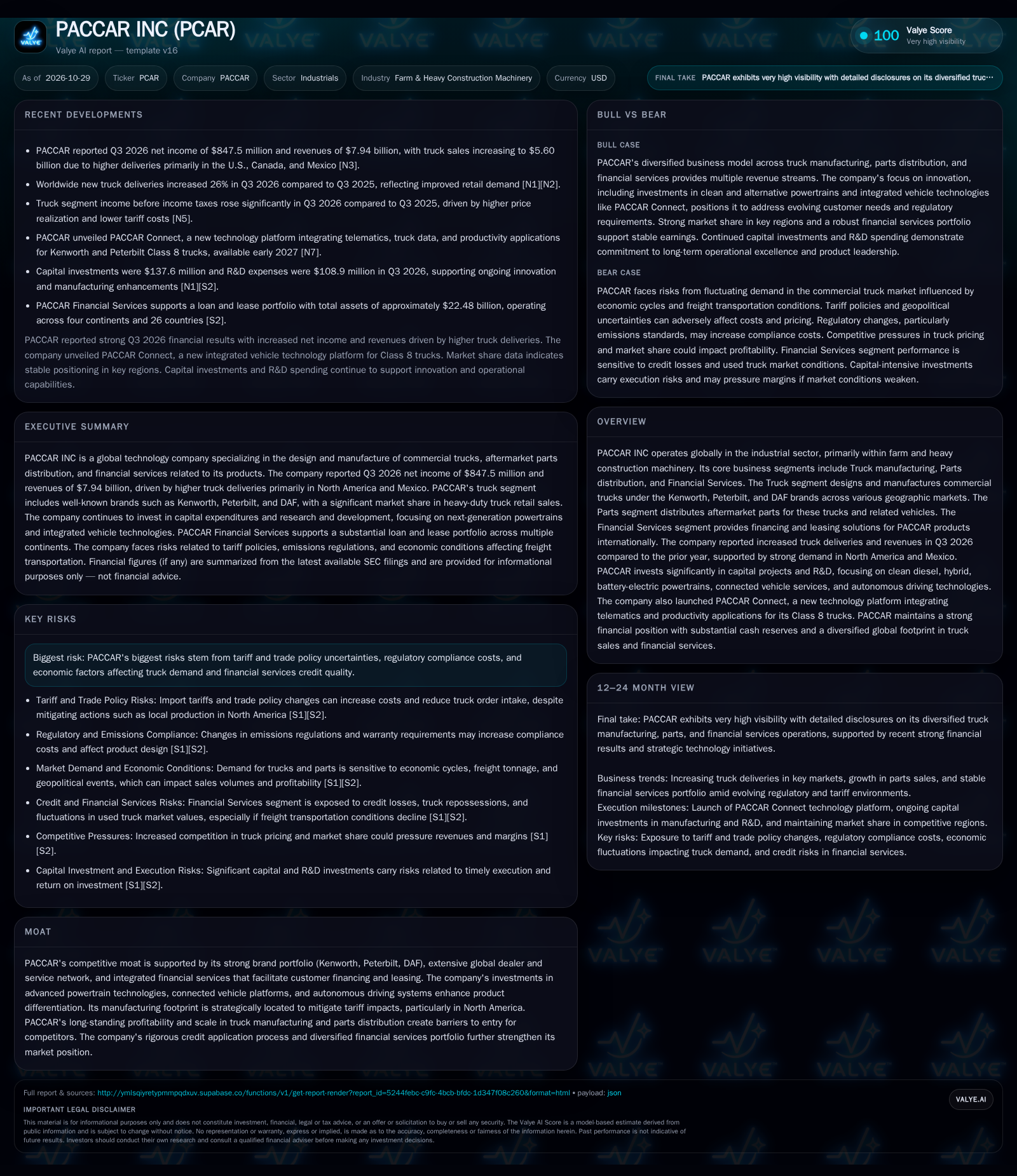
PACCAR reported Q3 2026 revenues of $7.94 billion and net income of $847.5 million, with truck sales reaching $5.60 billion and new truck deliveries up 26% year-over-year [N3] [N1] [N2]. This performance was driven primarily by strong retail demand in the U.S., Canada, and Mexico. Importantly, PACCAR’s heavy-duty truck retail market share in the U.S. and Canada was approximately 29.3% for the first nine months of 2026, reinforcing its leadership position [S2]. Truck segment income before taxes rose due to higher price realization and lower tariff costs, reflecting both pricing power and effective supply chain management [N5] [S2].
PACCAR’s capital investments totaled $137.6 million in Q3 2026, with R&D spend of $108.9 million in the quarter, supporting ongoing innovation in powertrains and vehicle connectivity [N1] [S2]. Its financial services arm managed a loan and lease portfolio with total assets of $22.48 billion, demonstrating scale but also increasing exposure to credit and residual value risks in a cyclical sector [S2].
How PACCAR Turns Scale, Pricing, and Financing Into Profits
PACCAR’s business model is anchored in high-volume truck manufacturing, aftermarket parts distribution, and in-house financing. The Truck segment is the primary revenue driver, with profitability sensitive to volumes, pricing, input costs, and tariff dynamics. In periods of strong demand—such as the current North American freight cycle—operating leverage can meaningfully expand margins as fixed costs are amortized over higher unit volumes. Recent results suggest that price realization has contributed to improved segment margins, aided by lower tariff-related headwinds [N5] [S2].
The Parts segment provides recurring, higher-margin revenue as PACCAR’s installed base ages, supporting countercyclical stability. The Financial Services segment captures value by financing customer purchases, boosting sales conversion and providing interest income, but introduces credit risk and exposure to used truck values—risks that rise in downturns or periods of tightening freight activity.
Capital intensity is high: PACCAR invested $411.8 million in capital expenditures and $332.3 million in R&D in the first nine months of 2026 [S2]. These investments are necessary to maintain technological relevance amid industry shifts toward clean powertrains, connectivity, and autonomous systems. However, these outlays must be matched by sustained demand and product adoption to deliver returns.
Brand Scale, Network, and Technology: PACCAR’s Moat and Its Limits
PACCAR’s competitive position is underpinned by its portfolio of premium brands—Kenworth, Peterbilt, and DAF—each with strong recognition in core markets. Its extensive dealer and service network reinforces customer loyalty and supports parts revenue, while a captive finance arm enhances sales conversion and deepens customer relationships.
However, the heavy-duty truck market is structurally competitive, with global manufacturers and new entrants investing in electrification, digital platforms, and autonomous technology. While PACCAR’s manufacturing footprint in North America offers tariff mitigation advantages, it faces ongoing price and innovation pressure from established and emerging competitors.
The company’s investments in clean diesel, electric, and hybrid powertrains, as well as connected vehicle and driver-assistance platforms, are necessary to defend market share and pricing power as regulatory and customer preferences shift. The question is whether PACCAR can successfully commercialize these technologies at scale and maintain its margin profile as the competitive landscape evolves.
If PACCAR’s Technology Bets Yield Early Adoption and Margin Expansion
The strongest upside scenario is one in which PACCAR accelerates adoption of its next-generation clean diesel, hybrid, and battery-electric trucks, capturing a disproportionate share of the early market for low- and zero-emission vehicles in North America and Europe. Regulatory tailwinds—such as stricter emissions standards and incentives for fleet electrification—could drive higher demand for PACCAR’s advanced products.
If PACCAR’s R&D investments in connected vehicle services and autonomous-ready platforms translate into differentiated offerings that command premium pricing and recurring software/service revenues, margin expansion could follow. The financial services arm could further amplify growth by enabling more customers to adopt high-value vehicles with integrated digital features.
Confirmation would come from above-market growth in electric/hybrid truck deliveries, rising share of revenue from connected services, and sustained improvement in truck segment margins. Evidence of successful product launches and customer wins in the zero-emission and connected segments would further validate this scenario.
Sustained Market Leadership Amid Cyclical Fluctuations and Gradual Tech Uptake
The most plausible trajectory is for PACCAR to maintain its leading market share in North American heavy-duty trucks, with truck and parts revenues tracking broader economic and freight cycles. The company’s parts and financial services businesses provide earnings stability, partially offsetting cyclical swings in truck sales.
Technology adoption—particularly in electrification and connectivity—is likely to be gradual, with regulatory mandates and customer economics dictating the pace. PACCAR’s capital investments and R&D spending should preserve its competitive position but may not drive immediate step-changes in growth or margins. Instead, the company is likely to experience incremental improvements in product mix and cost efficiency.
This scenario would be confirmed by stable or slightly increasing market share in core regions, steady growth in parts and financial services, and moderate improvement in segment profitability. Delays in regulatory changes or slower-than-expected electrification would reinforce this base case.
Tariff Shocks, Freight Downturns, or Technology Disruption Undermine Returns
The primary downside risk is a combination of macroeconomic slowdown, freight recession, or abrupt regulatory/tariff shocks that depress truck demand and squeeze margins. If economic activity slows, PACCAR’s truck deliveries and parts sales could contract, while credit losses and residual value declines would pressure the financial services segment.
A second risk is that PACCAR’s heavy R&D and capital investments fail to yield competitive, differentiated products in zero-emission or autonomous trucks, allowing rivals or new entrants to capture share and erode pricing power. This could force margin compression or require even greater investment to catch up technologically.
Confirmation would come from a sharp drop in truck orders, deteriorating segment margins, rising credit losses in the finance arm, or evidence of share loss in key regions—particularly if accompanied by negative regulatory or tariff developments.
What Will Prove Out PACCAR’s Next Phase of Truck Leadership?
Quarterly and annual trends in North American and European truck deliveries, segmented by powertrain (diesel, hybrid, electric), would help test the pace and success of PACCAR’s technology transition.
Market share movement in the U.S., Canada, and Europe, especially in the heavy-duty segment, would confirm whether the company is defending or expanding its leadership position.
Segment-level gross and operating margins, particularly in the Truck and Parts segments, would provide insight into pricing power, cost control, and operating leverage.
Growth in connected vehicle services and recurring digital/software revenues (if disclosed) would indicate progress in building a higher-margin, technology-driven business mix.
Credit loss rates, delinquency trends, and used truck residual values within the Financial Services portfolio would show vulnerability or resilience to freight market downturns.
Regulatory developments—such as new emissions mandates or zero-emission vehicle requirements in core markets—could materially affect product demand and capital allocation priorities.
Execution on capital and R&D project timelines, new product launches, and successful commercial deployments of electric/hybrid and autonomous-ready trucks would further validate PACCAR’s innovation strategy.
Tariff and trade policy changes impacting input costs or market access remain a wildcard, with any material shifts likely to flow through to both margins and demand.
Disclaimer: This is research-only, informational analysis and not investment advice. It may include AI-generated interpretation and general industry context. Always verify important details using primary sources.

Comments