
Ultra Clean Holdings’ Strategic Leverage: Record Growth, Customer Concentration, and the Semiconductor Cycle
Ultra Clean Holdings delivered record Q3 2026 revenue on the back of surging semiconductor and AI-related demand, yet its future trajectory hinges on navigating customer concentration, industry cyclicality, and the balance between expansion and a rising debt load.
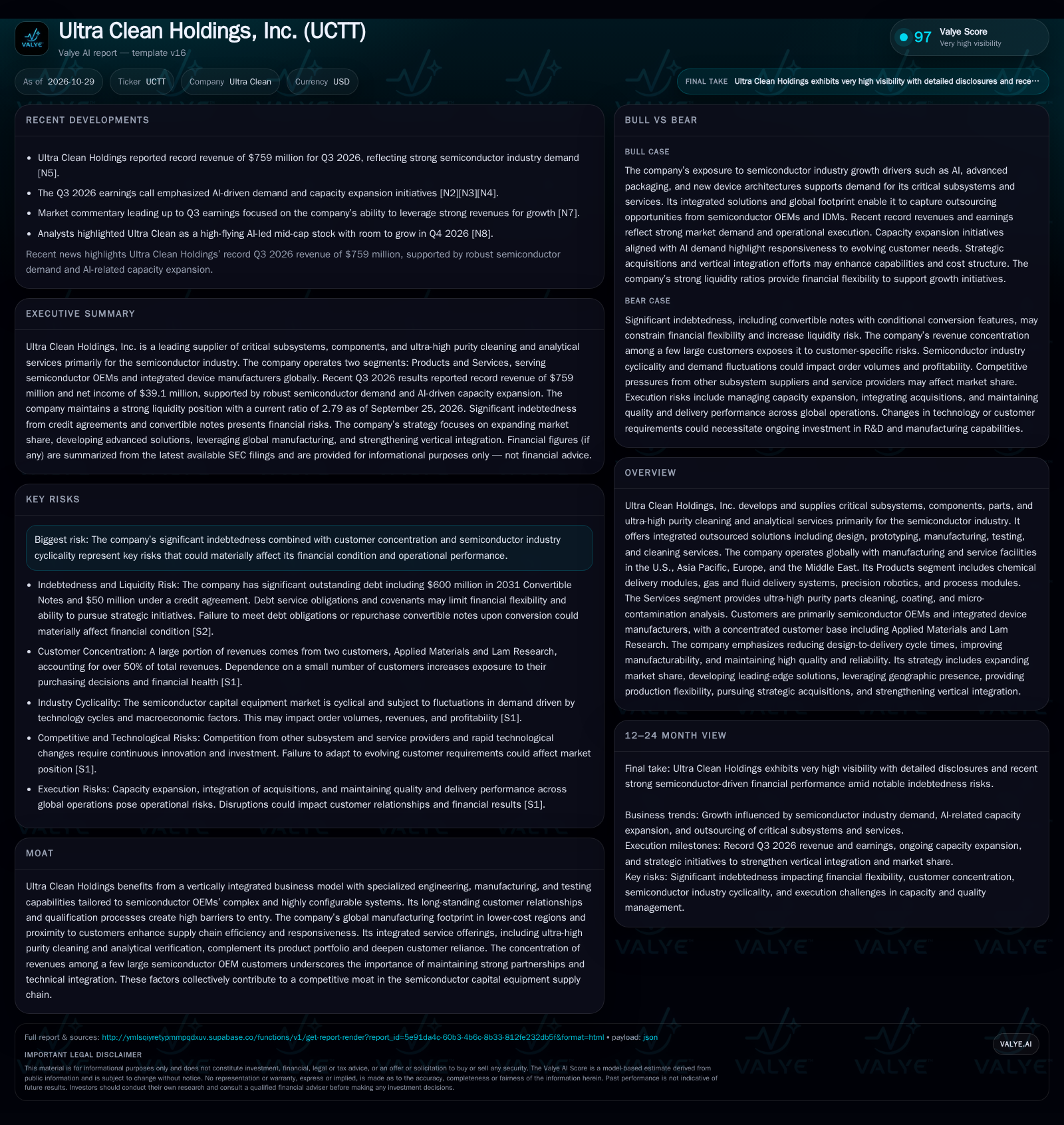
Ultra Clean Holdings posted all-time high Q3 2026 revenue as semiconductor and AI demand accelerated, but remains exposed to concentrated customer risk and rising indebtedness. Its ability to profitably scale amid industry cycles and execute on vertical integration will determine whether recent momentum translates into durable value creation. [N5] [S2]
Ultra Clean Holdings, Inc. (UCTT) stands at a pivotal intersection of semiconductor industry growth and operational risk. The company’s record-setting Q3 2026 results reflect not just robust demand for chips and advanced electronics, but also Ultra Clean’s ability to deliver critical subsystems and purity services at scale for leading OEMs. However, this performance comes with a caveat: customer concentration and a significant debt load introduce both opportunity and vulnerability. Whether Ultra Clean can turn near-term momentum into lasting value will depend on its agility in responding to industry cycles, managing key customer relationships, and executing its expansion and integration strategy.
Q3 2026: Record Revenue, AI Demand, and Financial Leverage Define the Moment
Ultra Clean Holdings reported record revenue of $759 million and net income of $39.1 million for the third quarter of 2026, surpassing market estimates on the strength of continued semiconductor and AI-related demand. The company’s Q3 performance was highlighted by robust order flows from leading chip equipment makers, with capacity expansion initiatives underway to meet evolving customer needs. However, this operational momentum is juxtaposed with a substantial debt profile: as of September 25, 2026, Ultra Clean held $270.9 million in cash and equivalents, but carried $50 million under a credit agreement and $600 million in 2031 Convertible Notes issued earlier in 2026. The company’s top two customers—Applied Materials and Lam Research—accounted for nearly 59% of fiscal 2025 revenue, underscoring a high degree of revenue concentration. [N5] [S1] [S2]
How Ultra Clean Turns Complex Integration into Cash Flow—But at What Margin?
Ultra Clean’s business model is built around supplying highly engineered subsystems and ultra-high purity services to semiconductor OEMs and device manufacturers. The company generates revenue through both its Products segment—delivering chemical and gas delivery modules, robotics, and process assemblies—and its Services segment, which provides cleaning, recoating, and contamination analysis. Pricing in this market is typically negotiated with large OEMs and is influenced by technology complexity, quality requirements, and qualification barriers. While Ultra Clean’s integrated offering could support premium pricing for mission-critical components, the company’s exposure to a concentrated customer base may limit pricing power over time, especially during industry downturns.
The company’s global manufacturing footprint—including facilities in lower-cost regions—enables it to shift production in response to demand and optimize its cost structure, contributing to potential operating leverage as volumes rise. However, the capital intensity of supporting advanced process nodes, coupled with the need for ongoing R&D and capacity expansion, means that fixed costs remain high. This creates a scenario where profitability is highly sensitive to volumes and utilization rates—a hallmark of the semiconductor capital equipment supply chain. The recent issuance of $600 million in convertible notes provides capital for expansion and strategic initiatives but increases interest expense and adds complexity to capital allocation decisions. [S1] [S2]
Barriers and Counterforces: Why Ultra Clean’s Moat Is Real but Not Absolute
Ultra Clean’s competitive advantage rests on its vertically integrated engineering, manufacturing, and purity services tailored to the stringent demands of semiconductor OEMs. The company’s qualification processes and long-standing relationships create high switching costs for customers, as integrating new subsystem suppliers involves technical risk, requalification, and potential production disruption. Its proximity to customers—through global manufacturing and service sites—enhances responsiveness and supply chain resilience.
However, the moat is not insurmountable. Other subsystem providers and specialty cleaning/analytical firms compete for share, especially as OEMs seek cost efficiencies and diversification in their supply base. The risk of disintermediation rises if customers bring capabilities in-house or if new entrants offer disruptive technology or lower-cost solutions. Additionally, as industry standards evolve rapidly with each new semiconductor node, Ultra Clean must continually invest in R&D, process innovation, and capacity upgrades to remain relevant. Customer concentration—nearly 59% of revenue from two clients—means that any shift in procurement strategy by a major customer could materially impact Ultra Clean’s top line. [S1]
If AI and Advanced Packaging Sustain Demand, Margin Expansion Could Follow
Ultra Clean’s most favorable scenario is one in which secular semiconductor growth—driven by AI, cloud infrastructure, and advanced packaging—remains robust. In this environment, OEMs and device makers continue to outsource critical subsystems and purity services to trusted partners. Ultra Clean’s strategic investments in capacity and vertical integration would allow it to capture incremental share and drive greater operating leverage, potentially expanding margins as utilization rates rise.
Confirmation of this scenario would come from sustained record revenues and margin improvement in subsequent quarters, new contract announcements for next-generation subsystems, and evidence of successful execution on capacity expansion without major cost overruns. Additional signals would include further diversification of the customer base and successful integration of any bolt-on acquisitions that enhance service breadth or geographic reach. If Ultra Clean is able to reduce customer concentration—either through new OEM wins or expansion into adjacent markets—its long-term value proposition would be significantly strengthened.
Falsification would occur if the semiconductor cycle rolls over sooner than expected, AI-driven demand proves transitory, or if major customers internalize more subsystem production, resulting in slowing revenue growth, margin compression, or underutilized new capacity.
Navigating Cyclicality: Steady Growth Amid Volatility and Customer Dependence
The most plausible outlook for Ultra Clean is one of continued but volatile growth, closely tied to the semiconductor capital equipment cycle. In this scenario, the company benefits from multi-year secular tailwinds—AI, cloud, and advanced memory—but experiences periodic slowdowns as customers adjust capital spending. Revenue and earnings remain healthy, but growth rates moderate and margin improvement is incremental rather than dramatic.
Evidence supporting this middle path would include ongoing strong revenues but with quarter-to-quarter fluctuations, stable gross margins, and maintenance of key customer relationships. Execution on capacity expansion and integration initiatives proceeds, but the company must remain vigilant about managing debt service and working capital, especially as the convertible notes mature. Customer concentration remains high, but no major share loss occurs. The scenario would be challenged if either a major customer reduces orders materially or if the company is unable to extract sufficient margin from new investments to offset higher fixed costs.
When the Cycle Turns: What If Customer Cuts and Debt Collide?
In an adverse scenario, a downturn in semiconductor capital spending—potentially triggered by macroeconomic weakness, inventory corrections, or a pause in AI infrastructure buildout—leads to sharp order reductions from Ultra Clean’s largest customers. Given the nearly 59% revenue concentration in two OEMs, even a modest pullback from either could have an outsized impact on revenue and plant utilization.
With high fixed costs and recent capacity expansions, underutilization would compress margins and could lead to operating losses. Confirmation of this scenario would come from sequential revenue declines, deteriorating cash flow, or disclosures about covenant stress or debt renegotiation. Falsification would require evidence of stable order flow, resilient margins, and proactive debt management even during a broader industry slowdown.
Milestones and Metrics That Will Test Ultra Clean’s Semiconductor Growth Thesis
Quarterly revenue and margin trends, with particular attention to whether the company can sustain or build on recent record levels in the face of industry cyclicality. [N5] [S2]
Customer concentration: Changes in revenue share from Applied Materials and Lam Research, or material wins with new OEMs, would help test Ultra Clean’s ability to diversify risk. [S1]
Execution on capacity expansion: On-time delivery, capital expenditure efficiency, and subsequent utilization rates—if disclosed—would indicate operational discipline.
Gross margin and operating leverage: Improvement in these metrics would suggest successful scaling and cost management, while deterioration could signal underutilization or pricing pressure.
R&D and new product introduction cadence: The pace of new subsystem qualifications and adoption by leading-edge customers would signal continued innovation relevance.
Balance sheet and debt metrics: Watch for any indications of covenant stress, refinancing needs, or changes in cash/debt ratios that could affect potential financial flexibility. [S2]
Progress on strategic initiatives such as vertical integration, service offering expansion, or acquisitions—if announced—would be evidence of execution on the stated growth plan.
External semiconductor capital equipment order trends and macro indicators impacting chip industry capex, which are leading signals for Ultra Clean’s order pipeline.
Disclaimer: This is research-only, informational analysis and not investment advice. It may include AI-generated interpretation and general industry context. Always verify important details using primary sources.

Comments