
Blackbaud’s AI-Driven Platform Strategy: Expanding Value and Navigating Structural Challenges in Social Impact Software
With rising demand for AI-powered solutions in the nonprofit and social impact sector, Blackbaud is leveraging a unified platform and proprietary AI agents to deepen customer engagement and expand its recurring revenue base. However, competitive fragmentation, renewal cohort pressures, and the economics of digital transformation remain central variables for long-term margin expansion and retention.
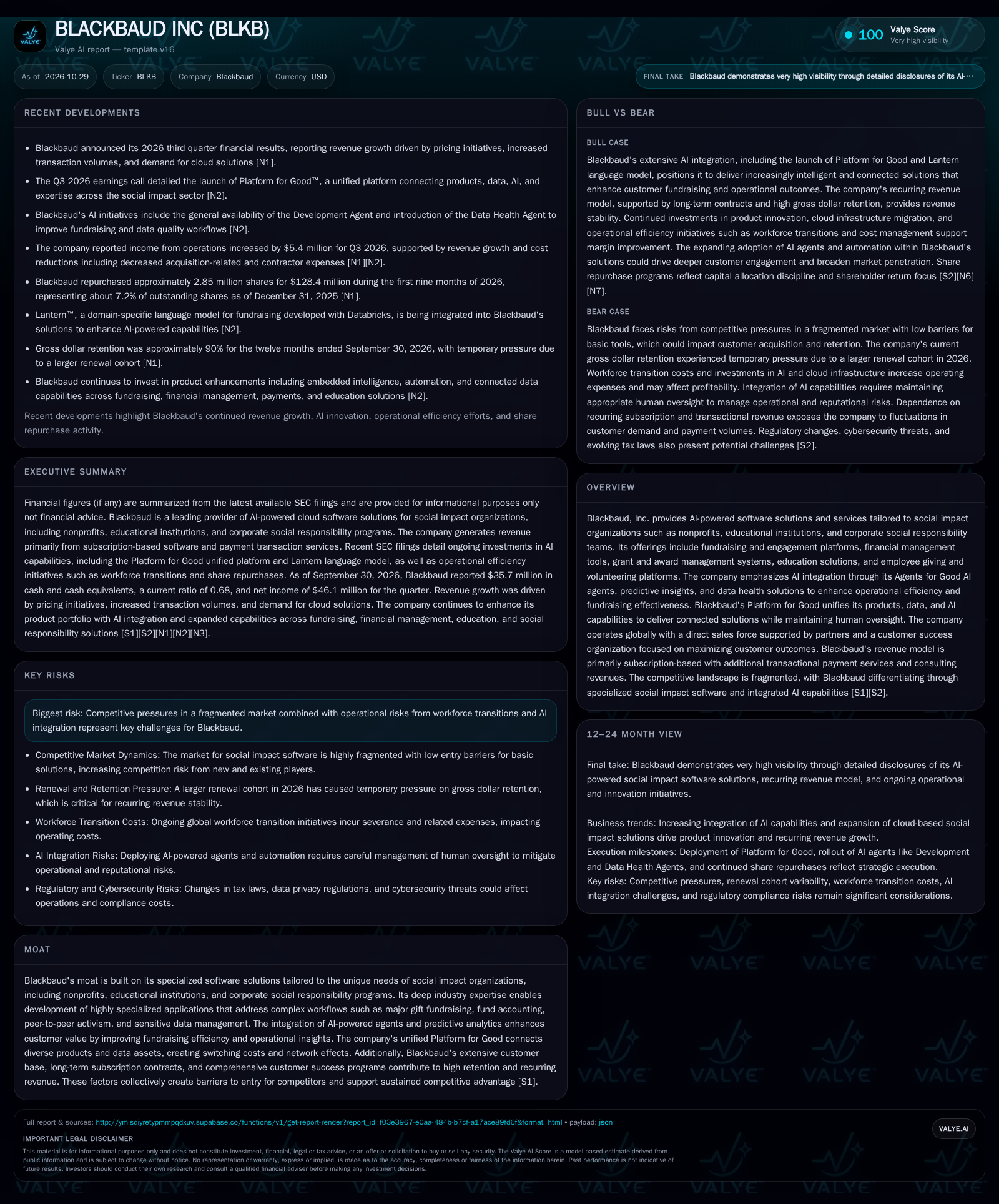
Blackbaud reported 4.1% revenue growth in Q3 2026, supported by pricing, payment volume, and AI-driven cloud solution demand, while gross dollar retention remains near 90% despite renewal cohort headwinds. The company continues to invest in AI integration and platform unification but faces structural competition and cost pressures from workforce transitions and cloud migration. Share repurchases and product innovation signal confidence, yet future margin and retention trajectories will hinge on execution and differentiation in a fragmented market. [S2] [N1] [N2]
Blackbaud stands at a pivotal juncture as it advances deep AI integration and expands its unified platform strategy for the social impact sector. The company’s most recent quarter showed resilient revenue growth and continued margin improvement, underpinned by pricing actions and payment processing strength. Yet, the sustainability of these gains will be tested by competitive fragmentation, evolving customer renewal dynamics, and the operational complexities of workforce realignment and cloud migration. Investors and stakeholders must weigh the promise of differentiated AI-powered solutions against the structural realities of a competitive, rapidly evolving market landscape. [S2] [N1] [N2]
Recent Results Signal Growth, but Pressures on Retention and Cost Structure Remain
Blackbaud reported a 4.1% increase in revenue for the three months ended September 30, 2026, with growth attributed to pricing initiatives, higher payment processing volumes, and increased demand for cloud-based solutions. Income from operations also improved by $5.4 million, benefiting from both revenue growth and cost reductions—particularly in acquisition-related costs and contractor expenses, partially offset by workforce transition spending. However, gross dollar retention was approximately 90%, reflecting temporary pressure from a larger-than-normal renewal cohort in 2026. The company’s balance sheet shows cash and cash equivalents of $35.7 million and a current ratio of 0.68, while nearly $128.4 million was allocated to share repurchases, representing about 7.2% of shares outstanding as of December 31, 2025. The company reported cash and liquidity metrics for the period; these figures do not by themselves establish operating runway, investment capacity, financial flexibility, or financing capacity. [S2] [N1] [N2]
Recurring Revenue Model, Transactional Leverage, and the Economics of Platform Unification
Blackbaud’s primary economic engine is its subscription-based software model, supplemented by payment transaction fees and one-time consulting revenues. The bulk of revenue is contractual and recurring, which can offer high visibility and stability if retention rates remain robust. Payment processing volumes provide additional transactional leverage, with volume growth amplifying incremental margins as fixed platform costs are absorbed. The company’s unified platform strategy—embodied in the Platform for Good—aims to cross-sell and integrate solutions, potentially increasing average revenue per customer and creating switching costs.
Cost structure is a mix of cloud infrastructure expenses, ongoing R&D (especially for AI and data integration), and customer success programs. The current global workforce transition, including the shift to a Global Capability Center in Hyderabad, India, is designed to lower long-term compensation costs and drive operational efficiency. However, these initiatives also produce near-term severance and transition expenses ($8–10 million in 2026) and add complexity to execution. The increasing reliance on public cloud hosting introduces variable costs, but could enable future operating leverage as scale grows. The success of these initiatives will hinge on sustaining high retention, expanding wallet share, and containing the costs of digital and organizational transformation. [S2]
Specialized AI Integration Versus Fragmented Competition and Low Entry Barriers
The social impact software space remains highly fragmented, with low barriers to entry for basic fundraising and CRM tools. Blackbaud’s competitive edge lies in its deep specialization—tailoring solutions to complex nonprofit, educational, and CSR workflows—and in the breadth of its integrated platform. The company differentiates through proprietary AI-powered agents (such as Agents for Good and the Lantern™ model), embedded analytics, and sector-specific compliance and data management capabilities.
However, the market’s fragmentation means that customers have many alternatives, especially for entry-level solutions. Larger software vendors and cloud providers present indirect competition through horizontal platforms, while niche SaaS startups can undercut on price or target specific verticals. Blackbaud’s long-term retention and wallet share will depend on its ability to maintain product leadership in automation, predictive analytics, and workflow integration—areas where AI adoption could create both switching costs and new value for established customers. The question is whether these advantages are sufficient to offset commoditization and renewal risks as digital transformation accelerates across the sector. [S1] [S2]
If AI-Powered Platform Adoption Accelerates, Margins and Retention Could Inflect Higher
The most favorable path for Blackbaud is one in which its unified platform and proprietary AI agents drive both deeper customer engagement and expanded market share. If customers increasingly adopt embedded AI features—such as autonomous workflow execution, predictive fundraising insights, and data health agents—the company could see higher average contract values, improved gross retention, and growing transactional revenue from payment services.
Confirmation of this scenario would include a sustained improvement in gross dollar retention (stabilizing above 92–94%), evidence of successful cross-selling or upselling of AI-powered modules, and a visible reduction in customer churn despite renewal cohort variability. Operating leverage would increase if cloud and workforce transition costs are offset by higher incremental margins from software and payment volume growth. Watch for public case studies or references illustrating that AI integration is driving tangible fundraising or operational outcomes for customers, as this would validate Blackbaud’s differentiation and pricing power.
Resilient Recurring Revenue with Ongoing Renewal and Margin Volatility
The most likely trajectory is that Blackbaud maintains moderate recurring revenue growth, with retention metrics fluctuating around historical norms but not deteriorating materially. Pricing initiatives and incremental demand for cloud and payment solutions continue to support top-line expansion, even as the company works through the operational complexities of workforce transitions and cloud migration. Margin improvement could be gradual, reflecting a balance between ongoing investment in AI/product innovation and the realization of cost efficiencies from organizational restructuring.
Evidence supporting this scenario would be steady gross dollar retention in the high 80s to low 90s, stable or modestly improving operating margins, and continued product launches or enhancements that keep pace with customer expectations. Conversely, a sharp deterioration in retention, persistent cost overruns, or visible delays in AI feature adoption would argue against this middle path.
Competitive Fragmentation and Transition Costs Undercut Retention and Profitability
The greatest risk is that the combination of competitive entry, pricing pressure, and operational transition costs erodes both customer retention and profitability. If renewal cohort headwinds persist or worsen, gross dollar retention could fall below 88%, undermining the predictability of recurring revenue and increasing pressure on acquisition costs. Simultaneously, if the shift to cloud infrastructure and the Hyderabad capability center fails to deliver the anticipated cost savings—due to execution missteps or customer support issues—operating margins could compress further.
This scenario would be confirmed by a sustained decline in retention metrics, negative operating leverage (costs rising faster than revenue), and indications that customers are migrating to lower-cost or more innovative alternatives. Watch for adverse customer feedback, delayed product launches, or negative trends in payment volume growth as early warning signs.
Milestones and Metrics That Will Shape Blackbaud’s Platform-Led AI Thesis
Trajectory of gross dollar retention, especially as the 2026 renewal cohort cycles through—sustained improvement or further deterioration would directly test the durability of Blackbaud’s recurring revenue model.
Adoption rates and upsell/cross-sell penetration of AI-powered features (such as Agents for Good, Data Health Agent, and Lantern™ integrations)—if disclosed, this would clarify whether AI integration is translating into higher customer value and stickiness.
Evidence of margin expansion or contraction as workforce transitions and cloud migration mature—look for trends in operating margin and cost of revenue as a percentage of sales.
Payment processing volume growth—continued acceleration would support the transactional revenue thesis; stagnation could signal saturation or competitive displacement.
Customer churn and new logo acquisition rates (if disclosed)—these would help differentiate between retention-driven and expansion-driven growth.
Progress on Platform for Good deployment and ecosystem integrations—case studies or customer references highlighting tangible workflow or fundraising improvements would validate the product-led growth thesis.
Ongoing capital allocation moves, such as the pace and scale of share repurchases versus reinvestment in R&D—this will reveal management’s confidence in organic growth and margin expansion opportunities.
Any regulatory, cybersecurity, or data privacy incidents—these could introduce new costs or undermine customer confidence, particularly as AI and data integration deepen.
Disclaimer: This is research-only, informational analysis and not investment advice. It may include AI-generated interpretation and general industry context. Always verify important details using primary sources.

Comments