
Annaly Capital’s Dividend Commitment Meets the Realities of Mortgage REIT Volatility
Annaly Capital Management reported a $1.0 billion net loss in Q3 2026 but maintained its quarterly dividend, highlighting management’s focus on shareholder returns even in volatile conditions.
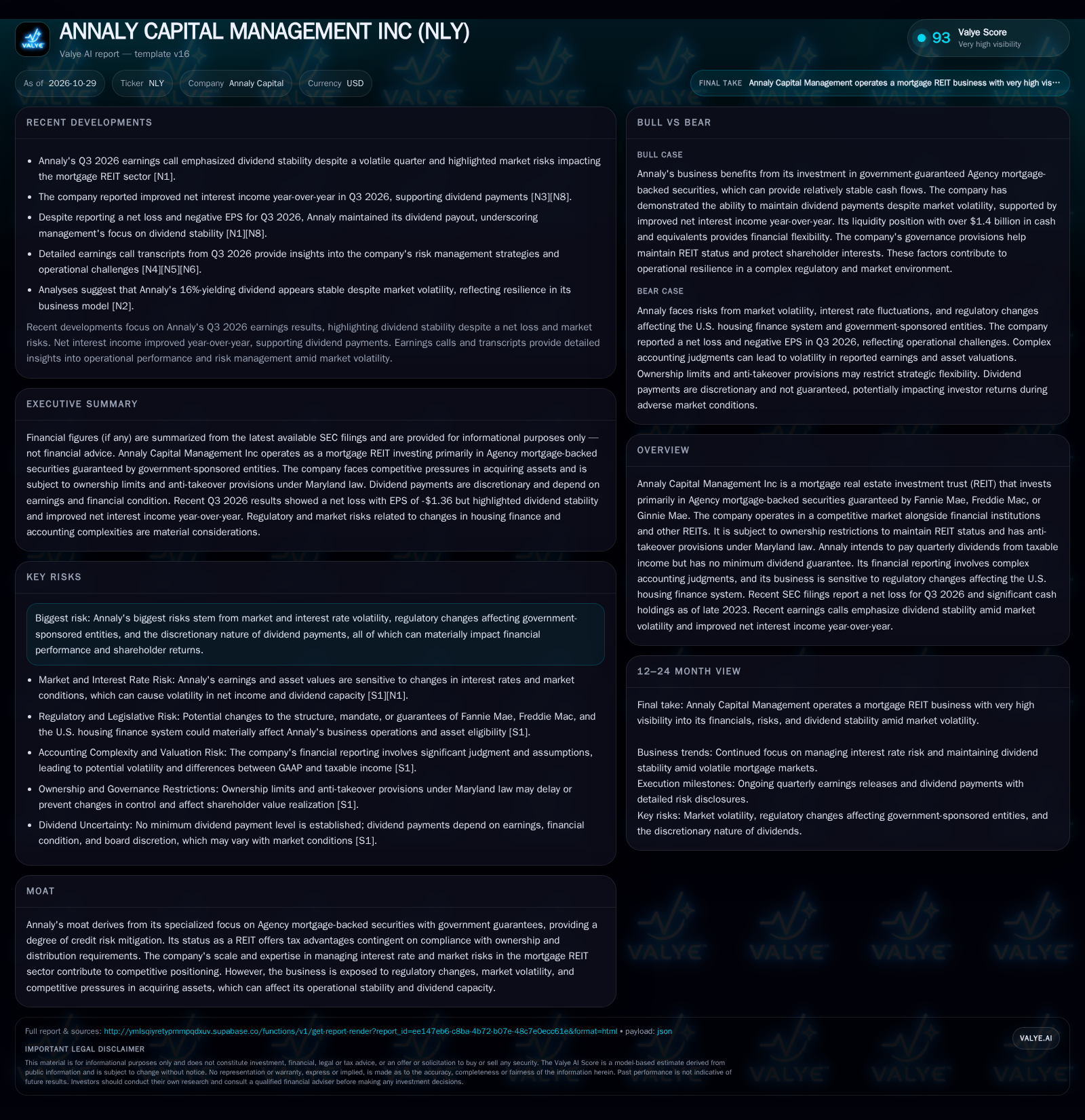
Annaly Capital Management reported a $1.0 billion net loss in Q3 2026 but maintained its quarterly dividend, highlighting management’s focus on shareholder returns even in volatile conditions. The company’s reliance on Agency mortgage-backed securities offers some credit protection, yet exposes it to interest rate and regulatory risks. [S2] [N1] [N8]
Annaly Capital Management, one of the largest mortgage REITs in the U.S., is navigating a period of heightened volatility. Despite posting a $1.0 billion net loss for Q3 2026, the company maintained its quarterly dividend, underscoring management’s focus on payout reliability even as market and regulatory risks loom large. The tension for investors is clear: Annaly’s strategy of leveraging Agency mortgage-backed securities for income depends on stable policy and manageable interest rate dynamics—both of which are increasingly uncertain. The next phase for Annaly will hinge on its ability to adapt its risk and capital management to sustain dividends without eroding long-term value. [S2] [N1] [N8]
Dividend Stability Amidst Reported Losses: What Recent Results Reveal
Annaly Capital Management reported a net loss of approximately $1.0 billion for Q3 2026, with basic and diluted EPS of -$1.36, a result that underscores the volatility inherent in the mortgage REIT sector. Despite this negative headline figure, management chose to maintain the company’s quarterly dividend, emphasizing payout stability even as earnings metrics came under pressure. This decision highlights the central role of the dividend in Annaly’s value proposition to shareholders, but also raises questions regarding the sustainability of distributions when GAAP losses are material. The company reported cash and liquidity metrics for the period; these figures do not by themselves establish operating runway, investment capacity, financial flexibility, or financing capacity. [S2] [N1] [N8]
The cited source reports dividend-related activity; that disclosure alone does not establish dividend-policy continuity, management confidence, or a material constraint on capital flexibility. From a financial management perspective, sustaining dividends during loss periods often signals management’s commitment to signaling stability, yet it may also strain liquidity if not supported by robust cash flows. The interplay between reported accounting losses and actual cash generation is critical; if operating cash flows remain positive, the dividend can be maintained without jeopardizing financial health. However, if losses translate into cash deficits, the firm risks depleting reserves or increasing leverage, which could impair long-term sustainability.
How Annaly’s Agency MBS Focus Shapes Earnings and Risk
Annaly’s core business model involves leveraging capital to acquire Agency mortgage-backed securities (MBS) guaranteed by government-sponsored entities. The cited source reports dividend-related activity; that disclosure alone does not establish dividend-policy continuity, management confidence, or a material constraint on capital flexibility. While Agency MBS mitigate credit risk due to government guarantees, the business remains highly sensitive to changes in interest rates, prepayment speeds, and funding costs. Operating leverage is significant: small shifts in the yield curve or funding rates can dramatically alter net income due to the portfolio’s scale and the use of leverage.
Annaly’s economics are further complicated by the requirement to distribute substantially all taxable income to maintain REIT status. This constraint means that retained earnings are limited, making external capital markets critical for growth and balance sheet flexibility. Accounting differences between GAAP and taxable income also introduce volatility into reported results and dividend coverage, making cash flow management and hedging strategies central to the company’s financial health. [S1]
The reliance on Agency MBS inherently ties Annaly’s earnings to the shape and dynamics of the yield curve, making interest rate risk management paramount. Given the sensitivity of prepayment speeds to interest rate fluctuations, the company’s portfolio performance can be materially affected by shifts in borrower behavior, which are difficult to predict and hedge perfectly. Moreover, the leverage employed amplifies both gains and losses, necessitating sophisticated risk analytics and dynamic hedging strategies. The interaction between regulatory constraints, such as REIT distribution requirements, and market-driven income volatility creates a complex environment where capital allocation decisions must weigh short-term income needs against long-term balance sheet resilience.
Annaly’s Competitive Edge and the Limits of Scale in Mortgage REITs
Annaly competes with a broad array of institutions—other REITs, banks, insurance companies, and asset managers—for Agency MBS and related assets. Its advantages stem from scale, operational expertise in risk management, and the ability to access capital markets at competitive rates. The focus on Agency MBS provides a degree of safety relative to credit risk, but offers limited differentiation versus other large mortgage REITs.
Counterforces include the commoditized nature of Agency MBS, regulatory and policy uncertainty, and competition for assets when spreads compress. Changes in GSE policy or the structure of U.S. housing finance could erode the value of Annaly’s specialized expertise. Substitutes—such as direct fixed-income investment or other types of real estate exposure—may become more attractive to investors if mortgage REIT returns become less compelling or more volatile. [S1]
While scale provides cost advantages and access to capital, it also introduces challenges in portfolio agility and responsiveness to market signals. Larger mortgage REITs like Annaly may face diminishing marginal returns when deploying additional capital into Agency MBS, especially during periods of spread compression. The commoditized nature of the underlying assets limits differentiation, making operational efficiency and risk management capabilities the primary competitive levers. Additionally, regulatory frameworks that protect REIT status can inadvertently restrict strategic flexibility, such as limitations on asset diversification or shareholder composition, potentially constraining the company’s ability to innovate or pivot in response to evolving market conditions.
Interest Rate Stability and Policy Support Could Revitalize Earnings Power
If the interest rate environment stabilizes and spreads between Agency MBS yields and funding costs widen, Annaly could see a significant recovery in net interest income. Additional upside could emerge if policymakers reaffirm the long-term viability of GSE guarantees, reducing regulatory uncertainty and supporting investor confidence.
Confirmation of this scenario would be visible in improved quarterly net income, positive EPS, and a dividend payout ratio comfortably below recurring earnings. Narrower GAAP-taxable income discrepancies and reduced portfolio volatility would further support the thesis. Conversely, persistent spread compression or policy headwinds would falsify this upside. [N3] [N8]
Dividend Model Endures but Remains at the Mercy of Volatile Markets
The most plausible trajectory is that Annaly continues to generate uneven but positive net interest income, using a combination of hedging and portfolio adjustments to navigate a volatile but not catastrophic market. Dividend payments are maintained but may be periodically adjusted downward if GAAP losses persist or taxable income falls below expectations. The company’s scale and liquidity buffer allow it to manage through occasional drawdowns, but not without periodic pressure on book value and payout ratios.
Confirmation would come from management commentary and earnings reports emphasizing risk management and capital discipline. Falsification would require either a sustained inability to cover dividends with recurring earnings or a regulatory shock that undermines the business model. [S2] [N1] [N4] [N5] [N6]
Regulatory Shocks or Funding Dislocation Could Force a Dividend Reset
A more adverse outcome could materialize if regulatory changes reduce or eliminate Agency MBS guarantees, or if a sharp rise in funding costs outpaces asset yields. Liquidity could become constrained if capital markets tighten, potentially forcing asset sales at unfavorable prices and compounding losses.
Confirmation of this downside would be evident in multiple consecutive quarters of large GAAP and taxable losses, dividend cuts or suspensions, and negative management guidance. A widening gap between funding costs and asset yields, or new legislation affecting GSEs, would further validate this scenario. [S1] [S2] [N1]
Signals That Will Clarify the Durability of Annaly’s Dividend Model
Quarterly net income and EPS trends: Persistent negative results would call the dividend sustainability into question. [S2]
Dividend payout ratio relative to both GAAP and taxable income: A useful metric would be the degree to which payouts are covered by recurring earnings, as opposed to capital or one-time gains.
Spread between Agency MBS yields and funding costs: If disclosed, this would illuminate core earnings power and risk.
Book value per share: Continued declines signal market stress and capital erosion.
Leverage metrics (debt-to-equity, portfolio leverage): A rising trend may indicate risk-taking or stress.
Management commentary on regulatory and policy risks: Specific disclosures regarding GSE reform or housing finance proposals would help test the thesis.
Changes in portfolio composition: Significant shifts away from Agency MBS could indicate a strategic pivot or response to adverse conditions. [S1]
Disclaimer: This is research-only, informational analysis and not investment advice. It may include AI-generated interpretation and general industry context. Always verify important details using primary sources.

Comments