
Mirion Technologies: Installed Base, Regulatory Moats, and the Next Phase of Nuclear and Medical Expansion
Mirion leverages a dominant installed base in nuclear and medical radiation safety, but faces shifting market dynamics as it integrates recent acquisitions, navigates supply chain and regulatory risks, and seeks growth in emerging reactor and healthcare segments.
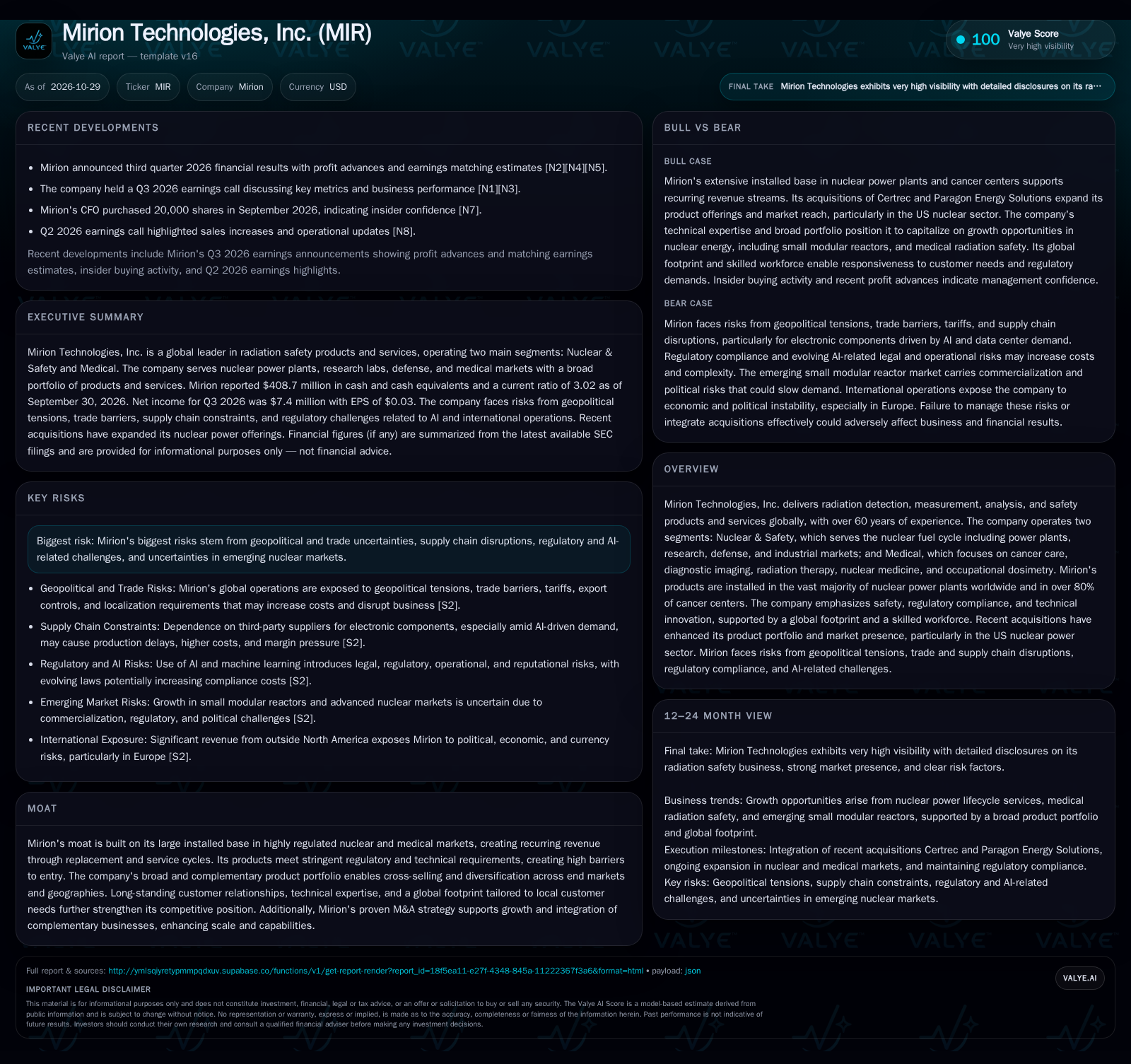
Mirion Technologies maintains a powerful position in radiation safety for nuclear and medical markets, supported by a vast installed base and recurring service opportunities. Recent acquisitions broaden its US nuclear footprint, but ongoing exposure to geopolitical, supply chain, and regulatory risks—especially around AI and international operations—shape both upside and downside scenarios. The next phase depends on successful integration, continued innovation, and the pace of adoption in new nuclear and medical segments. [S1] [S2] [N1] [N2] [N4] [N5]
Mirion Technologies stands at a pivotal moment, wielding one of the largest installed bases in radiation safety equipment for both nuclear and medical markets. Its reach into over 98% of nuclear power plants and 80% of cancer centers worldwide enables recurring revenues and entrenched customer relationships, giving the business resilience in highly regulated sectors. However, as the company integrates new acquisitions and adapts to rapidly evolving markets—including small modular reactors and AI-driven healthcare workflows—it must also navigate acute risks from geopolitics, regulatory change, and supply chain disruptions. The coming quarters will test whether Mirion can translate its entrenched position into sustainable, innovation-driven growth.
Recent Performance, Balance Sheet Strength, and Strategic Moves
The company reported cash and liquidity metrics for the period; these figures do not by themselves establish operating runway, investment capacity, financial flexibility, or financing capacity. [S2]
Q3 2026 net income reached $7.4 million with basic and diluted EPS of $0.03, matching consensus estimates and marking a period of profit advances [S2] [N2] [N4] [N5].
The acquisitions of Certrec Corporation and Paragon Energy Solutions in the second half of 2025 have enhanced Mirion’s offerings for the US nuclear power sector, potentially deepening its product stack and client engagement in a market with high regulatory and technical demands [S1].
Approximately 37% of net sales in 2025 came from outside North America, underscoring Mirion’s dependence on international markets and exposing it to currency, political, and economic risks [S2].
Installed Base Drives Recurring Revenue, but Growth Hinges on Adoption and Integration
Mirion’s economics are anchored in its vast installed base—over 98% of nuclear power plants and 80% of cancer centers globally utilize its products—which supports ongoing revenue through service, maintenance, upgrades, and replacement cycles [S1]. This creates a foundation of recurring, high-visibility revenue streams, particularly in markets with strict safety and regulatory requirements.
The business is divided into two segments: Nuclear & Safety (serving the nuclear fuel cycle, research, defense, and industrial end-markets) and Medical (focused on radiation therapy, diagnostic imaging, and occupational dosimetry). While the Nuclear & Safety segment likely features longer sales cycles and higher initial capital outlays, the Medical segment may offer more frequent but lower-ticket sales with potential for subscription or service-based models—though contract terms and pricing structures are not detailed in the current disclosures.
Capital intensity is moderate to high due to the need for continuous R&D, compliance, and the technical complexity of Mirion’s product offerings. The company’s global footprint with facilities in 12 countries enables proximity to regulated customers but also adds overhead and operational complexity [S1].
Operating leverage is plausible: incremental revenue from the installed base and new product extensions should drive margin expansion if service contracts and software integration scale without proportional increases in cost. However, acquisitions and international expansion could create periods of margin compression as integration costs and regulatory compliance expenses rise.
Regulation, Technical Complexity, and Installed Base as Structural Defenses—But Not Immunity
Mirion’s strongest competitive advantages lie in regulatory entrenchment, technical complexity, and the sheer scale of its installed base. High barriers to entry in both nuclear and medical radiation safety stem from rigorous certification requirements, long qualification cycles, and end-user aversion to switching due to safety and compliance risks.
The company’s portfolio breadth and history of cross-selling into both nuclear and healthcare settings further reinforce customer stickiness. Its reputation as a trusted provider in highly regulated markets—where failure carries existential risk for customers—makes displacement difficult for new entrants or low-cost alternatives [S1].
However, Mirion is not immune to competitive pressure. Large industrial conglomerates, specialized medical device firms, and emerging players in digital radiation monitoring or AI-enabled diagnostics may target niches within Mirion’s markets. The risk from substitutes is most acute where digital or software-driven solutions could displace hardware-centric approaches, or where new nuclear technologies (e.g., SMRs, advanced reactors) prompt customers to reevaluate incumbent vendors.
The company’s M&A track record is a source of strength but also a potential point of vulnerability if integration falters or if acquired businesses do not deliver expected synergies.
Leveraging Installed Base and Acquisitions to Capture Nuclear and Medical Market Expansion
The most optimistic scenario sees Mirion capitalizing on its entrenched positions by deepening wallet share in existing nuclear and medical accounts while expanding into emerging segments such as small modular reactors (SMRs) and advanced radiation therapies.
Successful integration of Certrec and Paragon Energy Solutions could unlock new cross-selling and bundled solution opportunities, particularly in the US nuclear sector where regulatory and technical hurdles are high and Mirion’s reputation is already strong [S1].
If the company can deploy new AI-driven products that enhance safety, compliance, and workflow efficiency—without triggering regulatory backlash—it may further differentiate itself and open higher-margin, software-enabled revenue streams.
Evidence confirming this scenario would include accelerated revenue growth from newly acquired businesses, rising share of software and services in the revenue mix, contract wins in SMR projects, and margin expansion despite integration costs.
Sustaining Share in Mature Markets While Managing Integration and Regulatory Complexity
The most plausible trajectory is continued dominance in core nuclear and medical markets, with the installed base supporting stable, recurring revenue and incremental growth from new product introductions and periodic upgrades.
Integration of Certrec and Paragon is successful but not transformational; these businesses bolster the US footprint and regulatory capabilities but do not radically change the revenue or margin profile.
Growth in SMRs and advanced reactors remains modest over the next few years, as commercialization and regulatory hurdles slow mass adoption, but Mirion establishes a credible foothold in pilot projects.
Operational risks—such as supply chain disruptions and evolving AI regulations—are managed but remain a persistent drag on margin improvement.
Supply Chain and Regulatory Shocks Undermine Margin and Delay Growth Ambitions
A downside scenario unfolds if Mirion’s exposure to geopolitical tensions, supply chain disruptions (especially for electronic components), and rapidly evolving AI and data privacy regulations results in unexpected costs, project delays, or contractual penalties [S2].
Failure to integrate recent acquisitions could lead to operational inefficiencies, customer attrition, or one-time charges that offset any revenue gains from expanded offerings.
Intensified competition or technological substitution—particularly from software-first entrants or low-cost international suppliers—could erode pricing power, especially in less regulated or emerging markets.
This scenario would be evidenced by margin contraction, missed earnings, project delays in SMR or medical rollouts, and announcements of regulatory investigations, penalties, or significant supply chain interruptions.
What Will Determine Whether Mirion Converts Its Moat Into Sustainable Growth?
Pace and quality of integration for Certrec and Paragon Energy Solutions—watch for synergies, cross-selling wins, or operational hiccups in coming quarters.
Revenue contribution and margin profile of emerging SMR and advanced reactor projects, if disclosed, as a test of new market penetration.
Growth in software, digital, and AI-enabled solution revenue as a percentage of total sales—would help confirm progress in higher-margin, recurring offerings.
Impact of supply chain constraints—especially electronic component shortages—on project delivery timelines and gross margin.
Changes in regulatory environment for AI and radiation safety, including new compliance costs or restrictions that could affect product launches or operational flexibility.
International revenue mix and profitability, particularly in Europe and Asia, given geopolitical and currency risk exposure.
Retention rates, service contract renewal rates, or customer churn in both nuclear and medical segments, if disclosed, to gauge the strength and stickiness of Mirion’s installed base.
Any major safety, compliance, or product quality incidents that could impair trust or trigger regulatory intervention.
Disclaimer: This is research-only, informational analysis and not investment advice. It may include AI-generated interpretation and general industry context. Always verify important details using primary sources.

Comments