
Sprouts Farmers Market Confronts Liquidity Strains and Supply Chain Changes in Specialty Grocery Sector
The next phase will test whether operational adjustments and customer engagement efforts can offset margin pressures and execution risks in a crowded natural foods market.
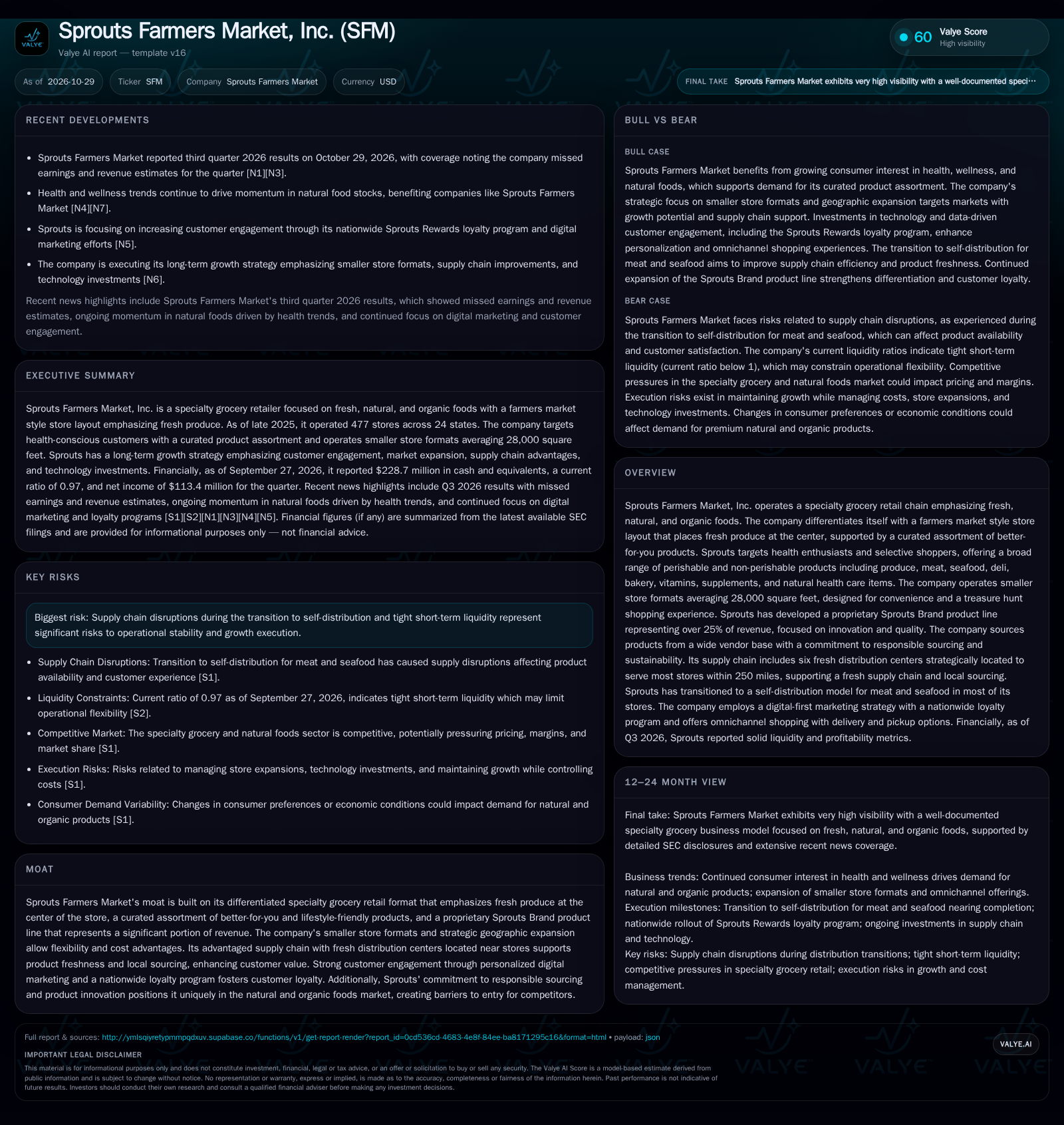
Sprouts Farmers Market missed Q3 2026 earnings and revenue estimates, highlighting pressures from supply chain transitions and tight short-term liquidity (current ratio of 0.97). The company’s specialty positioning—centered on fresh, natural, and organic foods, proprietary Sprouts Brand products, and smaller store formats—remains its core advantage. However, the success of supply chain self-distribution, digital engagement, and disciplined expansion will determine whether Sprouts can defend margins and grow profitably in a competitive sector. Watch for stabilization in distribution, cash flow trends, and traction in loyalty-driven sales as key signals for the thesis. [S2] [N1] [N3] [N5]
Sprouts Farmers Market, Inc. stands at a crossroads. Its specialty focus on fresh, natural, and organic foods and a proprietary product portfolio have helped it carve a distinctive niche in the crowded U.S. grocery landscape. These crosscurrents raise the stakes on Sprouts’ ability to execute its growth strategy, leverage its brand and customer engagement investments, and maintain margins as competition in the natural foods sector intensifies. The next year will likely reveal whether its differentiated model can deliver sustainable profitability or if execution risks and financial constraints will limit its trajectory. [S2] [N1] [N3]
Execution and Liquidity Issues Mark Recent Performance
Sprouts Farmers Market reported Q3 2026 results that fell short of both earnings and revenue expectations, underscoring operational headwinds as the company implements strategic changes. This period also saw the company continuing its transition to self-distribution for meat and seafood, a move intended to bolster supply chain efficiency and freshness but one that has introduced supply disruptions and customer experience risks. These facts frame the current inflection point: Sprouts must stabilize operations and cash flows while navigating execution risk in a competitive and margin-sensitive sector. [S2] [N1] [N3]
Revenue and Margin Dynamics in Sprouts’ Business Model
Sprouts’ core business model is built on specialty grocery retailing: smaller-format stores averaging 28,000 square feet, with a pronounced focus on fresh produce and a curated assortment of natural and organic products. The proprietary Sprouts Brand product line, now over 25% of revenue, is critical to both differentiation and potential margin expansion—private label typically offers higher gross margins than branded alternatives, assuming effective sourcing and brand resonance.
Revenue growth depends on a mix of new store openings, same-store sales (driven by traffic and basket size), and increased penetration of higher-margin private-label products. However, the economics are sensitive to product mix (perishables vs. shelf-stable), supply chain efficiency, and the ability to command premium pricing without sacrificing volume. Fixed costs are significant due to store operations and distribution infrastructure, but the smaller store format may provide some flexibility and lower per-store breakeven sales levels compared to traditional supermarkets.
Recent supply chain investments—most notably, the shift to self-distribution for meat and seafood—could unlock long-term cost savings and fresher inventory, but the near-term impact has been disruptive. If these transitions are not executed smoothly, they risk inventory losses, higher shrink, and customer attrition. [S2]
Maintaining a Specialty Niche Amid Growing Natural Foods Competition
Sprouts competes in a dynamic landscape, facing direct specialty players, traditional supermarkets expanding their organic offerings, mass merchants, and e-commerce grocers. Its differentiation lies in the farmers market store experience, curated selection, and the Sprouts Brand private label. These elements foster customer loyalty among health-conscious and value-seeking segments.
However, competitive counterforces are intensifying. Larger chains leverage scale for lower procurement costs and can cross-subsidize organics; digital grocers and delivery platforms have eroded location-based moats; and consumer price sensitivity, especially during economic slowdowns, can compress premiums for natural or specialty assortments. The shift to omnichannel and digital-first marketing, including the Sprouts Rewards program, is a necessary adaptation, but not a guaranteed moat. Customer switching costs remain low absent unique products or deeply embedded loyalty, and the risk of commoditization in organics/natural foods is rising as mainstream players ramp up their own offerings.
Margin Gains Possible if Supply Chain Stabilizes and Loyalty Strengthens
The most favorable outcome for Sprouts hinges on successfully executing its supply chain transformation—completing the shift to self-distribution, reducing shrink, and improving freshness—thereby unlocking gross margin gains and customer satisfaction. If the Sprouts Brand continues to grow as a share of revenue and proves able to command a premium, the company could see an uplift in both basket size and profitability.
A strong digital engagement strategy, with the Sprouts Rewards loyalty program driving personalized offers and repeat visits, could further boost same-store sales and customer lifetime value. Confirmation of this scenario would show up in stabilized or rising gross margins, improved inventory turns, positive comparable-store sales growth, and higher loyalty program participation. Falsification would come from continued supply disruptions, stagnant or shrinking margins, or evidence that competitive encroachment is eroding traffic and pricing power.
Growth Goals Meet Operational and Financial Constraints
The most plausible trajectory is one of cautious, disciplined expansion and operational stabilization. Sprouts is likely to focus on incremental new store growth in proven geographies, continued penetration of Sprouts Brand products, and measured investment in digital and supply chain capabilities. Liquidity constraints may force a slower pace of technology upgrades or store refreshes, but the company could still defend its core niche if it executes well on logistics, maintains a differentiated assortment, and avoids major supply shocks.
In this scenario, the company posts modest same-store sales growth, maintains or slightly improves gross margins, and keeps SG&A in check. Evidence supporting this outcome would be steady cash flows, a stabilized current ratio, and minimal supply chain disruptions. Signs of overextension, rising costs, or persistent competitive losses would falsify the base case.
Margin Pressure Arises from Supply Chain and Liquidity Challenges
The adverse scenario is one where execution falters: ongoing supply chain disruptions from the self-distribution rollout lead to persistent product shortages, higher shrink, and customer attrition. Tight liquidity restricts the company’s ability to respond—whether by investing in operational fixes, absorbing cost increases, or launching new initiatives—potentially forcing Sprouts to slow store openings or cut back on marketing and technology.
If competitors aggressively discount or expand their natural/organic assortments, Sprouts could face price wars that erode margin, especially if it cannot differentiate on unique product or experience. Confirmation of this scenario would include declining same-store sales, falling gross margins, negative cash flow trends, and deteriorating liquidity metrics. Falsification would require clear evidence of supply chain stabilization, margin recovery, and renewed traffic growth.
Factors Influencing Sprouts’ Specialty Market Position
Progress and stability in the transition to self-distribution for meat and seafood, as measured by supply chain costs, shrink rates, and in-stock positions (if disclosed).
Quarterly trends in gross margin and inventory turnover, which would indicate whether operational efficiencies are materializing or if disruptions are eroding profitability.
Participation and sales penetration of the Sprouts Rewards loyalty program, which would help test traction in digital engagement and customer retention.
Same-store sales growth or traffic/basket size trends, as indicators of competitive position and the effectiveness of assortment and marketing strategies.
Pace and success of new store openings, especially in new or existing markets, as a proxy for growth execution and market acceptance.
Competitive pricing actions and assortment changes from both specialty and mainstream grocers, which may signal intensifying price or margin pressures.
Customer satisfaction metrics and feedback, particularly related to product availability, freshness, and experience during the supply chain transition (if disclosed).
Disclaimer: This is research-only, informational analysis and not investment advice. It may include AI-generated interpretation and general industry context. Always verify important details using primary sources.

Comments