
T-Mobile’s 5G Scale, Customer-Centric Strategy, and the Next Phase of Telecom Competition
T-Mobile’s Q3 2026 outperformance and raised guidance reinforce its leadership in U.S. 5G infrastructure and customer experience, but competitive, cybersecurity, and operational shifts signal a pivotal period ahead. The company’s ability to translate network and digital investments into sustainable economics and defend its position against evolving alternatives will define its next chapter.
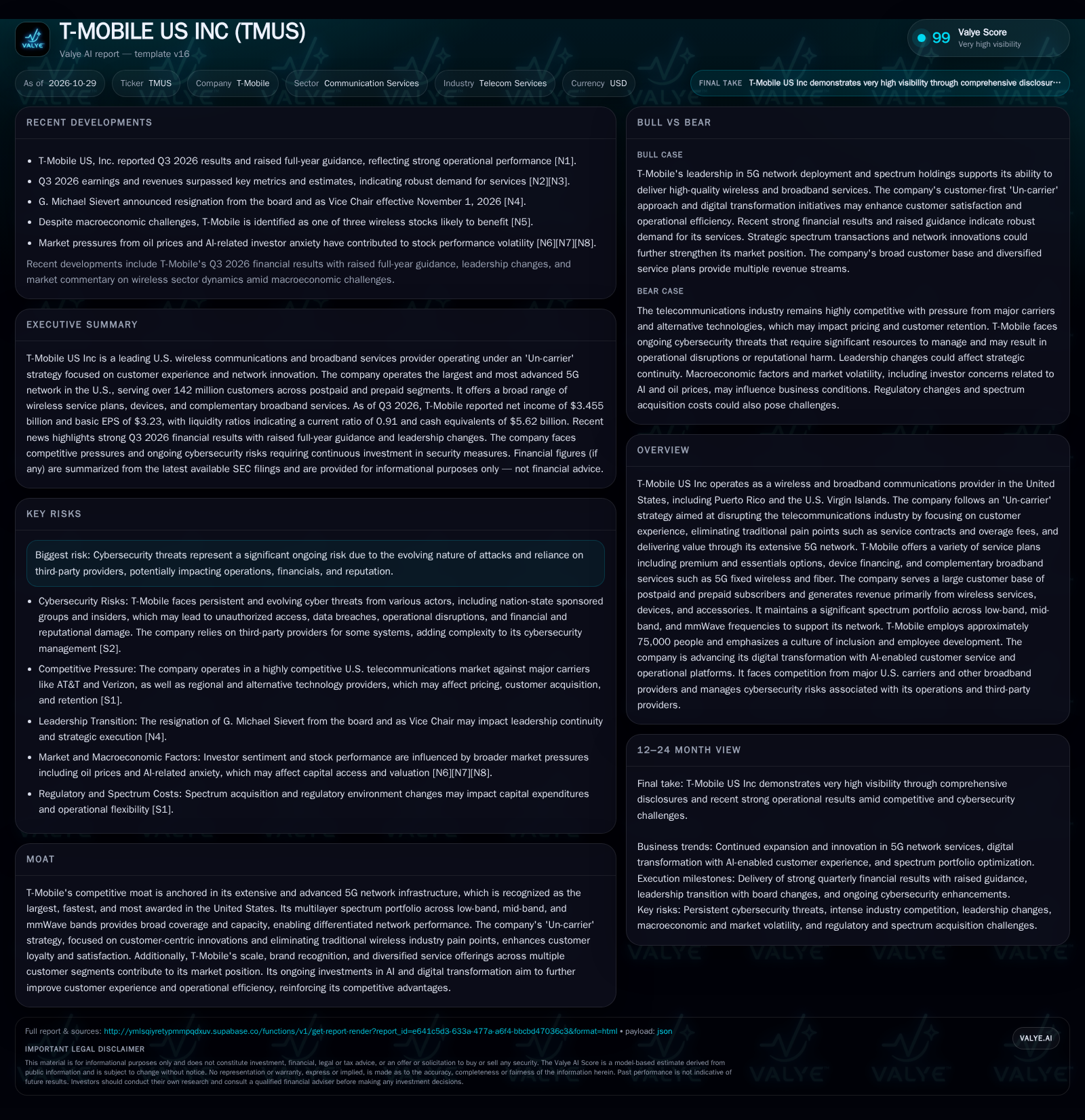
T-Mobile delivered strong Q3 2026 results, raising full-year guidance and demonstrating robust demand. The company’s leadership in 5G, spectrum holdings, and its ‘Un-carrier’ strategy underpin its market position, but it faces intensifying competition, ongoing cybersecurity risks, and a leadership transition. The durability of its economics will depend on execution in digital transformation, customer retention, and capital discipline as industry dynamics evolve. [N1] [N2] [N3] [N4]
T-Mobile’s third-quarter 2026 results underscore its operational momentum, with both earnings and revenues surpassing analyst expectations and prompting a raised full-year outlook. The company’s scale in 5G network deployment, spectrum breadth, and customer-centric ‘Un-carrier’ strategy have cemented its leadership among U.S. telecoms. However, a confluence of factors—including a high-profile leadership change, relentless industry competition, and persistent cybersecurity threats—pose new tests for the business. The challenge now is whether T-Mobile can maintain its growth trajectory and economic resilience as the telecom landscape shifts, digital transformation accelerates, and alternative broadband technologies vie for share.
Q3 2026 Outperformance and Strategic Inflection
T-Mobile’s Q3 2026 financial results stand out, with net income of $3.455 billion and basic EPS of $3.23, both exceeding key estimates and driving management to raise full-year guidance. This operational strength signals that T-Mobile is capitalizing on robust demand for wireless and broadband services, likely aided by the breadth and quality of its 5G network and the continued appeal of its customer-first ‘Un-carrier’ branding. The company now serves more than 142 million customers across postpaid and prepaid segments, reflecting both scale and a degree of resilience in subscriber growth. [N1] [N2] [N3] [S2]
Leadership transition introduces potential strategic uncertainty: G. Michael Sievert’s resignation from the board and as Vice Chair, effective November 1, 2026, marks a significant change at the top of the organization. The timing, coming on the heels of strong results, puts additional focus on how successor leadership will navigate T-Mobile’s next phase. [N4]
Liquidity ratios as of Q3 2026 show cash equivalents of $5.62 billion and a current ratio of 0.91. The company reported cash and liquidity metrics for the period; these figures do not by themselves establish operating runway, investment capacity, financial flexibility, or financing capacity. [S2]
How T-Mobile Converts Network Scale Into Revenue Streams
T-Mobile’s core economic engine is its wireless service revenue, driven by a mix of postpaid and prepaid plans. The company’s scale—serving over 142 million customers—supports significant operating leverage, as fixed network investments (including spectrum acquisition and infrastructure build-out) are amortized across a broad subscriber base. Pricing power is influenced by the company’s network quality, breadth of service options, and the ‘Un-carrier’ approach that positions T-Mobile as a disruptor of traditional telecom pain points such as contracts and overage fees.
Device sales (including financing arrangements) and complementary broadband offerings—such as 5G fixed wireless and emerging fiber solutions—provide incremental revenue streams but are typically lower margin or more capital-intensive than core wireless service. The economics of fixed wireless depend on customer acquisition costs, usage patterns, and the ability to monetize excess network capacity without eroding margins or cannibalizing higher-value mobile subscriptions.
T-Mobile’s ongoing digital transformation, including AI-enabled customer service and operational platforms, is designed to reduce service costs, improve retention, and enhance cross-selling. If successful, these initiatives could shift the cost structure toward greater efficiency and enable more flexible go-to-market models. However, persistent capex needs (notably spectrum and infrastructure upgrades) and the need for ongoing cybersecurity investment remain significant drains on free cash flow, and the capital intensity of the business will continue to shape its financial profile.
Defending the Moat: 5G Differentiation and Industry Counterforces
T-Mobile’s competitive advantages rest on its extensive 5G network (the largest and most advanced in the U.S.), a multi-layer spectrum portfolio (low-band, mid-band, and mmWave), and a brand built on customer-centric disruption. These assets enable differentiated network performance and broad coverage, which are particularly attractive to both consumers and enterprise clients seeking reliable, high-speed connectivity.
However, T-Mobile faces sustained pressure from other national carriers—most notably AT&T and Verizon—who are themselves investing heavily in network upgrades and spectrum. Alternative broadband providers, including cable operators and fixed wireless entrants, are also targeting segments of T-Mobile’s addressable market, particularly in home broadband and small business. The risk is that price-based competition and technological substitution (such as fiber-to-the-home or satellite broadband) could limit T-Mobile’s pricing flexibility or slow customer growth.
Switching costs in telecom are meaningful but not insurmountable; device financing, family plans, and bundled services create friction, but regulatory and industry practices (such as number portability and promotional incentives) can erode customer stickiness. T-Mobile’s ongoing investment in digital transformation and customer experience is an attempt to reinforce loyalty and reduce churn, but the effectiveness of these efforts will be tested as the market matures and new alternatives proliferate.
If Digital Transformation Drives Retention and Margin Expansion
The most favorable outcome for T-Mobile involves its AI-enabled platforms and customer-centric innovations successfully lowering churn, increasing cross-sell rates, and reducing support costs. In this scenario, digital investments—particularly in automated service and operational efficiency—translate into measurable operating leverage, allowing T-Mobile to defend pricing and expand margins even as competition intensifies.
Continued 5G network leadership, combined with effective monetization of fixed wireless and emerging broadband products, could further diversify revenue and enhance average revenue per user (ARPU). If T-Mobile can leverage its scale to negotiate better device and equipment terms, and if its spectrum portfolio continues to yield superior network performance, the company could maintain or even grow share in both consumer and enterprise segments.
Evidence that would confirm this scenario includes sustained declines in churn (if disclosed), improvement in ARPU, and operating margin expansion outpacing peers. Acceleration in fixed wireless net adds and strong digital engagement metrics would also support the thesis that T-Mobile’s digital transformation is yielding tangible economic benefits.
Sustained Growth Amid Competitive and Capital Pressures
The most plausible near-term trajectory for T-Mobile is continued growth in its core wireless business, incremental gains in broadband, and gradual operational improvement from digital initiatives. Revenue and profit growth may moderate as the 5G upgrade cycle matures and as price competition from rivals and alternative providers intensifies. Capital expenditures for spectrum and network upgrades will remain high, offsetting some of the benefits of scale-driven operating leverage.
Customer acquisition and retention will remain a battleground, with T-Mobile’s ‘Un-carrier’ positioning and network quality helping to preserve share, but not fully insulating the company from industry churn or pricing pressure. The company’s large customer base and diversified service offerings provide some buffer against macroeconomic headwinds, but margin expansion could be constrained by the need for ongoing investment in cybersecurity, digital transformation, and network infrastructure.
Evidence supporting this scenario would include stable or modestly improving subscriber metrics, sustained service revenue growth, and maintenance of current operating margins. Conversely, a sharp uptick in churn, margin compression, or slowing broadband net adds would challenge the base case.
When Competition, Cyber Threats, or Strategic Disruption Erode Momentum
The adverse scenario unfolds if T-Mobile’s digital transformation fails to deliver cost or retention benefits, or if the competitive environment intensifies beyond expectations—leading to higher churn, ARPU pressure, and stalled broadband growth. Aggressive pricing from rivals, technological substitution (such as rapid fiber or satellite broadband adoption), or regulatory changes could further squeeze margins and slow customer acquisition.
Cybersecurity remains a material risk: a significant breach, operational disruption, or reputational event could result in customer attrition, regulatory penalties, or elevated costs. Leadership transition risk is also non-trivial—if new management fails to maintain strategic clarity or execution discipline, T-Mobile could lose ground in both network innovation and customer experience.
Evidence of downside would include rising churn, declining ARPU, negative subscriber growth, unexpected increases in cybersecurity or regulatory costs, or material delays/disruptions in digital transformation projects.
What Will Reveal the Staying Power of T-Mobile’s Model
Trends in postpaid and prepaid churn rates (if disclosed), as these will test the effectiveness of T-Mobile’s digital and customer experience investments.
ARPU trajectory across both wireless and broadband segments, indicating the company’s ability to defend or expand pricing.
Net additions in fixed wireless and broadband products, which would show whether T-Mobile can successfully diversify revenue beyond core mobile services.
Progress and cost-effectiveness of digital transformation initiatives—metrics such as digital engagement rates, AI-driven support resolution, or cost per interaction would illuminate operational leverage if disclosed.
Capital expenditures relative to guidance, particularly for spectrum and network, as a signal of ongoing investment discipline versus the risk of overextension.
Incidence, impact, and resolution of cybersecurity events, as these could materially alter customer trust, regulatory profile, and cost structure.
Strategic direction and execution clarity following the leadership transition, including any changes in capital allocation, market positioning, or innovation priorities.
Disclaimer: This is research-only, informational analysis and not investment advice. It may include AI-generated interpretation and general industry context. Always verify important details using primary sources.

Comments