
Boyd Gaming’s Liquidity Tension and Strategic Resilience: Navigating the Next Phase of U.S. Gaming
Boyd Gaming reported Q3 2026 net income of $124.9 million and EPS of $1.71, demonstrating robust operating profitability.
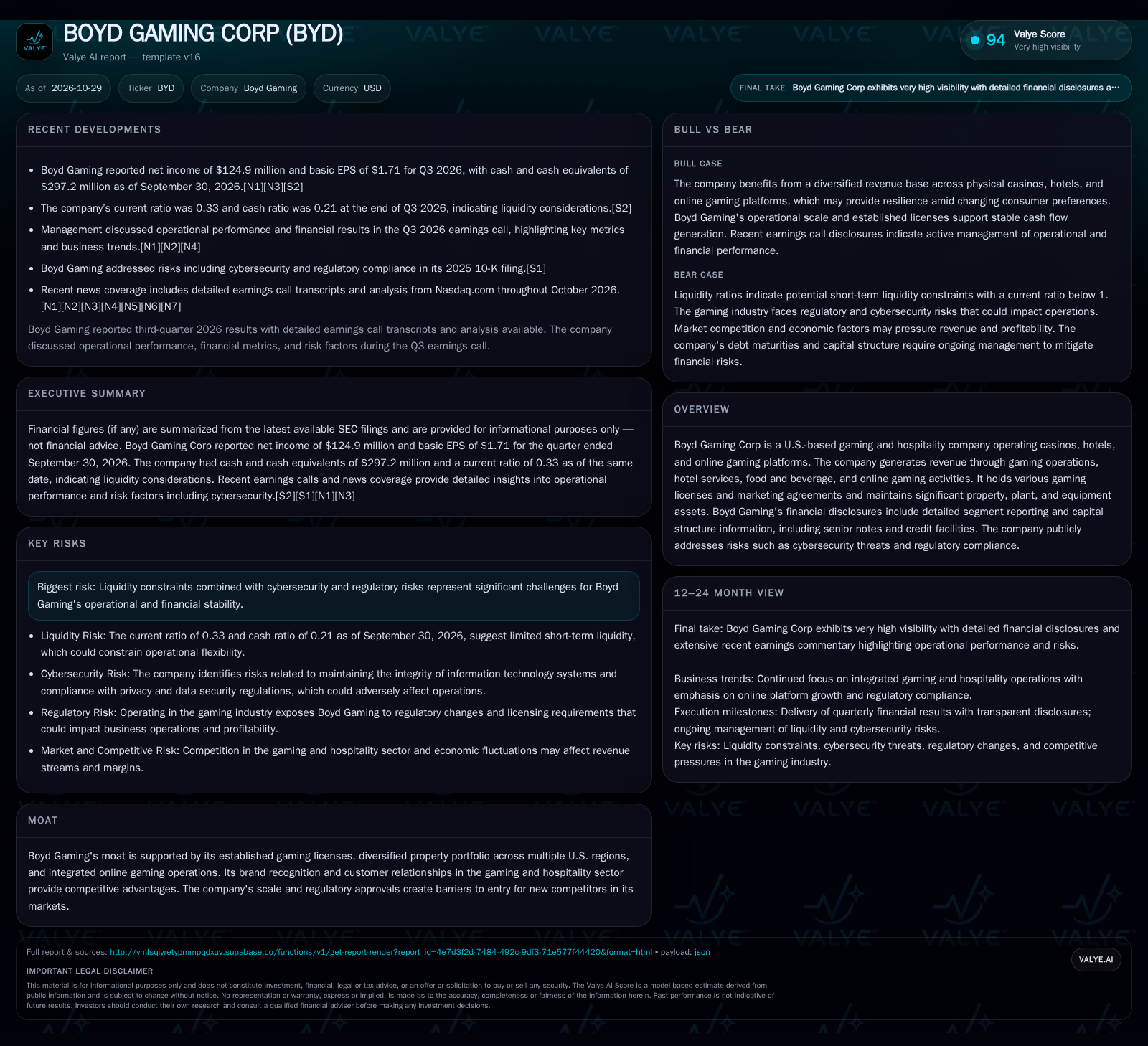
Boyd Gaming reported Q3 2026 net income of $124.9 million and EPS of $1.71, demonstrating robust operating profitability. The company’s multi-channel approach, spanning casinos, hotels, and online platforms, offers some resilience but also exposes Boyd to regulatory, competitive, and cybersecurity risks. Capital structure management and the pace of digital transformation are likely to dictate Boyd’s ability to sustain and expand its market position over the next 12–24 months. [S2] [N1] [N3]
With $124.9 million in net income for Q3 and a multi-channel revenue model spanning casinos, hotels, and online platforms, Boyd’s operational engine is firing. [S2] [N1] [N3]
Profitability Remains Strong, but Liquidity Signals Immediate Pressure
Boyd Gaming reported net income of $124.9 million and basic EPS of $1.71 for the third quarter of 2026, indicating healthy operational profitability. As of September 30, 2026, the company held $297.2 million in cash and cash equivalents, but its current ratio stood at just 0.33 and the cash ratio at 0.21. This means that Boyd’s liquid assets cover only a fraction of its short-term obligations, suggesting a constrained ability to absorb shocks or pursue new opportunities without external funding or asset reallocation. The company’s capital structure includes senior notes due in 2027 and 2031 and active bank credit facilities, which will require ongoing attention as maturities approach. [S2] [N1] [N3]
How Boyd Gaming’s Multi-Channel Model Drives Revenue and Risk
Boyd Gaming’s revenue engine is built on a blend of physical casino operations, hotel and hospitality services, food and beverage, and online gaming platforms. Each segment has distinct economics: physical casinos typically offer high-margin gaming revenue but require substantial fixed investment in property, plant, and equipment, while hotel and F&B operations provide incremental revenue but often at lower margins. The online gaming arm introduces variable costs related to technology, marketing, and compliance but can scale more rapidly and with lower incremental capital requirements.
Boyd’s operating leverage comes from high fixed costs in its brick-and-mortar assets—once occupancy and casino utilization rise, incremental margins can be attractive. However, this cuts both ways: in downturns or periods of muted demand, the same fixed-cost base can compress margins and strain cash flow. Debt maturities and interest obligations are persistent drains on free cash flow, reinforcing the importance of disciplined capital allocation and operational efficiency.
The interplay between fixed and variable costs in Boyd’s multi-channel model also introduces complexity in forecasting operating leverage under different demand scenarios. For instance, a sustained increase in online gaming revenue could partially offset fixed cost absorption challenges in physical properties by contributing higher-margin, variable-income streams. However, this depends on Boyd’s ability to optimize marketing spend and technology investments to scale digital operations efficiently. Additionally, the seasonality and geographic diversity of physical casino revenues can affect cash flow stability, requiring careful working capital management. Understanding how Boyd balances these cost dynamics across channels will be essential to evaluating its capacity to maintain profitability amid fluctuating market conditions.
Competitive Advantages and the Mounting Challenge of Digital Substitution
Boyd Gaming’s competitive moat is anchored by its portfolio of established gaming licenses, diverse regional presence, and integrated online operations. Regulatory approvals and the capital intensity of casino development create barriers to entry for new competitors in most U.S. jurisdictions. Boyd’s brand equity and long-standing customer relationships provide some insulation from transient shifts in local demand.
However, the rise of digital gaming and sports betting platforms is intensifying competition—not only from traditional peers but also from tech-driven entrants and state-sponsored online offerings. The risk is that digital channels may erode physical foot traffic and compress margins if Boyd cannot capture a significant share of online growth or differentiate its digital experience. Additionally, regulatory changes, including potential expansions or restrictions of online gaming, could alter the competitive landscape rapidly. Boyd’s ability to integrate its online and offline offerings, leverage its player database, and manage cross-channel customer incentives will be critical in sustaining its competitive position.
Boyd’s competitive positioning also hinges on its ability to innovate within regulatory frameworks that vary significantly across jurisdictions. The heterogeneity of state-level gaming regulations means Boyd must tailor its digital and physical offerings to local market conditions, which can increase operational complexity and compliance costs. Moreover, the company’s success in leveraging data analytics to personalize customer experiences and optimize cross-channel promotions will be a key differentiator against both traditional competitors and emerging digital-only platforms. If Boyd can develop proprietary insights from its integrated customer base, it may sustain higher customer lifetime value and loyalty, mitigating some risks posed by digital substitution and regulatory shifts.
Unlocking Value Through Digital Scale and Capital Reallocation
The most compelling upside for Boyd would come from successfully scaling its online gaming operations while maintaining robust performance in its core physical properties. If Boyd can leverage its brand, customer database, and marketing agreements to drive high-margin online growth, the company could reduce its reliance on capital-intensive physical assets and enhance return on invested capital.
Confirmation of this scenario would involve disclosure of accelerating online revenue growth, improving digital segment margins, and evidence of cross-channel customer engagement (e.g., digital sign-ups leading to increased on-property visitation or spend). An additional catalyst would be proactive refinancing or asset sales that shore up liquidity, enabling Boyd to invest in digital capabilities or opportunistically acquire complementary assets. A reduction in net debt, improved liquidity ratios, or successful extension of debt maturities would also validate the upside pathway.
Sustaining Profitability Amid Liquidity Constraints and Incremental Digital Progress
The most likely scenario is that Boyd continues to generate solid profitability from its diversified operations but remains constrained by liquidity pressures and a measured pace of digital expansion. The company may focus on incremental improvements in operational efficiency, disciplined capital spending, and careful management of upcoming debt maturities.
In this scenario, Boyd’s revenue mix would remain stable, with physical gaming and hospitality providing the bulk of cash flow, while online platforms contribute modest but growing earnings. Confirmation would come from consistent quarterly net income, stable or slightly improving liquidity ratios, and the absence of disruptive refinancing events or asset sales.
Liquidity Shortfall or Regulatory Shock Forces Asset Sales or Restructuring
The principal downside risk is that Boyd’s liquidity constraints become acute—whether due to an external shock (e.g., regulatory change, cyber incident, economic downturn) or a sustained revenue shortfall—forcing the company to execute distressed asset sales, seek emergency financing on unfavorable terms, or restructure segments of its business.
Regulatory actions that restrict gaming operations, impose new compliance costs, or disrupt online platforms would also accelerate downside risk. A major cybersecurity breach, if disclosed, could exacerbate liquidity and reputational pressure.
Milestones That Will Shape Boyd Gaming’s Next 24 Months
Disclosure of refinancing activity, maturity extensions, or new credit facility terms would illuminate Boyd’s ability to manage near-term debt obligations.
Growth rates and margin trends in online gaming operations—if disclosed—would help test the thesis that digital can offset physical property risk.
Updates on property-level EBITDA and margin performance, especially in markets with new competitive entrants or regulatory changes, are essential for tracking core profitability.
Any announced asset sales, acquisitions, or joint ventures should be scrutinized for their impact on liquidity, strategic focus, and long-term value creation.
Cybersecurity incident disclosures or commentary on IT system investments, given the identified risk and potential operational disruption.
Changes in regulatory environment, including new state-level legislation on online gaming or casino licensing, could materially shift the risk/reward profile.
Quarterly commentary on customer acquisition, retention, and cross-channel engagement metrics would help clarify the effectiveness of Boyd’s integrated platform strategy.
Disclaimer: This is research-only, informational analysis and not investment advice. It may include AI-generated interpretation and general industry context. Always verify important details using primary sources.

Comments