
PC Connection’s Strategic Push Into AI and Services: Economic Leverage, Customer Dynamics, and the Next Growth Phase
Recent outperformance in revenue and earnings points to operational momentum, but the company’s long-term trajectory hinges on its ability to deepen higher-margin IT services and AI-driven solutions while navigating competitive pressures and evolving technology cycles.
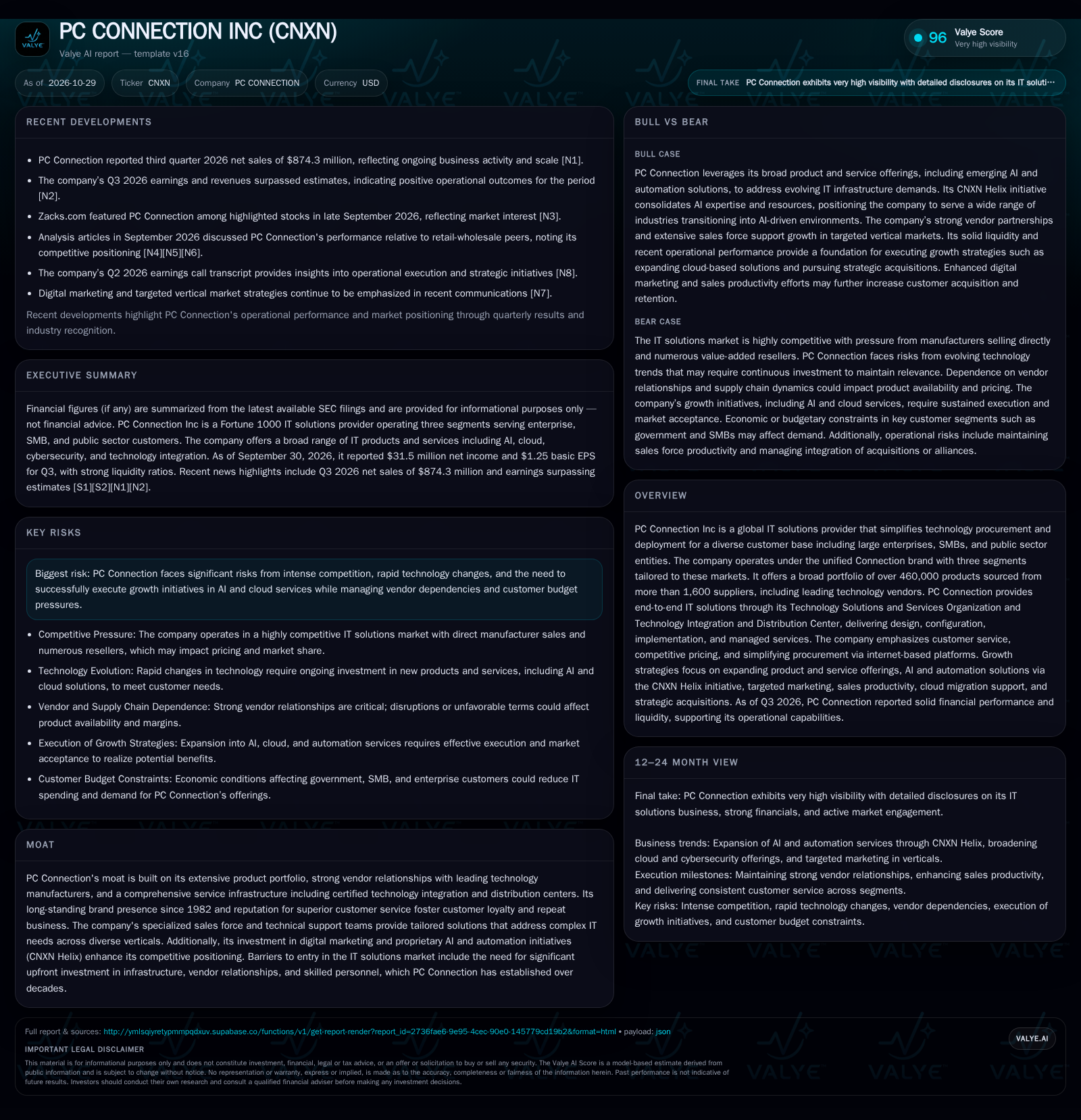
PC Connection reported Q3 2026 net sales of $874.3 million and net income of $31.5 million, exceeding expectations and reflecting strong operational execution. The company’s business spans enterprises, SMBs, and public sector customers, leveraging over 460,000 IT products and increasingly focusing on services and AI/automation solutions via its CNXN Helix initiative. Key watchpoints include the mix of services revenue, adoption of AI/cloud offerings, and sales force productivity improvements. [S1] [S2] [N1] [N2]
PC Connection’s third quarter 2026 results—net sales of $874.3 million and net income of $31.5 million—underscore the company’s ability to execute in a competitive IT solutions market. As the firm expands its suite of services, including AI and automation through the CNXN Helix initiative, its future will be shaped by how effectively it can shift its business mix toward higher-value, more defensible offerings. The coming quarters will test whether PC Connection can maintain operational outperformance, deepen customer integration, and build sustainable economic leverage amid sector evolution and competitive threats. [S1] [S2] [N1] [N2]
Recent Financial Performance and Strategic Initiatives Shape the Narrative
PC Connection posted Q3 2026 net sales of $874.3 million and net income of $31.5 million, with basic EPS of $1.25—both exceeding market expectations and reflecting continued operational strength [S2] [N1] [N2]. As of September 30, 2026, the company reported $124.6 million in cash and $218.7 million in short-term investments, with a current ratio of 2.72 and cash ratio of 0.68 [S2]. These results come as PC Connection advances its CNXN Helix initiative for AI and automation solutions, aiming to capitalize on new IT spending priorities across enterprises, SMBs, and the public sector [S1]. The company’s outperformance, potential financial flexibility, and ongoing investments in high-value services set the stage for its next phase of growth.
How the Business Mix and Service Expansion Could Drive Margin Leverage
PC Connection’s core economics historically center on large-scale product distribution—selling over 460,000 products from more than 1,600 vendors—at competitive prices, enabled by strong vendor relationships and efficient logistics [S1]. Gross margins in this segment are typically thin due to high price transparency and competition among IT resellers. However, the company’s strategy to expand higher-margin services—including cloud, cybersecurity, managed services, and AI-driven solutions—offers a plausible path to improved profitability.
The CNXN Helix initiative represents an effort to move up the value chain, bundling consulting, integration, and automation services that command higher margins and offer more recurring revenue potential than pure product sales. If PC Connection can increase the share of revenue from these services, operating leverage may improve: fixed costs in technical expertise and digital infrastructure can be spread over a larger base, while variable costs tied to hardware fulfillment remain tightly managed.
Sustaining this transition requires ongoing investment in technical staff, digital platforms, and sales force training. The business is capital-light relative to manufacturing, but working capital needs can be substantial due to inventory and receivables. The company reported cash and liquidity metrics for the period; these figures do not by themselves establish operating runway, investment capacity, financial flexibility, or financing capacity.
Navigating a Crowded IT Solutions Landscape: Advantages and Threats
PC Connection competes in a fragmented, highly competitive market that includes global distributors, direct sales from manufacturers, and a long tail of value-added resellers and niche service providers. Its core advantages stem from scale—broad product access, longstanding vendor relationships with major technology brands, and the ability to serve enterprises, SMBs, and public sector clients from a unified platform [S1].
Barriers to entry in IT distribution are moderate: building relationships with top-tier vendors, achieving ISO-certified integration capabilities, and developing a skilled sales/support organization require years of investment. However, these moats are not absolute. Direct-to-customer channels from vendors, cloud-native procurement, and new digital-first resellers continue to erode traditional distribution margins.
The true test for PC Connection’s defensibility will be its ability to differentiate through bundled solutions, superior service, and consultative selling—particularly in high-growth areas like AI, automation, and cybersecurity. If the company can establish itself as a trusted advisor and integration partner, customer switching costs and retention may rise, but this is not yet proven at scale.
Unlocking Value Through Services and AI Integration: What Could Accelerate Growth
The most favorable scenario for PC Connection is one in which its CNXN Helix and broader services portfolio gain significant traction, driving a higher mix of recurring, higher-margin revenue. If customers increasingly adopt bundled AI, cloud, and cybersecurity solutions—backed by the company’s design, implementation, and managed services—PC Connection could see both revenue growth and margin expansion.
Confirmation of this scenario would come from disclosed increases in the proportion of services revenue, rising average deal sizes, higher renewal rates for managed services, and growing cross-sell rates into existing accounts. Evidence of major customer wins in AI or automation, or public case studies highlighting successful digital transformation projects, would further validate the shift.
This scenario depends on effective sales force enablement, continued investment in technical expertise, and the ability to outpace competitors in solution innovation. A faster-than-expected ramp in AI/cloud adoption among enterprise and public sector customers would be a key accelerant.
Sustaining Multi-Segment Growth While Managing Margin Pressures
The most plausible outcome is that PC Connection maintains steady growth across its enterprise, SMB, and public sector segments, benefiting from ongoing IT refresh cycles and incremental adoption of cloud and automation solutions. Product sales remain the bulk of revenue, but services gradually account for a larger share, helping to stabilize margins as hardware competition intensifies.
Evidence supporting this scenario would include continued top-line growth in line with recent quarters, stable or modestly improving gross margins, and incremental increases in services-related revenue or bookings (if disclosed). Sales force productivity metrics, customer retention rates, and digital marketing effectiveness would also be important markers.
Risks to this scenario include slower-than-expected customer adoption of new solutions, margin compression from pricing competition, and execution missteps in integrating new service offerings. The company would need to balance growth investments with cost discipline to avoid margin erosion.
Competitive Pressures, Technology Shifts, and Execution Risks Could Derail Progress
In a less favorable scenario, PC Connection faces intensifying pricing pressure from direct vendor sales and digital-native competitors, leading to margin compression and stagnant revenue growth. If customers increasingly bypass traditional resellers for cloud marketplaces or direct procurement, the company’s core distribution business could erode.
Failure to scale AI, automation, or managed services—whether due to insufficient technical differentiation, weak sales execution, or lack of market acceptance—would leave PC Connection exposed to commoditization. Supply chain disruptions or deteriorating vendor relationships could further impact product availability and pricing.
Signs of this scenario would include declining gross margins, stagnant or falling services revenue, higher customer churn (if disclosed), or public setbacks in major solution launches. Negative changes in vendor terms or loss of key supplier relationships would exacerbate the downside.
Benchmarks for Testing PC Connection’s Shift Toward Higher-Value IT Solutions
The proportion of revenue derived from services (cloud, cybersecurity, AI, managed services) versus traditional hardware/software products—if disclosed—would clarify progress in shifting the business mix.
Average deal size and frequency of multi-product or bundled solution sales could indicate success in deepening customer relationships and capturing more wallet share.
Sales force productivity metrics, such as revenue per rep or services sold per account, would help assess the effectiveness of ongoing sales training and digital enablement.
Gross margin trends, especially in services versus product sales, will indicate whether the company is achieving the intended economic leverage.
Customer retention and renewal rates for managed services and recurring contracts—if available—would demonstrate stickiness and the potential for compounding growth.
Major public customer wins or case studies in AI, automation, or cloud migration projects would signal market acceptance of new offerings.
Updates on the CNXN Helix initiative, including new solution launches, customer adoption rates, or technical partnerships, would help validate the strategic narrative.
Any changes in vendor relationships—such as new partnerships, exclusive agreements, or terminations—could materially affect product availability and pricing power.
Disclaimer: This is research-only, informational analysis and not investment advice. It may include AI-generated interpretation and general industry context. Always verify important details using primary sources.

Comments