
Lithia Motors: Scaling Multi-Segment Retail, Margin Pressures, and the Search for Resilient Profit Streams
Lithia Motors’ global platform leverages a diversified mix of new and used vehicle sales, F&I, and aftersales, but faces margin normalization in new vehicles and tight liquidity. The company’s growth by acquisition and operational breadth are offset by integration, credit, and macroeconomic risks, with aftersales and used vehicles emerging as critical profit drivers.
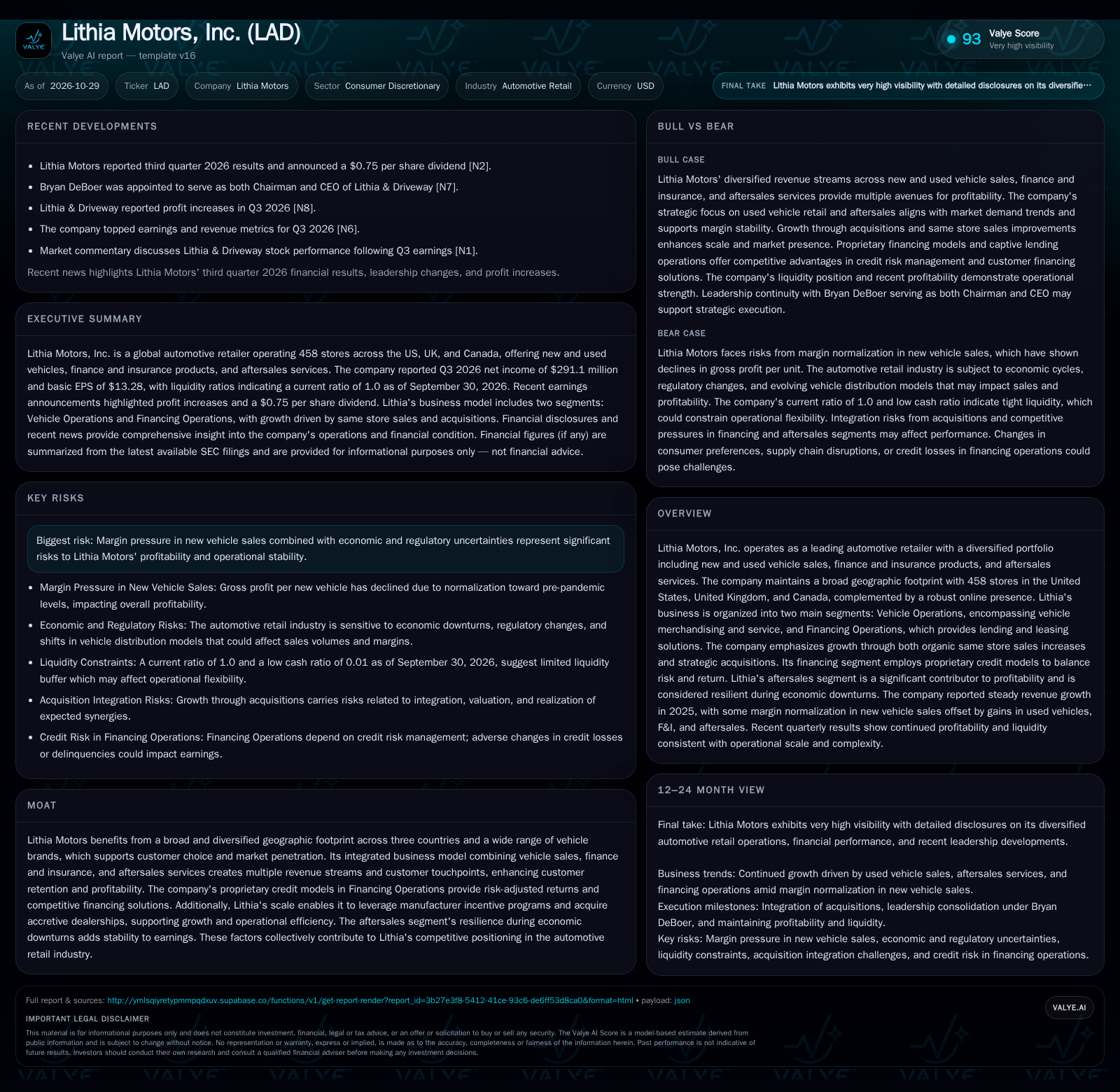
Lithia Motors reported $37.6 billion in 2025 revenue, driven by same-store and acquisition growth, but faces declining new-vehicle margins and a current ratio of 1.0. Used vehicles and aftersales are gaining as profit centers. Leadership consolidation under Bryan DeBoer aims to support execution amid a shifting retail landscape. [S1] [S2] [N6] [N7] [N8]
Lithia Motors, Inc. stands at a critical juncture in automotive retail, balancing rapid scale with evolving profit dynamics. The company’s $37.6 billion in 2025 revenue underscores its status as a top global consolidator, spanning 458 stores across North America and the UK. Yet, beneath headline growth, the mix is shifting: new vehicle margins are compressing, while used vehicles and aftersales are stepping into the profitability gap. The next phase will test whether the company’s multi-segment model can sustain profitability as the industry’s structure and consumer behaviors evolve. [S1] [S2] [N6] [N7] [N8]
Recent Results Reveal Margin Shifts and Leadership Consolidation
Lithia Motors reported approximately $37.6 billion in 2025 revenue, with growth propelled by both same-store improvements and acquisitions [S1]. New vehicle revenues increased 2.1% as higher average selling prices offset slightly lower unit sales, but gross profit from new vehicles declined due to margin normalization toward pre-pandemic levels [S1]. In contrast, used vehicle revenues grew 5.9% with improved gross profits, while aftersales revenues rose 7.0% and delivered a 10.4% increase in gross profit, reflecting the segment's expanding role in overall profitability [S1]. The company reported Q3 2026 net income of $291.1 million and basic EPS of $13.28 [S2]. The company reported cash and liquidity metrics for the period; these figures do not by themselves establish operating runway, investment capacity, financial flexibility, or financing capacity. [S2] Leadership was recently consolidated under Bryan DeBoer, now serving as both Chairman and CEO, a move that may streamline strategic execution [N7].
How Lithia Motors Monetizes Scale: Revenue Mix and Margin Dynamics
Lithia’s business model is anchored in its Vehicle Operations segment—which includes new and used vehicle sales, F&I, and aftersales—and its Financing Operations segment, which provides captive lending and leasing [S1]. The economics of new vehicle sales are inherently cyclical and margin-sensitive: Lithia’s recent margin compression in this segment reflects a return to historical norms after an extraordinary pandemic-driven period. This exposes the business to swings in OEM incentives, inventory costs, and consumer demand. In contrast, used vehicles and aftersales offer higher and more stable gross margins due to less price transparency, greater control over inventory sourcing, and recurring service revenue. Aftersales, in particular, is less exposed to economic cycles and provides a buffer during downturns.
Financing and insurance (F&I) products are another key profit lever, typically generating high-margin revenue with limited incremental capital requirements. Lithia’s proprietary credit models may allow it to optimize risk-adjusted returns, though this introduces exposure to consumer credit cycles. Operating leverage is mixed: while scale enables better purchasing power and cost absorption, the capital intensity of acquisitions and inventory—combined with a current ratio of 1.0—means the company must closely manage liquidity, especially as expansion continues.
Assessing Lithia’s Defenses: Scale, Diversification, and Industry Shifts
Lithia competes in a fragmented automotive retail market against other large consolidators, independent dealerships, and digital-first platforms. Its broad geographic reach—458 stores across three countries—and multi-brand offering provide significant customer choice and enable cross-selling across new, used, F&I, and aftersales channels [S1]. This diversification supports resilience, as profit streams do not depend solely on new vehicle sales.
However, competitive pressure is intensifying. Digital retail models and direct-to-consumer initiatives by automakers threaten to compress dealer margins and disintermediate traditional sales channels. Lithia’s robust online presence (over 400 websites) helps counter this risk, but the company must continually invest in digital capabilities to match evolving customer expectations. In financing, proprietary credit models may offer some differentiation, but are replicable by other large players and subject to consumer credit risk. Lithia’s scale allows it to leverage manufacturer incentives and negotiate favorable acquisition terms, but also magnifies integration and operational risks as the network grows.
Profit Expansion If Aftersales and Used Vehicles Outpace New Car Margin Compression
Lithia could deliver sustained earnings growth if aftersales and used vehicle segments continue to expand their share of revenue and gross profit. The aftersales business, with its 7% revenue and 10.4% gross profit growth in 2025, is structurally more resilient, benefiting from ongoing vehicle maintenance needs and higher-margin services [S1]. If Lithia succeeds in increasing customer retention for service work and cross-selling F&I products, this could offset new vehicle margin pressures.
The upside case strengthens if the company’s acquisition strategy delivers accretive growth without significant integration setbacks, and if captive financing operations maintain low delinquencies through effective credit risk management. Further, continued digital investment could enhance both sales conversion and customer lifetime value, particularly in used vehicles where online channel adoption is growing. Evidence supporting this scenario would include continued double-digit aftersales profit growth, expanding used-to-new sales ratios, stable or improving F&I margins, and minimal increases in credit losses or integration costs.
Multi-Segment Growth Balances Margin Normalization and Acquisition Integration
The most plausible scenario is that Lithia maintains steady top-line growth through a combination of same-store sales improvements and targeted acquisitions, while experiencing ongoing margin normalization in new vehicle sales. Used vehicle and aftersales segments become increasingly important to profit mix, but are unlikely to fully offset new vehicle margin pressures in the near term. The financing segment continues to contribute, with periodic fluctuations based on credit trends and economic conditions.
Lithia’s liquidity remains tight, requiring careful working capital management and disciplined capital allocation. Some integration friction from acquisitions is likely, but the company’s operational scale and leadership stability under Bryan DeBoer provide a measure of continuity. Confirmation of this scenario would come from moderate revenue growth, stable or slightly declining new vehicle margins, incremental gains in used and aftersales gross profit, and manageable credit costs and integration expenses.
Liquidity Strains and Acquisition Risk Expose Lithia to Profit Volatility
The adverse scenario plays out if new vehicle margins deteriorate faster than aftersales and used vehicle segments can compensate, or if macroeconomic weakness reduces overall vehicle demand and service revenue. [S2] Should acquisition integration costs rise, or if acquired stores underperform, Lithia’s profitability and cash flow could come under pressure.
Financing operations could amplify risk if consumer credit quality deteriorates, leading to higher delinquencies or charge-offs. Additionally, a shift in OEM strategies toward direct-to-consumer sales or regulatory changes could erode dealer economics. Evidence supporting this downside would include declining same-store sales, contracting aftersales gross profit, rising credit losses, missed acquisition synergy targets, or any need to access external financing at unfavorable terms.
What Will Validate Lithia’s Multi-Segment Profit Model in a Changing Retail Landscape?
Trend in aftersales gross profit growth—continued double-digit increases would support the thesis that this segment can buffer margin compression elsewhere.
Used-to-new vehicle sales ratio—an increasing ratio would confirm the shift toward higher-margin used vehicle retail.
F&I gross profit per unit—if disclosed, this would provide insight into the resilience of high-margin ancillary products.
Net credit losses or delinquency rates in captive financing—rising figures would signal increased risk to financing profitability.
Acquisition integration costs as a percentage of acquired revenue—would help test whether scale benefits are being realized or eroded by complexity.
Liquidity and working capital trends—ongoing monitoring of the current and cash ratios, along with operating cash flow, is necessary given the tight buffer.
Impact of digital channel investments—metrics such as online-driven sales growth, digital customer acquisition cost, and digital service bookings (if disclosed) would indicate success in fending off digital-first competitors.
Disclaimer: This is research-only, informational analysis and not investment advice. It may include AI-generated interpretation and general industry context. Always verify important details using primary sources.

Comments