
Tiptree’s Strategic Reset After Divestitures: Capital Focus and Renewal Prospects
The company’s next act will test its ability to generate returns, maintain relevance, and manage the risks that come with a narrower strategic footprint.
Tiptree’s sales of Fortegra and Reliance will leave it with a vastly smaller business and a large liquidity reserve. The company’s future hinges on how effectively it can redeploy capital for long-term value creation or return it to shareholders, while managing the risks of increased concentration and a less diversified income stream. Execution, strategic clarity, and market discipline are now critical.
Tiptree Inc. stands at a critical inflection point as it completes the divestiture of its flagship insurance and mortgage subsidiaries, Fortegra and Reliance. With over $1.7 billion in pending sale proceeds and a lean corporate structure, the company shifts from an operating conglomerate to a focused capital allocator. The challenge now is twofold: redeploying a substantial cash pile into new, high-return investments, and maintaining strategic relevance in a market where scale, diversification, and recurring earnings have become the norm. Execution risk is rising, and the company’s next moves will define its long-term trajectory.
Implications of Fortegra and Reliance Divestitures for Tiptree’s Strategy
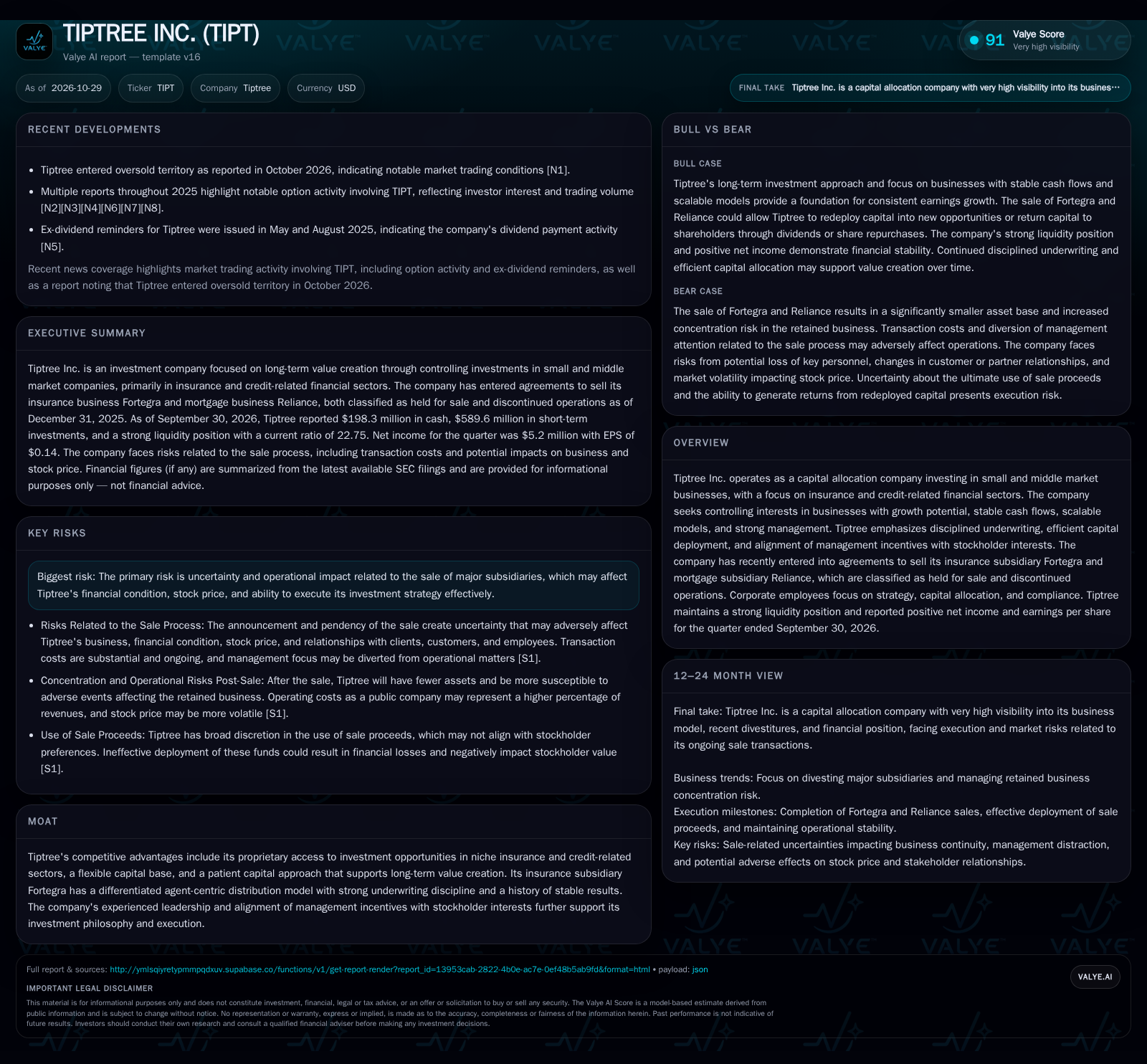
Tiptree has entered into agreements to sell its two largest businesses: the specialty insurer Fortegra for approximately $1.65 billion and the mortgage originator Reliance for about $50 million. Both are now classified as held for sale and discontinued operations as of December 31, 2025 [S1]. The proceeds from these divestitures will leave Tiptree with a dramatically reduced asset base and a much smaller operating footprint. As of September 30, 2026, the company reported $198.3 million in cash, $589.6 million in short-term investments, and a current ratio of 22.75 [S2]. Notably, Tiptree reported zero revenue but posted $5.2 million in net income for the latest quarter, reflecting the transitional state of its income statement [S2]. The company has stated it does not expect to distribute sale proceeds directly to shareholders, making the deployment of capital and future investment strategy the key variables for value creation [S1].
Managing Capital Post-Sale: Balancing Cash, Costs, and Yield Opportunities
With the sale of Fortegra and Reliance, Tiptree’s ongoing business model shifts from a diversified operating company to a pure-play capital allocator. The economics of this model depend almost entirely on the company’s ability to identify, acquire, and manage new investments that can generate returns exceeding the cost of capital. In the near term, Tiptree’s substantial cash and short-term investment balances will generate some interest income, but this is unlikely to match historical operating earnings or support a premium valuation. Fixed costs at the holding company—primarily personnel and public company expenses—will become a much larger percentage of total income, raising the bar for new investments to deliver meaningful net returns. The company’s ability to generate operating leverage will hinge on sourcing scalable businesses with strong cash flow profiles, but the loss of recurring insurance and mortgage earnings means that Tiptree may face periods of earnings volatility and capital drag as it rebuilds its portfolio. The risk of value-dilutive acquisitions or a prolonged search for suitable targets is now central to the thesis.
New Competitive Landscape: From Insurance Platforms to Alternative Asset Players
Tiptree’s competitive set is fundamentally altered post-divestiture. Without Fortegra and Reliance, it no longer competes directly in specialty insurance or mortgage origination, but rather with alternative asset managers, holding companies, and private equity vehicles targeting small and middle market businesses. The company’s historical advantages—such as proprietary deal flow in insurance and credit, and underwriting expertise—may be less relevant unless it can leverage its relationships and reputation to access unique investment opportunities. Tiptree’s ability to offer patient, flexible capital could appeal to founders and management teams, but it now faces intense competition from well-capitalized private equity, family offices, and SPACs. Moreover, with only 14 employees at corporate headquarters [S1], the company’s bandwidth for due diligence and portfolio oversight may be a constraint relative to larger, more diversified rivals.
Potential for Re-rating Through High-Quality Deal Execution
The most favorable scenario for Tiptree involves the disciplined and timely redeployment of sale proceeds into high-quality, cash-generative businesses with strong growth prospects. If management is able to leverage its network, reputation, and patient capital approach to secure proprietary deals—especially in overlooked or complex segments—Tiptree could rebuild a diversified earnings base and restore investor confidence. Evidence confirming this scenario would include announcements of new controlling investments in businesses with defensible market positions, recurring revenue, and management alignment. Early signs of accretive earnings, restored revenue growth, and a clear capital allocation framework would likely catalyze a re-rating of the stock. Conversely, the absence of deal activity, or investments in low-margin or cyclical businesses, would undermine this thesis.
Navigating an Extended Transition with Conservative Cash Deployment
The most plausible near-term outcome is an extended period of transition, during which Tiptree maintains high liquidity, generates modest interest income, and incurs ongoing public company and transaction costs while searching for new investment opportunities. This phase could be characterized by low or no operating revenue, limited earnings visibility, and potentially increased stock price volatility, as investors await clarity on capital deployment. Management may take a cautious approach, prioritizing capital preservation and deal selectivity over rapid reinvestment. Confirmation of this scenario would be a continued lack of material acquisitions, persistently low operating income, and public communications emphasizing patience and discipline. A shift out of this mode—such as a large announced acquisition or a new investment platform—would mark a new phase of execution risk and opportunity.
Risks of Value Erosion from Ineffective Capital Use
The adverse scenario centers on the risk that Tiptree fails to identify attractive investment opportunities, leading to prolonged capital drag, rising overhead as a percentage of assets, and mounting pressure from shareholders frustrated by a lack of returns or capital return. If management succumbs to the temptation to deploy capital quickly into mediocre or highly cyclical businesses—perhaps to justify the public company structure—Tiptree could face value leakage through poor returns, impairment charges, or loss of investor confidence. This risk would be confirmed by a pattern of small, undifferentiated acquisitions, deteriorating earnings quality, or a growing gap between book value and market price. Additional warning signs include management turnover, shrinking cash balances without corresponding growth in recurring earnings, and any signals of governance or incentive misalignment.
Signs That Will Define Tiptree’s Progress in Its Next Phase
The announcement and closing of new controlling investments, including details on industry, deal structure, and expected returns, would provide essential insight into Tiptree’s post-divestiture strategy.
Changes in the size and composition of cash and short-term investment balances—especially if disclosed quarterly—will indicate whether capital is being deployed or idling.
Disclosures around public company operating expenses and compensation at the holding company level would help assess the efficiency and scalability of the new structure.
Any stated capital allocation policy or framework for returning excess cash to shareholders, including special dividends or buybacks, would clarify management’s priorities.
Updates on the pipeline of potential deals or investment targets, if provided, would signal management’s ability to source and compete for attractive opportunities.
Board and management changes, especially the addition of new investment professionals or directors with relevant sector expertise, would suggest a shift in strategic direction.
If disclosed, a useful metric would be the projected internal rate of return (IRR) or cash-on-cash yield on new investments, compared to historical returns from Fortegra and Reliance.
Feedback from major shareholders or activist investors, should it emerge, would provide another lens on market confidence and pressure for action.
Disclaimer: This is research-only, informational analysis and not investment advice. It may include AI-generated interpretation and general industry context. Always verify important details using primary sources.

Comments