
MYR Group’s Growth Surge: Backlog Momentum, Cyclical Risks, and the Economics of Power Infrastructure Services
MYR Group’s record backlog and continued net income growth highlight robust demand for electrical transmission and distribution services, but the company’s exposure to cyclical swings, competitive pricing, and labor dynamics underscores the fragility of its recent momentum.
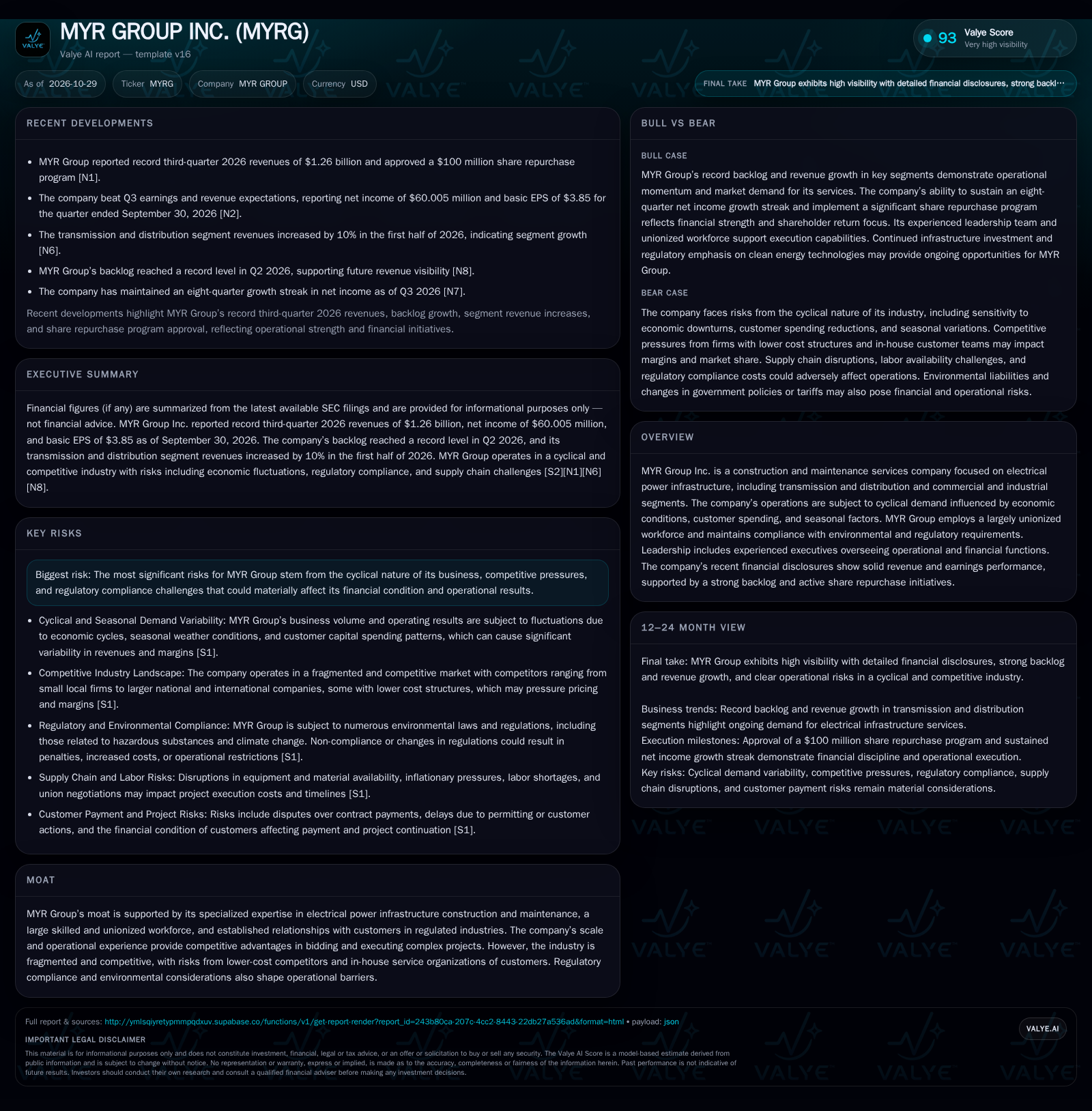
MYR Group’s eight-quarter streak of net income growth and a 10% rise in T&D segment revenues signal strength in utility and infrastructure markets, supported by a record backlog. However, seasonality, exposure to economic cycles, and rising competition from lower-cost players temper the outlook. The sustainability of margin expansion will hinge on how MYR Group navigates project mix changes, labor costs, and regulatory shifts in the coming quarters. [S2] [N6]
MYR Group Inc. stands at a critical juncture: its record backlog and sustained net income growth underscore powerful demand tailwinds in the electrical transmission and distribution sector, even as the broader construction and infrastructure landscape faces persistent cyclicality and operational headwinds. As utility customers continue to invest in grid modernization, electrification, and resilience, MYR Group’s ability to deliver large-scale, labor-intensive projects has driven a notable run of profitability. Yet, the underlying economics of the business—characterized by high fixed labor costs, union exposure, and project-based variability—mean that any disruption in spending patterns or cost structures could rapidly erode margins. The question for investors is whether MYR Group’s operational strengths and market positioning will prove durable as the cycle inevitably turns.
Recent Performance: Net Income Growth and Segment Expansion
MYR Group reported net income of $60.0 million and basic earnings per share of $3.85 for the quarter ended September 30, 2026, marking its eighth consecutive quarter of net income growth. This sustained profitability is notable in an industry known for its volatility and underscores the company’s strong execution and favorable project mix over the past two years. The transmission and distribution (T&D) segment, a core revenue driver, posted a 10% increase in revenues for the first half of 2026, reflecting heightened utility spending on electrical infrastructure upgrades and grid resilience. The company’s current assets of $1.19 billion against current liabilities of $889.4 million yield a current ratio of 1.33, with cash and cash equivalents at $26 million—indicating reported liquidity position but not a large cash reserve. [S2] [N2] [N6]
How Project Mix, Labor Costs, and Margins Drive MYR Group’s Financial Model
MYR Group’s business model is fundamentally project-driven, with revenues primarily recognized as construction milestones are met on electrical transmission, distribution, and commercial/industrial projects. Gross margins are highly sensitive to project mix: large, complex contracts can deliver operating leverage, but cost overruns, weather delays, or customer-driven changes can erode profitability. The company’s heavy reliance on a unionized workforce—about 85% of craft employees—means that labor costs are relatively fixed in the short term and subject to collective bargaining outcomes. This structure supports execution quality and safety but limits flexibility in downturns and exposes MYR Group to wage inflation and potential labor actions. Capital requirements are moderate relative to asset-heavy industries, as much of the equipment can be leased or depreciated over long cycles, but working capital swings can be significant, especially when project starts and customer payments do not align. In periods of strong demand, operating leverage can drive earnings growth, but the inverse is also true: a slowdown in awards or unexpected project losses can quickly compress margins.
Competitive Landscape: Scale, Specialization, and the Cost Pressures of a Fragmented Market
MYR Group’s competitive positioning derives from its scale, specialized expertise in high-voltage and complex electrical infrastructure, and longstanding relationships with utilities and large commercial clients. Its ability to mobilize a large, skilled, unionized workforce is a barrier to entry for smaller firms and supports bidding on multi-year, capital-intensive projects. However, the market remains fragmented, with competition ranging from local contractors to national players—some with lower cost structures or more flexible labor arrangements. Customers, particularly utilities, may also develop in-house capabilities, further intensifying price competition. Regulatory compliance, environmental restrictions, and evolving safety standards add structural complexity, favoring experienced operators but also increasing baseline costs. The company’s moat is therefore situational: strong in technically demanding, large-scale projects, but less defensible in commodity service segments where price is the primary differentiator.
Electrification and Grid Modernization: Pathways to Sustained Expansion
The most favorable scenario for MYR Group is a prolonged investment cycle in North American grid modernization, electrification, and renewable integration. As utilities and municipalities accelerate spending to upgrade aging infrastructure, accommodate distributed energy resources, and enhance grid resilience against climate risks, MYR Group could benefit from a steady pipeline of large, higher-margin projects. Margin expansion may be possible if project mix shifts toward more technically challenging work and if the company can pass through labor and material cost inflation to customers. Evidence confirming this scenario would include continued net income growth, a consistently rising backlog, stable or improving gross margins, and contract wins in emerging areas like renewable integration and electric vehicle infrastructure. Conversely, a slowdown in utility capital spending or a decline in backlog would challenge this thesis.
Typical Cycle: Growth Cools, Margins Normalize Amid Competitive and Cost Headwinds
The most plausible trajectory is that MYR Group’s revenue and net income growth moderate as the recent surge in utility infrastructure spending tapers. Project awards remain solid but increasingly competitive, with some mix shift toward lower-margin work. Labor and materials cost inflation persist but are only partially offset by customer pricing. The company maintains profitability, but margins revert toward historical averages, and earnings growth slows. Confirmation would come from stable (but not accelerating) backlog, flattish gross margins, and earnings growth decelerating to single digits, with no major project losses or customer payment issues. A material drop in backlog, sharp margin compression, or escalation in labor disputes would falsify this scenario.
Cyclical Downturn, Contract Losses, and Labor Disruption: How Profit Momentum Could Reverse
A negative outcome could arise if economic conditions deteriorate, leading to a pullback in utility and commercial capital spending. Project delays, cancellations, or customer financial distress could result in revenue shortfalls and working capital stress. Simultaneously, labor cost inflation or a breakdown in union negotiations might increase costs or disrupt project delivery. In this scenario, MYR Group could see rapid backlog erosion, margin compression, and potentially net losses—especially if cost overruns or contract disputes emerge. Evidence would include a sharp decline in new awards, negative backlog growth, shrinking margins, rising days sales outstanding, and any labor-related work stoppages or cost spikes.
Testing the Durability of MYR Group’s Backlog, Margins, and Competitive Edge
Backlog growth or contraction: Changes in reported backlog would indicate future revenue visibility and test the thesis of sustained demand.
Gross margin trends: Sequential margin expansion or compression, if disclosed, would clarify how well MYR Group is managing costs and project complexity.
Project mix evolution: A shift toward higher-value, technically complex projects would support the upside case; a tilt toward lower-margin commodity work would raise concerns.
Union labor negotiations and wage trends: Updates on contract renewals, strike risks, or wage settlements would provide early signals of cost pressures.
Customer concentration and payment delays: Any disclosure of increased customer concentration or rising accounts receivable days would highlight credit or project risk.
Supply chain and material cost developments: Evidence of material shortages, inflationary spikes, or procurement bottlenecks would directly impact project economics.
Regulatory or policy changes: New environmental, safety, or permitting requirements could alter the cost structure or project timelines.
Disclaimer: This is research-only, informational analysis and not investment advice. It may include AI-generated interpretation and general industry context. Always verify important details using primary sources.

Comments