
Microsoft’s Cloud and AI Expansion: Durable Advantages, Competitive Pressures, and Execution Tests
Microsoft’s latest results underscore the strength of its diversified model and AI-driven cloud momentum, but intensifying competition and regulatory scrutiny pose ongoing challenges. The company’s scale and integration create high switching costs, yet future outperformance will depend on sustaining innovation and managing legal and market risks.
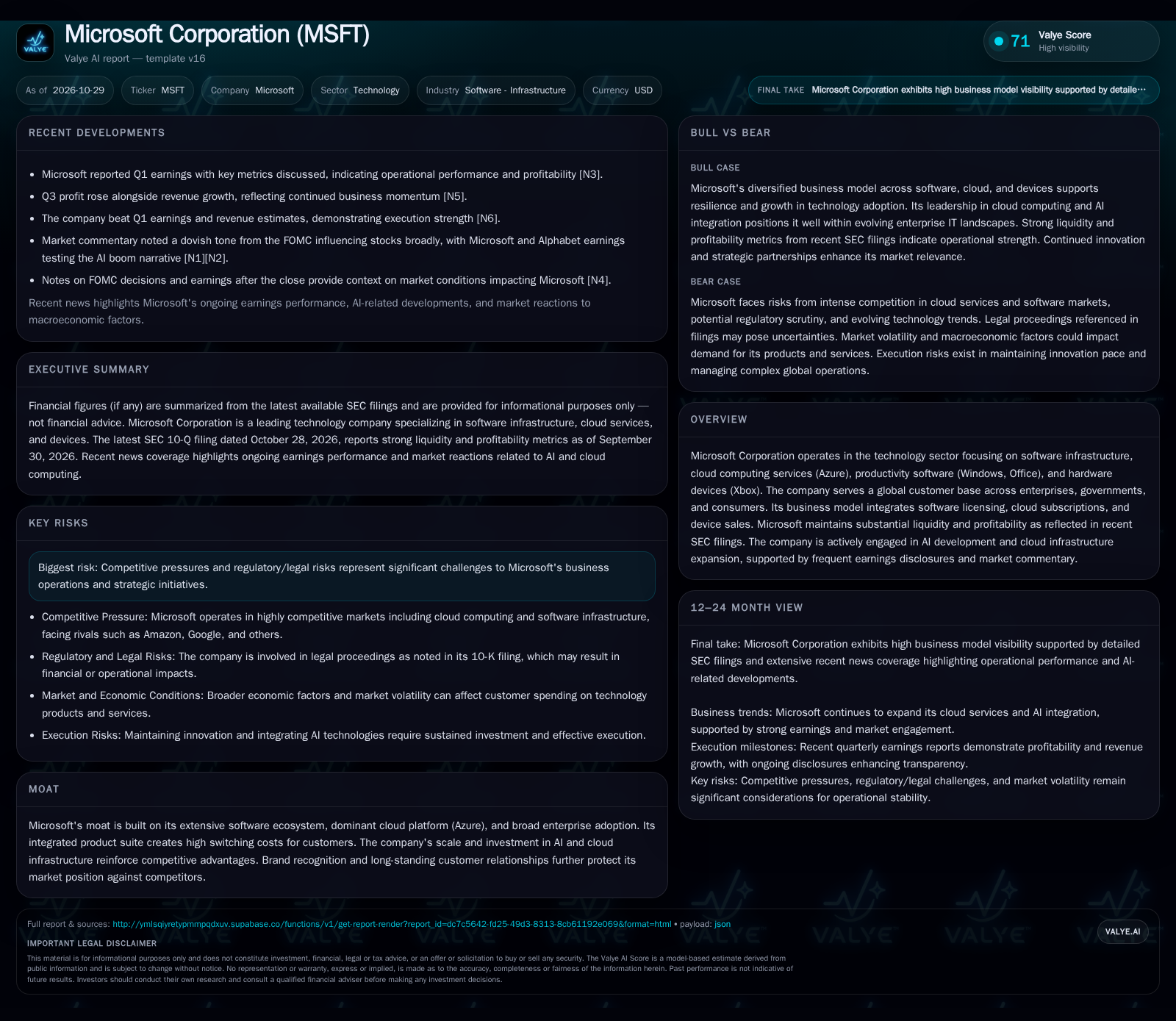
Microsoft reported strong Q1 and Q3 results with growing profits and revenue, reflecting continued momentum in core cloud and software businesses. The company’s substantial liquidity and robust earnings highlight operational strength, while its strategic focus on AI and cloud integration positions it for further growth. However, competition from major technology peers and potential regulatory/legal risks remain material headwinds. Sustained outperformance will require ongoing innovation, effective execution, and navigating a complex regulatory landscape. [S2] [N3] [N5] [N6]
Microsoft’s latest quarterly filings and earnings headlines reinforce its position as a technology bellwether, showing both strong financial performance and the complexity of sustaining leadership in a rapidly evolving market. Reporting net income of $36.629 billion for the September 2026 quarter and consistently beating revenue and profit estimates, Microsoft demonstrates the operating leverage of its diversified model anchored in software, cloud, and AI. However, as the company leans further into AI-driven growth and cloud infrastructure, it faces mounting competition from other tech giants and growing regulatory scrutiny. The next phase of Microsoft’s trajectory will hinge on its ability to maintain innovation leadership, execute at scale, and manage legal and market risks that could meaningfully impact its future economics and strategic optionality. [S2] [N3] [N5] [N6]
Recent Financial Performance Highlights Microsoft’s Resilient Operating Model
Microsoft reported net income of $36.629 billion and diluted EPS of $4.92 for the quarter ending September 30, 2026, with Q1 and Q3 results both exceeding market expectations [S2] [N3] [N5] [N6]. This ongoing earnings outperformance signals the strength and durability of Microsoft’s core businesses across cloud, software, and devices. The company reported cash and liquidity metrics for the period; these figures do not by themselves establish operating runway, investment capacity, financial flexibility, or financing capacity. [S2] Recent news commentary also anchors Microsoft at the center of the AI adoption narrative, as market participants scrutinize whether the company can sustain its AI-driven growth trajectory [N2]. These facts matter because they reinforce both the company’s ability to generate large-scale profits and its central role in the next phase of technology infrastructure and AI platform competition.
How Microsoft’s Mix of Recurring Revenue and Cloud Scale Drives Profits
Microsoft’s business model is built around a blend of recurring software licensing (e.g., Windows, Office), fast-growing cloud subscriptions (Azure), and hardware sales (Xbox), each with distinct margin profiles and operating leverage. The economics of software and cloud subscriptions are especially attractive: high gross margins on software, low incremental delivery costs, and the potential for significant operating leverage as revenue scales. Azure’s infrastructure-as-a-service and platform-as-a-service offerings provide volume-driven growth, but are exposed to price competition and require substantial capital investment in data centers and AI infrastructure.
Enterprise contracts, multi-year cloud agreements, and integration with legacy IT systems create switching frictions, which can support pricing power and customer retention, but the extent of these frictions varies by product and customer segment. The rise of AI services—such as Copilot for Office and Azure OpenAI integration—could further increase average contract values if adoption is robust, but also introduces higher R&D and infrastructure costs. The company’s scale allows it to amortize fixed costs over a vast installed base, supporting margins even as it invests heavily in cloud and AI. However, sustaining this advantage will require continued capital deployment for infrastructure and ongoing innovation to justify premium pricing and defend against commoditization.
Defending the Moat: Integration, Ecosystem Lock-In, and New Rivals in Cloud and AI
Microsoft’s competitive advantages stem from its integrated product suite, entrenched enterprise relationships, and the breadth of its software and cloud ecosystem. High switching costs are created by deep integration between Office, Windows, Azure, and security/compliance features, making wholesale migration to competitors operationally risky and costly for large organizations. These factors, reinforced by Microsoft’s brand and global reach, create a durable moat in core markets.
However, competitive pressure remains intense in cloud infrastructure and AI services, with Amazon Web Services and Google Cloud Platform as primary rivals, and a growing cohort of smaller AI-native entrants. While Microsoft’s partnership and investment in OpenAI have helped it leapfrog in some AI capabilities, these advantages may erode as open-source models and alternative AI platforms proliferate. Regulatory scrutiny—especially around bundling, platform power, and data privacy—could constrain Microsoft’s ability to integrate new features or drive cross-sell. The company’s ability to maintain its ecosystem lock-in will be tested as customers increasingly demand modular, interoperable solutions and as rivals invest aggressively in their own AI and cloud offerings.
AI Adoption and Cloud Expansion Outpace Expectations
In a favorable scenario, Microsoft successfully accelerates enterprise adoption of its AI-enhanced cloud services, driving higher Azure revenue growth and expanding average contract values. The company leverages its integration of generative AI into Office, Dynamics, and Azure to create differentiated offerings that justify premium pricing and increase customer stickiness. Capital investments in AI infrastructure yield both technological leadership and cost efficiencies, while regulatory actions do not materially impede new product rollouts or bundling strategies.
Evidence that would confirm this scenario includes sustained double-digit Azure revenue growth, rapid uptake of Copilot and other AI modules across the enterprise base, and increasing multi-year cloud commitments. If Microsoft is able to expand margins in cloud and software segments despite higher infrastructure costs, and if customer churn remains low or declines, it would further validate the upside thesis. Announcements of major new enterprise AI wins or industry partnerships would provide additional confirmation.
Software and Cloud Growth Moderates Amid Execution and Regulatory Hurdles
The most plausible outcome is that Microsoft continues to deliver steady growth in software and cloud, but at a moderated pace as competitive intensity and regulatory complexity increase. AI-driven enhancements to Office and Azure provide incremental revenue uplift, but pricing pressure in cloud infrastructure and rising R&D and compliance costs partially offset margin gains. The company maintains its leadership position in enterprise IT, but faces periodic challenges in integrating new technologies and responding to evolving customer demands.
Confirmation of this scenario would come from revenue and earnings growth in line with recent trends, but with slowing Azure growth rates or increased disclosure of customer migration to rival platforms. Regulatory updates that impose new compliance costs or restrict bundling would reinforce the base case. If Microsoft continues to beat consensus estimates but by narrowing margins, or if capital expenditures for data centers and AI infrastructure remain elevated, it would suggest the company is investing to defend share rather than driving outsized new growth.
Regulatory and Competitive Disruption Erode Margins and Growth
In a negative scenario, regulatory interventions—such as antitrust actions, forced unbundling, or data privacy restrictions—meaningfully constrain Microsoft’s ability to cross-sell, bundle, or integrate new AI features. At the same time, aggressive competition from AWS, Google, and AI-native challengers drives down pricing in cloud and AI services, leading to margin compression and potential loss of enterprise customers. Large-scale enterprise migrations or a shift toward open-source AI platforms could further weaken Microsoft’s lock-in.
Evidence for this scenario would include regulatory rulings that limit Microsoft’s integration strategies, public disclosures of large customer defections, or a marked slowdown in Azure and Office growth. If profit margins decline sharply due to price wars or escalating compliance costs, and if Microsoft is forced to restructure or spin off business units, the downside would be playing out. Heightened legal expenses and adverse outcomes in ongoing proceedings would reinforce this risk.
What Will Determine Microsoft’s Next Phase of Outperformance or Risk?
Azure revenue growth rate and the contribution of AI-enhanced services to total cloud revenue, if disclosed, would help test the pace and sustainability of cloud/AI adoption.
Adoption rates and revenue impact of Copilot and other AI-infused modules across Office and Dynamics suites would provide evidence for incremental monetization.
Gross and operating margin trends, particularly within the cloud and productivity segments, would clarify whether pricing power or margin compression is emerging.
Disclosure of major enterprise customer wins or losses, and the renewal/retention rates for multi-year contracts, would signal competitive dynamics.
Capital expenditure levels for data center and AI infrastructure buildout, and commentary on ROI, would reveal the cost of sustaining technological leadership.
Updates on ongoing legal proceedings or regulatory actions—especially those related to antitrust, bundling, or data privacy—would indicate the scale of external risks.
Employee headcount trends and R&D spending, if disclosed, would inform the company’s capacity to innovate and execute on its AI roadmap.
Disclaimer: This is research-only, informational analysis and not investment advice. It may include AI-generated interpretation and general industry context. Always verify important details using primary sources.

Comments