
Universal Display: OLED Intellectual Property Leverage and the Dynamics of Royalty-Driven Growth
Universal Display’s high-margin licensing model, underpinned by a substantial patent portfolio in OLED technology, delivers strong profitability and liquidity. As OLED adoption broadens, the company’s fortunes hinge on IP enforcement, the pace of next-gen display rollouts, and the durability of royalty streams amid industry and legal headwinds.
Universal Display demonstrates robust profitability and liquidity, benefiting from OLED technology’s expanding adoption and its IP-centric business model. Its ability to sustain royalty-driven growth will depend on the outcome of patent challenges, demand cycles in consumer electronics, and the evolving competitive landscape.
Universal Display stands at a pivotal intersection of technology enablement and intellectual property monetization in the OLED ecosystem. Its Q3 2026 results underscore a business model built on high-margin licensing and materials sales, supported by a formidable patent portfolio and substantial liquidity. As OLED continues to proliferate across mobile, TV, automotive, and other display segments, Universal Display’s ability to sustain and grow its royalty streams will be tested by patent disputes, evolving customer strategies, and the relentless pace of display technology innovation. The company’s future trajectory hinges on its capacity to defend its IP, maintain relevance as a technology licensor, and navigate the cyclical dynamics of global electronics demand.
Recent Financials and Legal Landscape Shape the Near-Term Outlook
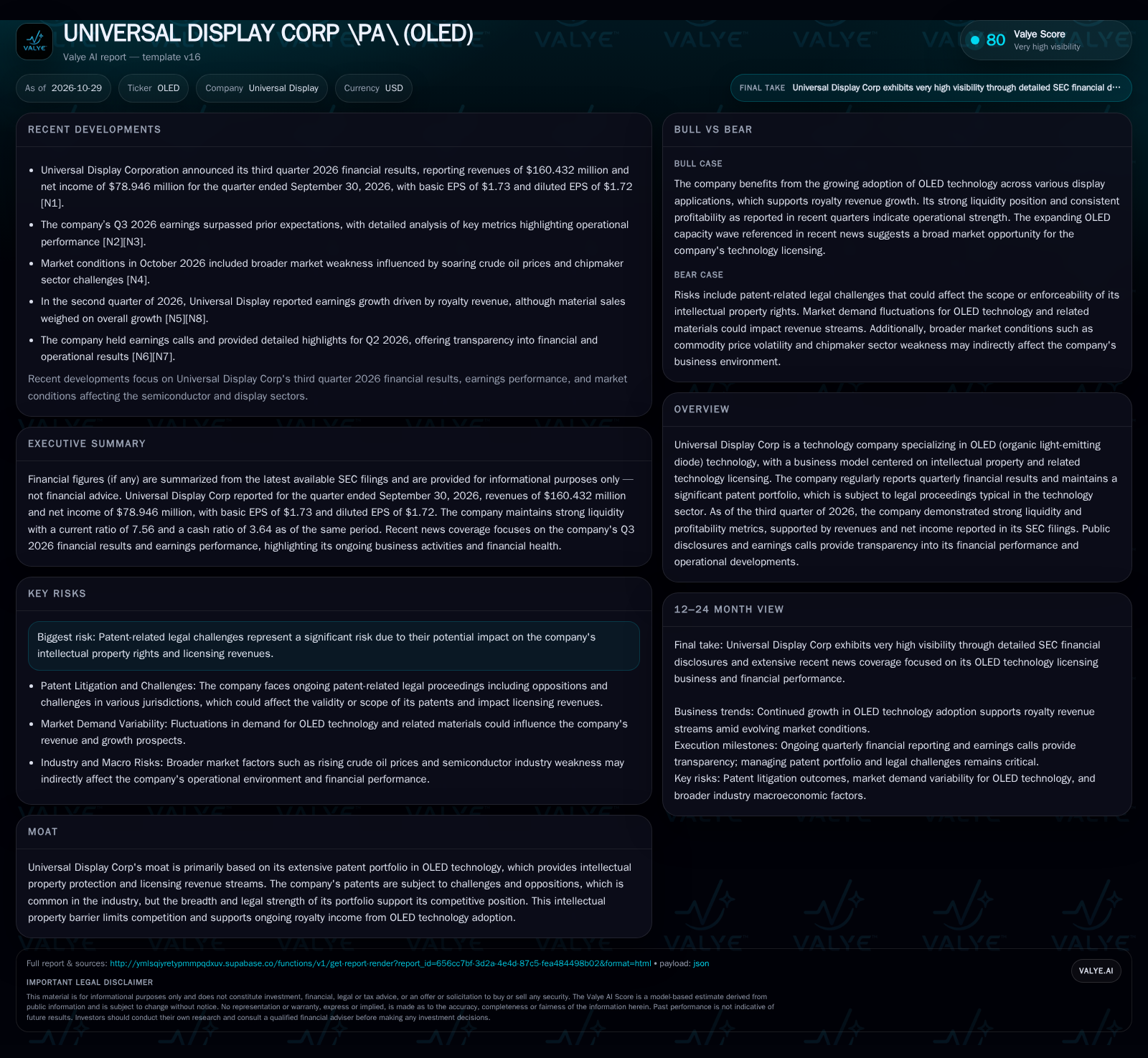
Universal Display reported Q3 2026 revenues of $160.4 million and net income of $78.9 million, demonstrating the profitability of its underlying business model [S2] [N1]. The company’s balance sheet is exceptionally liquid, with $93.4 million in cash and $340 million in short-term investments, yielding a current ratio of 7.56 [S2]. The company reported cash and liquidity metrics for the period; these figures do not by themselves establish operating runway, investment capacity, financial flexibility, or financing capacity.
The business continues to face patent-related legal proceedings in multiple jurisdictions, a reflection of both the value and vulnerability of its extensive IP portfolio [S2]. The outcome of these proceedings could directly impact the scope and sustainability of royalty streams, which are increasingly central to Universal Display’s growth as OLED technology matures and adoption widens.
IP Licensing Economics and the Leverage of Royalty Streams
Universal Display’s revenue model is anchored in two primary streams: IP licensing—where it receives royalties from display manufacturers using its patented OLED technologies—and the sale of proprietary OLED materials. The company’s Q3 2026 results highlight the high-margin nature of licensing, with royalty revenues outpacing material sales growth [N5] [N8]. This structure provides operating leverage, as incremental licensing revenue typically incurs minimal direct cost, allowing a large portion to flow through to the bottom line.
Variable costs are more closely tied to material sales, while fixed costs are dominated by R&D and ongoing patent defense and prosecution. As OLED adoption grows, the company’s capital needs remain moderate compared to manufacturers with large-scale fabrication operations. However, the sustainability of the model depends on the enforceability of IP rights and the renewal or renegotiation of licensing agreements as display technologies evolve.
Should display manufacturers find alternative technologies or successfully challenge key patents, the economics could shift rapidly.
The interplay between licensing revenue and material sales also introduces strategic considerations regarding customer dependency and bargaining power. As licensing royalties become a larger share of total revenue, Universal Display’s financial performance becomes increasingly sensitive to the volume of OLED panels produced by licensees. This concentration risk implies that shifts in a few major manufacturers’ production strategies or technology choices could disproportionately impact the company’s top line. Moreover, the company must continuously balance investment in R&D to maintain its patent portfolio’s relevance against the diminishing returns of older patents, ensuring that the marginal cost of innovation does not outpace the incremental royalty income derived from new technologies.
Patent Portfolio as a Barrier—and a Battleground—in a Shifting Display Market
Universal Display’s competitive edge rests on its broad and deep portfolio of OLED patents, which serve as both a barrier to entry and a source of leverage in negotiations with display makers. This portfolio has enabled the company to secure licensing relationships with major panel manufacturers, extracting royalties as OLED panels are adopted in smartphones, TVs, wearables, automotive displays, and more.
However, the IP-centric model is not unassailable. Patent expirations, successful legal challenges, or the emergence of alternative display technologies (such as MicroLED or quantum dot) could erode Universal Display’s bargaining power. The company faces competition not only from other IP holders and material suppliers, but also from vertically integrated electronics giants that may seek to develop or license around key technologies.
The competitive environment is further complicated by regional patent law variations and the willingness of some manufacturers to contest or delay royalty payments. Universal Display’s ability to maintain its ‘moat’ will depend on the continued relevance of its patents to next-generation display architectures and its effectiveness in defending them.
The patent portfolio’s effectiveness as a competitive barrier is also contingent on the evolving standards and interoperability requirements within the display industry. As manufacturers seek to optimize performance, cost, and supply chain resilience, the relevance of specific patented technologies may fluctuate, potentially necessitating adaptive licensing terms or cross-licensing arrangements. Additionally, the geographic scope of patent enforcement plays a critical role; jurisdictions with weaker intellectual property protections or slower judicial processes may serve as loopholes for licensees or competitors, undermining the portfolio’s global leverage. Consequently, Universal Display’s strategic focus on jurisdictions with robust IP enforcement mechanisms is essential to sustaining its royalty streams and deterring infringement.
Royalty Acceleration if OLED Penetration Outpaces Patent Attrition
A favorable scenario could unfold if OLED adoption accelerates across new device categories—such as automotive dashboards, foldable displays, and mid-tier TVs—while Universal Display’s core patents remain enforceable and licensees continue to pay royalties. In this outcome, the company’s high-margin licensing revenues would scale with industry volume, potentially outpacing any incremental legal or R&D expense.
Confirmation of this scenario would include: sustained or growing royalty revenue outpacing material sales, disclosure of new or expanded licensing agreements, and favorable outcomes in ongoing patent litigation. Additionally, visible OLED capacity expansions by leading manufacturers and the absence of disruptive alternative technologies gaining share would support the upside case.
Royalty Streams Endure Amid IP Challenges and Incremental OLED Adoption
The most plausible path forward is a continuation of gradual OLED adoption in consumer devices and automotive applications, with Universal Display’s royalty streams growing modestly but facing ongoing legal and renewal headwinds. Material sales may fluctuate with end-market demand, and the company will likely need to defend its IP portfolio in court and at the patent office as older patents expire or are challenged.
Evidence supporting this scenario would be stable or slightly growing total revenue, periodic legal expenses, and continued references to both new licensees and the extension of existing agreements. The scenario would be challenged if significant patents were invalidated or if a major display manufacturer publicly defected or negotiated materially lower royalty rates.
Patent Erosion or Technological Leapfrogging Disrupts Royalty Model
A negative outcome could materialize if Universal Display loses key patent litigation, leading to invalidation or narrowing of its most valuable IP and a reduction in enforceable royalty streams. Alternatively, a rapid shift to non-OLED display technologies—such as MicroLED—could diminish the relevance of the company’s portfolio and reduce licensing opportunities.
This scenario would be confirmed by adverse court judgments, significant declines in disclosed royalty revenue, or public statements from major licensees ceasing payments or adopting alternative technologies. Material sales would likely be insufficient to offset a structural decline in licensing income, leading to margin compression and possibly a re-evaluation of the company’s long-term business model.
Milestones and Metrics That Will Shape Universal Display’s Royalty-Driven Thesis
Quarterly and annual royalty revenue growth versus material sales—if disclosed—will reveal the health and trajectory of the licensing model.
Updates on the status, outcome, or settlement of major patent litigation and opposition proceedings in key jurisdictions.
Announcements of new or expanded licensing agreements with major display manufacturers, particularly in emerging OLED applications.
Evidence of OLED technology adoption rates in core markets (smartphones, TVs) and new verticals (automotive, wearables, IT displays).
Patent expiration schedules, and the company’s ability to refresh its portfolio with new foundational inventions.
Any disclosed defection, non-renewal, or public dispute with a major licensee, which could signal pressure on the royalty base.
R&D progress and disclosures around next-generation OLED materials or architectures that could sustain the company’s innovation edge.
Disclaimer: This is research-only, informational analysis and not investment advice. It may include AI-generated interpretation and general industry context. Always verify important details using primary sources.

Comments