
Illinois Tool Works: Margin Expansion, Portfolio Discipline, and the Challenge of Sustained Differentiation
ITW’s Q3 2026 results underscore the strength of its proprietary business model, with organic growth, margin gains, and segment resilience. Yet, strategic portfolio simplification, geographic pressures, and the durability of its competitive advantages are key variables for the next phase.
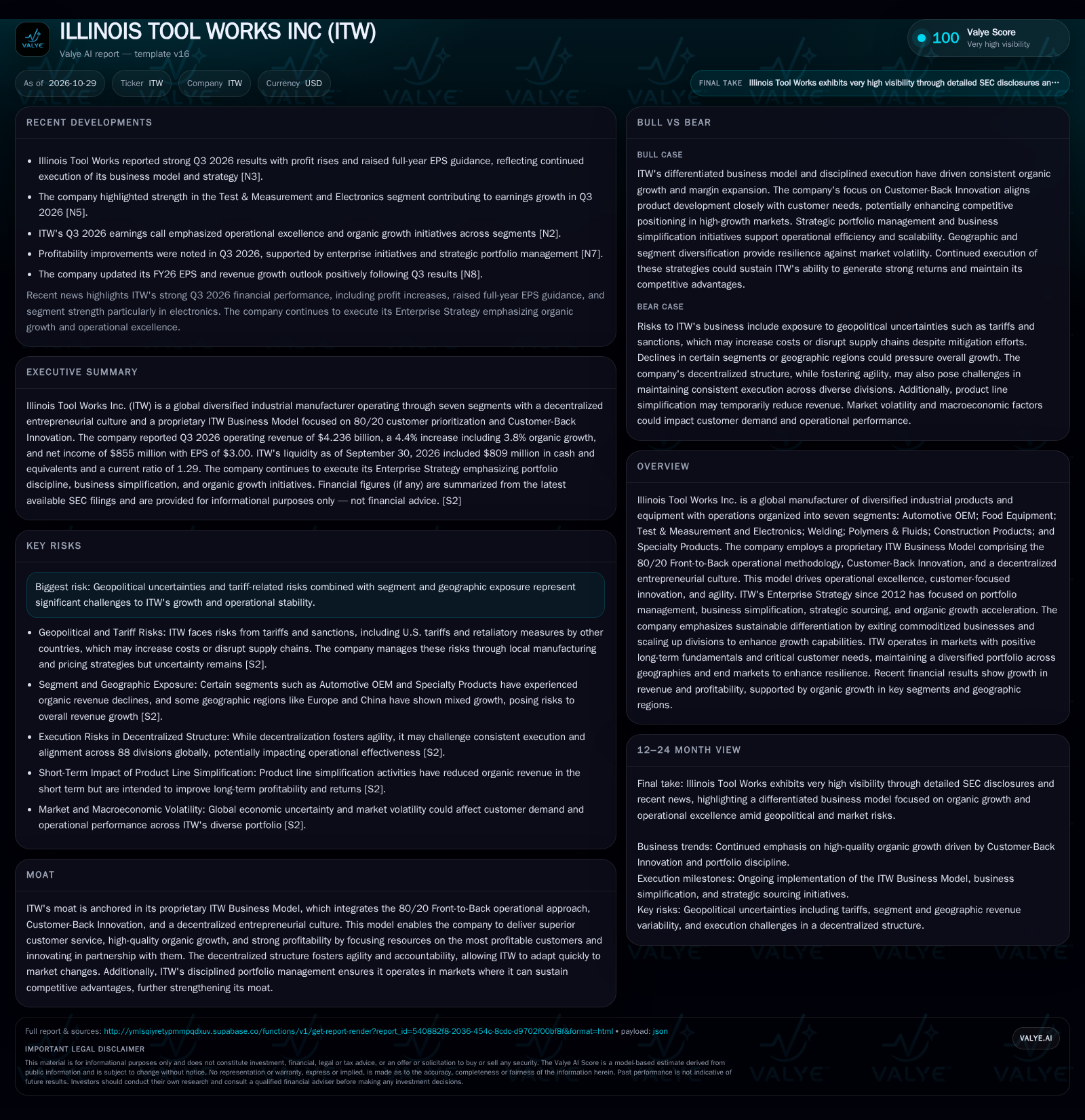
Illinois Tool Works delivered 4.4% revenue growth and 40 basis points of margin expansion in Q3 2026, with strong results from Test & Measurement and Electronics offsetting softness in Automotive OEM and Specialty Products. The ITW Business Model—anchored in 80/20 customer focus, decentralized innovation, and disciplined portfolio management—remains central to its resilience and profitability. Key questions ahead center on the pace of organic growth, the impact of ongoing product line simplification, and the ability to sustain differentiation amid geopolitical and macroeconomic pressures. [S2] [N3] [N5] [N8]
Illinois Tool Works Inc. (ITW) continues to validate its business model in a complex industrial landscape, generating above-market organic growth and margin expansion in Q3 2026. While the company’s 80/20 customer prioritization and Customer-Back Innovation have delivered operational excellence and resilience, the current period also reveals the balancing act between portfolio simplification and top-line momentum. As ITW raises its full-year EPS outlook, investors must weigh the enduring strengths of its decentralized model and diversified end-markets against persistent segment headwinds, macro volatility, and the challenge of sustaining differentiation in a shifting global environment.
Recent Performance Highlights Margin and Segment Divergence
Illinois Tool Works reported Q3 2026 operating revenue of $4.236 billion, up 4.4% year-over-year, with organic growth accounting for 3.8% of the increase. Operating income rose 5.9% to $1.177 billion, and operating margin improved by 40 basis points to 27.8%. Net income for the quarter was $855 million, with EPS of $3.00. Segment performance was uneven: Test & Measurement and Electronics, Polymers & Fluids, and Welding segments posted growth, while Automotive OEM and Specialty Products saw declines. Notably, North America drove 6.0% organic growth, but EMEA declined and Asia Pacific grew modestly at 3.4%. Product line simplification reduced organic revenue by 40 basis points in Q3, though management expects this to benefit long-term profitability. The company raised its full-year EPS and revenue guidance following these results. [S2] [N3] [N5] [N8]
How ITW’s Model Drives Margin and Capital Efficiency
ITW’s economics are shaped by its proprietary business model, which combines the 80/20 Front-to-Back operational discipline, Customer-Back Innovation, and a decentralized structure. The 80/20 methodology channels resources toward the top 80% of customers, driving higher gross margins by reducing complexity and cost-to-serve for less profitable accounts. Customer-Back Innovation aligns product development with critical customer needs, often resulting in differentiated solutions that command premium pricing and support share retention or gains.
The company’s business simplification and strategic sourcing initiatives reinforce operating leverage, as evidenced by the 40 basis point margin improvement in Q3 2026. ITW’s cost structure reflects a mix of fixed and variable elements: while manufacturing assets require upfront capital, the focus on high-value, engineered products and local manufacturing mitigates the risk of overcapacity and allows for flexible cost management. The company’s capital requirements are moderate compared to heavy industrial peers, due to its asset-light divisional model and disciplined portfolio management. Strategic sourcing has delivered a roughly 1% annual spend reduction since 2013, compounding margin gains over time. [S2]
Organic growth ambitions (4%+ through the cycle) are underpinned by selective investments in R&D, engineering, and customer-facing resources, supported by ongoing portfolio pruning. The company reported cash and liquidity metrics for the period; these figures do not by themselves establish operating runway, investment capacity, financial flexibility, or financing capacity. [S2]
Sustaining Differentiation in Diversified Industrials
ITW’s moat is rooted in its ability to deliver tailored, often proprietary solutions to customers across diverse end-markets, leveraging its 80/20 and innovation frameworks. The decentralized structure empowers 88 divisions to adapt quickly to customer and market changes, supporting agility and accountability. This approach contrasts with more centralized industrial conglomerates that may struggle with bureaucratic inertia.
However, the competitive landscape is fluid. In each of its seven segments, ITW faces competition from global diversified manufacturers and focused niche players. The company’s exit from commoditized businesses and focus on sustainable differentiation is meant to avoid price-based competition, but it also reduces exposure to volume-driven recoveries during cyclical upswings. Customer relationships and embedded solutions can increase switching costs, but the degree of retention and pricing power varies by segment and application—metrics not specifically disclosed in current filings.
Technology substitution and evolving customer requirements represent ongoing risks. For example, in Automotive OEM, electric vehicle adoption and platform shifts can disrupt established supply relationships, while in Electronics, rapid innovation cycles favor nimble, specialized competitors. ITW’s resilience will depend on its ability to continuously refresh its value proposition and avoid margin erosion from new entrants or substitutes.
When Portfolio Discipline and Innovation Compound
A favorable scenario sees ITW’s business simplification and Customer-Back Innovation efforts yielding both sustained organic growth and further margin expansion. If the company continues to exit low-value product lines without significant loss of cross-selling or customer relationships, the mix shift could drive higher average margins and more stable cash flows. Successful innovation, particularly in high-growth areas like Test & Measurement and Electronics or advanced welding solutions, could allow ITW to gain share and command premium pricing, offsetting sluggish segments.
Confirmation would come from several quarters of 4%+ organic growth, further margin improvements, and a narrowing performance gap between segments. Consistent above-peer returns on invested capital and evidence of successful new product launches or customer wins—especially in segments exposed to secular growth—would support the case. Material accretive acquisitions in targeted segments could also provide incremental upside.
Balancing Growth, Simplification, and Volatility
The most plausible trajectory is one in which ITW maintains steady, mid-single-digit organic growth and modest but consistent margin improvement, with performance varying by segment and geography. Portfolio simplification continues to create short-term revenue headwinds but supports long-term profitability. Some segments, such as Automotive OEM and Specialty Products, may lag due to cyclical or structural pressures, while stronger areas like Electronics and Welding offset the drag.
Over time, the company’s decentralized model and operational discipline allow it to adapt to market changes, but do not fully insulate it from macro volatility or competitive encroachment. Confirmation of this scenario would include organic growth near management’s 4% through-the-cycle target, stable or gradually improving margins, and continued portfolio adjustments. Falsification would involve a sustained decline in organic growth, margin compression, or evidence that simplification is eroding customer relationships or stalling innovation.
If Differentiation Fades and Volatility Bites
A bearish scenario emerges if ITW’s differentiation proves less durable than expected, or if macro/geopolitical shocks overwhelm the company’s operational advantages. For instance, a deeper downturn in Automotive OEM, prolonged weakness in EMEA or China, or rising tariff and supply chain disruptions could lead to negative organic growth and margin contraction. If product line simplification accelerates revenue declines without corresponding margin benefits—or if decentralized execution falters across divisions—profitability could erode.
Early warning signs would include consecutive quarters of declining organic revenue, widening disparities between segment performance, or evidence that pricing power and customer retention are slipping. Material write-downs, restructuring charges, or a cut to EPS guidance would further support this scenario.
What Will Shape ITW’s Margin and Growth Trajectory Next?
Sustained organic revenue growth by segment, especially in lagging areas like Automotive OEM and Specialty Products, would help test whether portfolio simplification is enhancing or eroding the company’s growth engine.
Quarterly and annual trends in operating margin, including the impact of further simplification and strategic sourcing, will reveal whether ITW can continue to expand profitability.
New product introductions, major customer wins (if disclosed), or evidence of share gains from Customer-Back Innovation would signal the durability of ITW’s differentiation.
Geographic performance—particularly in EMEA and China—should be monitored for signs of persistent weakness or recovery, given their recent volatility.
The pace and financial impact of divestitures or acquisitions will help determine if ITW is maintaining its disciplined approach to portfolio management.
Developments in geopolitical risks, including tariffs or sanctions, and the company’s ability to offset these through local manufacturing and pricing strategies, could materially affect margins and growth.
If disclosed, customer retention rates or recurring revenue metrics would provide insight into the stickiness of ITW’s solutions and the resilience of its business model.
Any sustained deviation from management’s long-term targets for organic growth (4%+) or return on invested capital would be a critical signal for thesis reassessment.
Disclaimer: This is research-only, informational analysis and not investment advice. It may include AI-generated interpretation and general industry context. Always verify important details using primary sources.

Comments