
NeoGenomics: Innovation in Oncology Diagnostics Confronts Scale, Margin, and Execution Tests
NeoGenomics’ Q3 2026 revenue beat and new product launches highlight its strategic positioning in cancer diagnostics, but persistent net losses and intense competition underscore the operational and financial hurdles ahead.
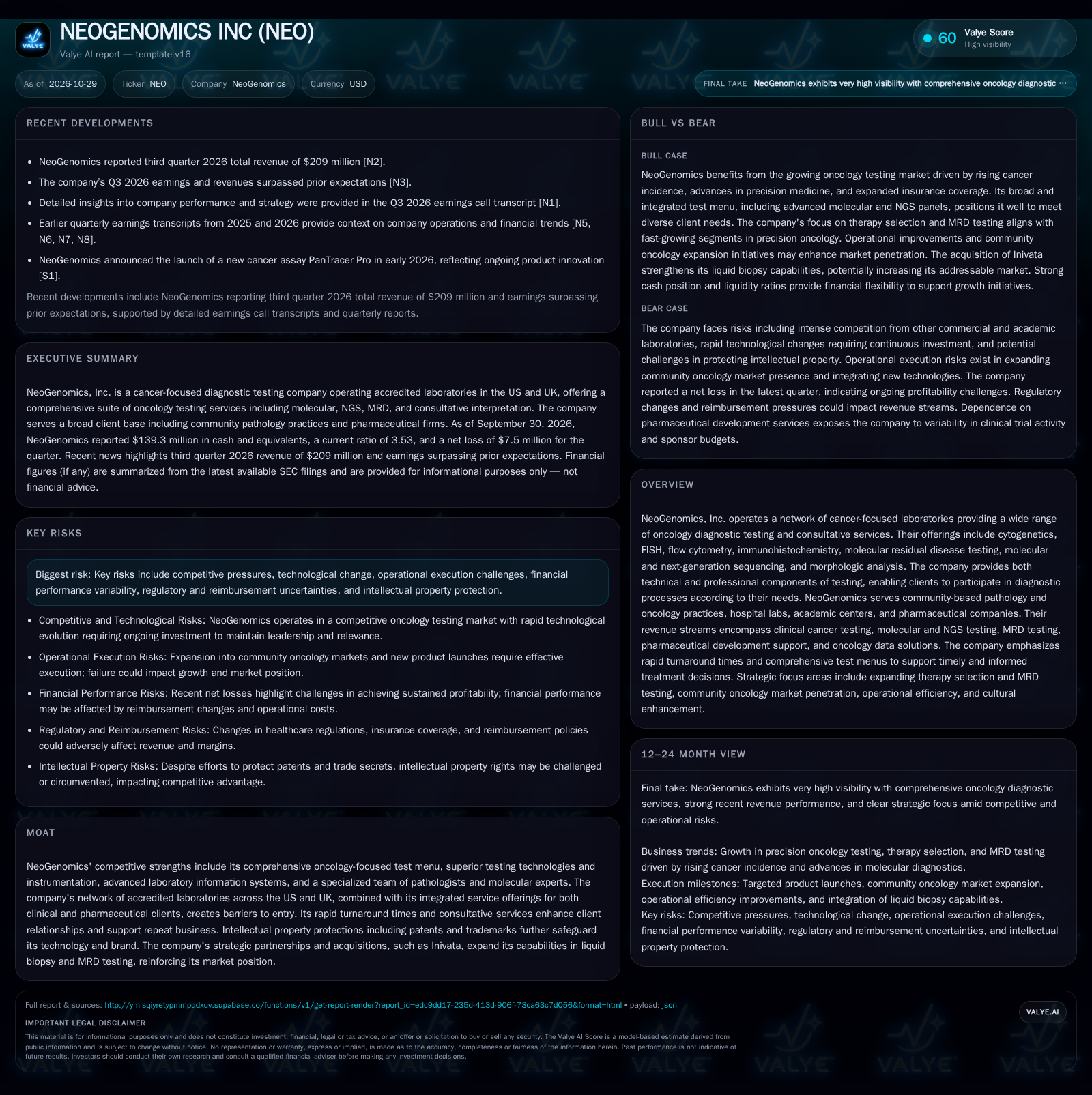
NeoGenomics reported Q3 2026 revenue of $209 million, surpassing expectations and underlining strong demand for its oncology diagnostics. However, a net loss of $7.5 million for the quarter demonstrates ongoing profitability challenges. The company’s future hinges on the adoption of new testing modalities, operational leverage, and navigating reimbursement and competitive pressures. [N2] [N3] [S2] [S1]
NeoGenomics, Inc. stands at a pivotal juncture in the fast-evolving cancer diagnostics landscape. Its Q3 2026 results demonstrated both robust revenue momentum—driven by broad-based demand for advanced oncology testing—and the persistent challenge of attaining sustained profitability. With the recent launch of its PanTracer Pro assay and a focus on precision medicine, NeoGenomics is betting on innovation and operational scale to drive future growth. Yet, as competition intensifies and reimbursement dynamics remain fluid, the company’s ability to translate top-line gains into durable earnings will be a key determinant of long-term value.
Recent Revenue Momentum and Product Launches Shape the Short-Term Outlook
NeoGenomics reported Q3 2026 revenue of $209 million, beating analyst expectations and marking a continuation of top-line growth. This performance was accompanied by a net loss of $7.5 million, highlighting that, despite scale, the company has yet to consistently achieve profitability. The launch of the PanTracer Pro cancer assay in early 2026 expands NeoGenomics’ test portfolio and signals ongoing investment in innovation. [N2] [N3] [S2] [S1]
Revenue Streams, Margin Structure, and the Scaling Challenge in Oncology Diagnostics
NeoGenomics derives revenue from clinical cancer testing, molecular and next-generation sequencing (NGS), minimal residual disease (MRD) testing, pharmaceutical development services, and oncology data solutions. The economics of this model hinge on high-volume, high-complexity lab operations with significant fixed costs—such as laboratory infrastructure, compliance, and specialized talent—offset by variable costs tied to test volumes and mix. While comprehensive test menus and rapid turnaround times can justify premium pricing, reimbursement rates are often negotiated with payors and subject to regulatory shifts, compressing margins.
The company’s ability to achieve operating leverage depends on driving higher sample volumes, expanding into high-value segments like MRD and therapy selection, and improving laboratory efficiency. However, persistent net losses suggest that either cost structure or pricing/mix is not yet optimized at current scale. The expansion into pharmaceutical services and data solutions could enhance margins, but these segments are typically more volatile and dependent on external clinical trial activity. Capital needs remain significant for ongoing innovation, automation, and compliance.
A critical factor influencing NeoGenomics’ margin structure is the reimbursement landscape, which is inherently dynamic and can significantly affect pricing power. Changes in payer policies, shifts toward value-based reimbursement, and increased scrutiny on test utility may compel the company to demonstrate clear clinical benefit and cost-effectiveness to maintain or improve reimbursement levels. Consequently, NeoGenomics must invest in robust health economics and outcomes research to support its assays’ value propositions. Failure to do so could exacerbate margin compression, especially in commoditized test categories where payors have multiple alternatives.
Operational scaling also entails balancing capacity utilization with quality control and regulatory compliance. As testing volumes grow, maintaining stringent laboratory standards and accreditation requirements becomes increasingly complex and costly. Automation and process standardization can mitigate some fixed costs, but initial capital outlays and ongoing maintenance expenses may delay margin improvement. Moreover, the heterogeneity of test types—from high-volume routine assays to specialized, low-volume MRD tests—introduces complexity in workflow optimization, requiring flexible yet efficient lab configurations to avoid bottlenecks and ensure turnaround time commitments.
Competitive Differentiation Versus Structural Headwinds in Oncology Lab Services
NeoGenomics competes with large commercial labs, academic medical centers, and emerging precision oncology startups. Its key differentiators include a broad, integrated test menu, advanced laboratory information systems, and a network of accredited labs in the US and UK. The company’s consultative services and rapid turnaround times are designed to strengthen customer stickiness, especially among community oncology and pathology practices. The acquisition of Inivata has expanded its presence in liquid biopsy and MRD testing—fast-growing, high-value areas.
However, competitive intensity remains high, with rivals frequently introducing new molecular assays and leveraging scale for pricing power. Technology substitution risk is elevated: advances in at-home testing, point-of-care diagnostics, or disruptive sequencing platforms could shift the value chain. Additionally, academic centers continue to innovate at the high end, while larger labs compete on cost and breadth. NeoGenomics’ ability to defend its position will depend on sustained innovation, service differentiation, and efficient scaling.
Precision Oncology Adoption and Operational Leverage Drive Margin Expansion
In a favorable scenario, NeoGenomics capitalizes on rising demand for precision oncology and MRD testing. Broad adoption of new assays like PanTracer Pro, combined with deeper penetration into community oncology practices, drives higher sample volumes and a richer test mix. Operational improvements—such as automation, workflow optimization, and digital integration—unlock margin expansion, while pharmaceutical and data services contribute a growing share of revenues with higher incremental margins.
Confirmation of this scenario would include sustained double-digit revenue growth, sequential improvement in gross and operating margins, successful cross-selling of new tests, and visible wins in pharma services. A shift toward positive net income and free cash flow, alongside evidence of customer retention and expanded payer contracts, would further validate the upside.
Innovation and Growth Offset by Margin Pressure and Execution Demands
The most likely outcome is that NeoGenomics continues to grow its top line through innovation, new product launches, and incremental share gains in community oncology. However, ongoing margin pressure from reimbursement headwinds, competitive pricing, and the need for continuous investment in technology and compliance limits profitability gains. Pharmaceutical services and data solutions provide diversification but remain variable and subject to external dynamics.
Evidence supporting this scenario would be continued revenue growth in the high single to low double digits, intermittent net losses or breakeven quarters, and modest improvement in cost efficiency. Signs of progress in new test adoption and operational execution, but with lagging margin expansion, would reinforce this base case.
Competitive and Regulatory Pressures Undermine Profitability and Strategic Flexibility
In the adverse scenario, NeoGenomics faces intensified competition from both larger labs and nimble startups, leading to pricing pressure and the commoditization of core testing services. Regulatory or reimbursement changes reduce payment rates for key assays, compressing margins further. Execution missteps in new product launches or community oncology expansion result in underutilized capacity and rising fixed costs. Pharmaceutical services, instead of offsetting volatility, become a drag due to clinical trial slowdowns or sponsor budget cuts.
Confirmation would come from revenue growth stalling or reversing, sustained or widening net losses, negative cash flow, and the need to curtail investment or raise additional capital. Customer attrition, delays in new test rollouts, or adverse reimbursement decisions would further substantiate the downside.
Milestones and Metrics That Will Shape NeoGenomics’ Strategic Trajectory
Quarterly revenue growth rates and their drivers by segment (clinical, molecular/NGS, MRD, pharma services) would help assess competitive and operational momentum.
Gross and operating margin progression, especially in the context of new product launches and automation initiatives, is critical to evaluating scalability.
Adoption rates and revenue contribution from new assays such as PanTracer Pro—if disclosed—would signal success in innovation and market penetration.
Net income and free cash flow trends, including any movement toward profitability or persistent losses, are essential for gauging financial sustainability.
Customer retention, contract renewals, and expansion within community oncology clients—either through disclosed metrics or qualitative commentary—would test customer loyalty and stickiness.
Reimbursement rate developments, payer contract wins/losses, and regulatory changes impacting test pricing could materially alter margin structure.
Pharmaceutical services revenue variability and pipeline updates—if disclosed—would indicate exposure to external clinical trial cycles and diversification success.
Disclaimer: This is research-only, informational analysis and not investment advice. It may include AI-generated interpretation and general industry context. Always verify important details using primary sources.

Comments