
CONMED Corp: Global Diversification, Product Innovation, and the Shifting Economics of Medtech Growth
CONMED’s robust international footprint, solid Q3 2026 performance, and capital allocation shifts highlight a business navigating both opportunity and risk. The interplay between new product adoption, operational leverage, and exposure to global volatility will shape the company’s next phase.
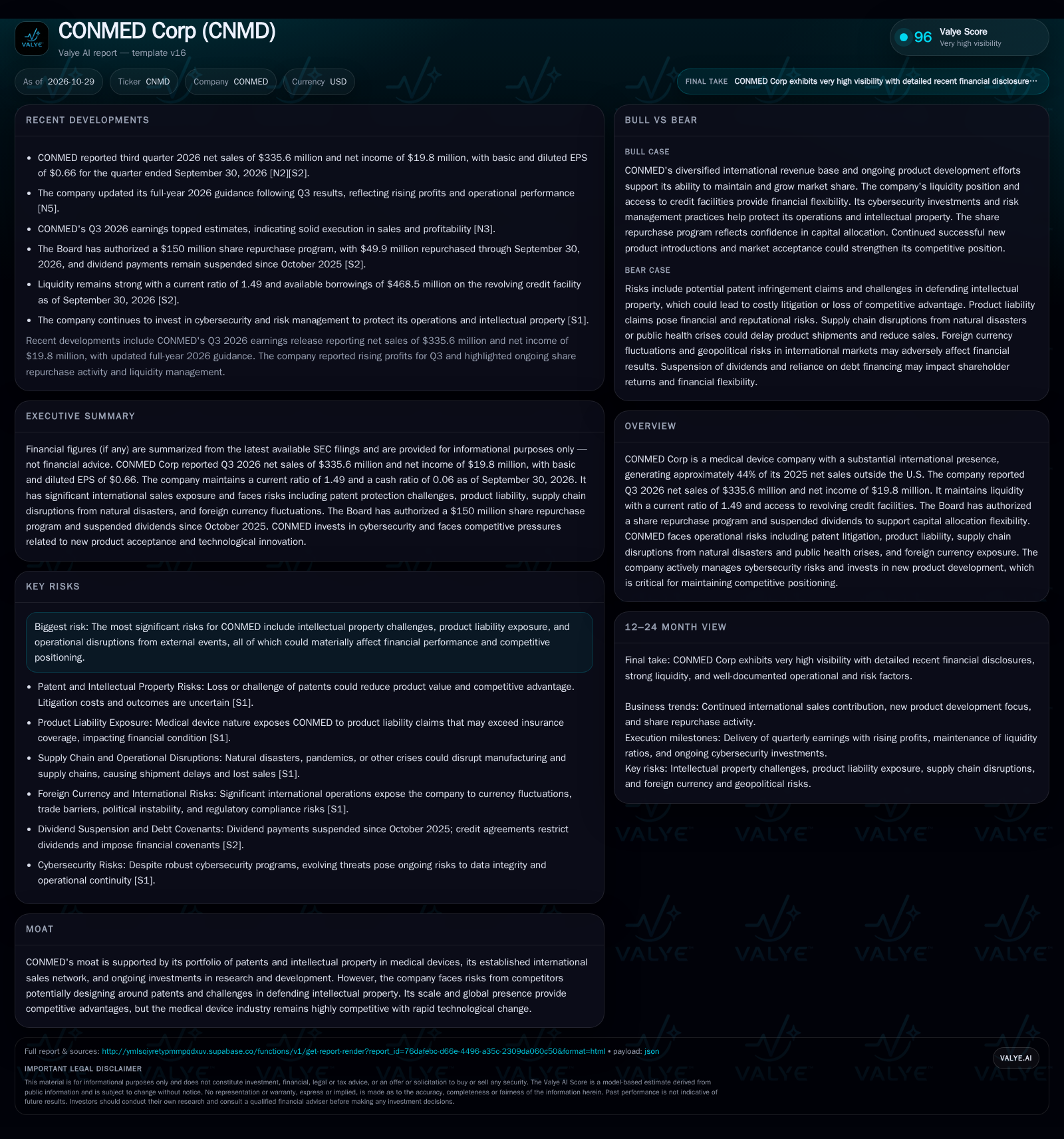
CONMED reported Q3 2026 net sales of $335.6 million and net income of $19.8 million, with nearly half of its sales generated internationally. The company maintains a $150 million share repurchase program and has suspended dividends to retain flexibility. Key levers for future value include successful new product launches and navigating risks from IP, global operations, and supply chain resilience. [S2] [N2]
CONMED Corp enters late 2026 with a blend of strengths and challenges emblematic of the evolving medical device sector. Its Q3 results reflect strong execution, backed by a substantial international presence and a pivot in capital allocation strategy—suspending dividends in favor of share repurchases. Yet, the company’s future hinges on its ability to deliver successful new products, defend its intellectual property, and manage supply chain and geopolitical risks across a diverse global footprint. The next phase will test whether its operational resilience and innovation pipeline can translate into sustained value creation.
Recent Results, Capital Moves, and Global Exposure Set the Stage
CONMED reported net sales of $335.6 million and net income of $19.8 million for Q3 2026, outpacing market expectations and supporting updated full-year guidance. Nearly 44% of 2025 net sales originated from outside the U.S., highlighting the company’s deep international integration. The Board’s decision to suspend dividends since October 2025 in favor of a $150 million share repurchase program, of which $49.9 million has been executed, signals a move toward capital allocation flexibility and possible confidence in intrinsic value. [S2] [N2]
Revenue Drivers and Cost Structure in a Shifting Medtech Landscape
CONMED’s core economics are shaped by recurring consumables sales, capital equipment placements, and a global hospital/clinic customer base. Pricing power is often constrained by group purchasing organizations, competitive tenders, and reimbursement pressures, making volume growth and product mix expansion critical. New product introductions—dependent on clinical validation, regulatory clearance, and rapid adoption—are the primary route to margin expansion, as mature portfolios tend to face commoditization.
The company reported profitability for the period.
Capital allocation has shifted: with dividends suspended, repurchases are now the primary return mechanism. This may reflect management’s assessment of market valuation, future investment needs, or credit agreement constraints. The question is whether this discipline will be matched by durable earnings growth and innovation-driven margin improvement.
The interplay between fixed and variable costs in CONMED’s cost structure critically influences its margin sensitivity to volume fluctuations. Given the capital-intensive nature of medical device manufacturing and regulatory compliance, a significant portion of operating expenses are fixed or semi-fixed, including R&D investments, quality assurance, and manufacturing overhead. Consequently, achieving scale through volume growth or higher utilization of production capacity can unlock meaningful operating leverage, provided that incremental sales do not necessitate disproportionate increases in variable costs such as raw materials or distribution expenses. This dynamic underscores the importance of sustaining robust demand for new products to absorb fixed costs effectively.
Defending Turf in a Crowded Global Device Market
CONMED’s competitive environment is defined by entrenched multinational device manufacturers, regional specialists, and emerging technology entrants. Its global sales network and breadth of product lines provide scale advantages, but the company faces relentless competition on both price and innovation. Intellectual property is a double-edged sword: patents support pricing and differentiation, but are vulnerable to design-arounds and litigation, especially as device technologies converge.
Switching costs for hospitals are moderate—procedural standardization and clinician familiarity foster inertia, but reimbursement and procurement cycles can drive rapid change if competitors launch superior or lower-cost alternatives. The risk of substitution is growing as digital health, robotics, and AI-driven procedural tools gain traction. Regulatory hurdles, clinical validation, and capital intensity act as barriers to entry, but do not fully insulate incumbents from disruption.
CONMED’s international reach is a source of both advantage and risk. Local regulatory requirements, pricing dynamics, and currency volatility can erode profits or impede growth. Success increasingly depends on the company’s ability to refresh its portfolio, demonstrate clinical value, and defend its IP globally.
Innovation-Driven Adoption Could Accelerate Margin and Revenue Growth
A favorable trajectory for CONMED would see new product launches—particularly in high-growth procedural categories—gaining rapid clinical acceptance and reimbursement, enabling premium pricing and share gains without margin-diluting discounting. If the company’s R&D investments yield differentiated devices that address unmet needs or offer clear cost-effectiveness, hospitals may prioritize its products despite procurement headwinds.
Operating leverage could materialize as fixed costs are absorbed over higher volumes, especially if international expansion outpaces local inflation and currency drag. Share repurchases at attractive valuations could further amplify per-share earnings growth.
Evidence confirming this scenario would include: sustained above-industry sales growth; margin expansion attributable to new product mix; clinical adoption metrics or published studies supporting efficacy; and management commentary on pipeline traction and competitive wins.
Incremental Gains Amid Margin Pressures and Global Volatility
The most plausible outlook is a continuation of steady, mid-single-digit revenue growth, with new products offsetting attrition in legacy lines. Margins may remain under pressure from pricing competition, inflation in materials and labor, and periodic supply chain disruptions. International sales will contribute meaningfully, but may be offset by currency headwinds or regional regulatory challenges.
Capital allocation will likely remain balanced between opportunistic buybacks and reinvestment in R&D. Dividend resumption appears unlikely in the near term, given credit agreement restrictions and a preference for liquidity. Debt servicing is manageable but will require discipline in cost control and inventory management.
This scenario would be confirmed by quarterly results showing stable or modestly improving margins, continued product launches, and international sales maintaining their proportion of the mix. Falsification would come from abrupt margin compression, delayed product introductions, or significant regulatory setbacks.
IP, Supply Chain, or Regulatory Shocks Could Disrupt Momentum
A negative turn could be triggered by patent litigation losses, product recalls, or inability to defend intellectual property in key markets, resulting in lost exclusivity and rapid commoditization. Supply chain disruptions—whether from geopolitical events, natural disasters, or persistent public health crises—could delay shipments, inflate costs, and erode customer trust.
Material currency devaluation or trade barriers in major international markets could further pressure profits. Product liability claims exceeding insurance coverage could create financial or reputational damage, while cyberattacks targeting operational continuity or patient data could lead to regulatory or legal consequences.
Confirmation of this scenario would include: legal settlements or adverse court rulings; significant product withdrawal announcements; unexpected declines in international sales; or disclosure of major operational disruptions.
Milestones and Metrics That Will Shape CONMED’s Next Phase
Quarterly revenue and operating margin trends, especially attribution to new product lines if disclosed, will reveal whether innovation is driving growth or merely offsetting attrition.
International sales as a percentage of total revenue—any major shifts, especially in Europe or Asia, could signal currency or regulatory impacts.
Gross R&D spending and the cadence of regulatory approvals or major product launches would help assess the sustainability of the innovation pipeline.
Updates on patent litigation, settlements, or IP portfolio changes—material legal developments could affect future competitive positioning.
Inventory turns and days sales outstanding, if disclosed, would clarify working capital discipline and supply chain management effectiveness.
Utilization of the revolving credit facility and any changes in net debt, especially following further buybacks or external shocks.
Management commentary on the timeline or conditions for dividend reinstatement may indicate evolving capital allocation priorities.
Major cybersecurity events or public disclosures of breaches, given increasing regulatory and operational scrutiny in medtech.
Disclaimer: This is research-only, informational analysis and not investment advice. It may include AI-generated interpretation and general industry context. Always verify important details using primary sources.

Comments