
Essex Property Trust: Managing West Coast Multifamily Dynamics with Strategic Portfolio and Capital Moves
Recent results at Essex Property Trust highlight the interplay between rising property expenses and the company’s ability to recalibrate guidance upward despite short-term margin pressure. The REIT’s concentration in supply-constrained West Coast markets offers both pricing power and exposure to regional volatility, while its balance sheet and portfolio management provide levers for sustained performance if market conditions remain favorable.
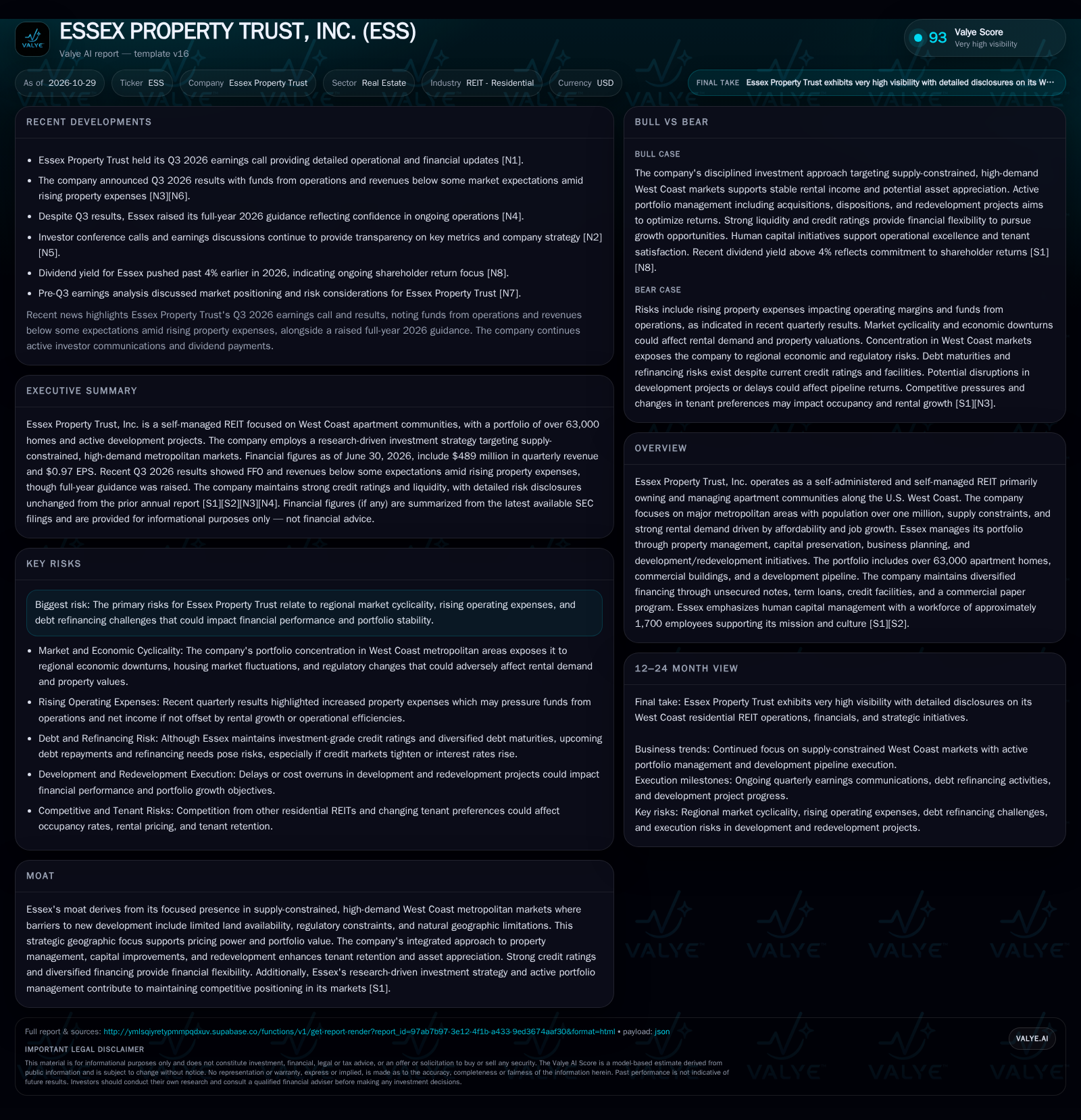
The company’s focus on high-barrier West Coast apartment markets supports pricing power, though cyclical risks and cost inflation remain ongoing challenges. Essex’s capital structure and active portfolio management offer flexibility, but execution on development and redevelopment projects will be critical to long-term value creation. [S1] [S2] [N3] [N4]
Essex Property Trust’s recent quarter underscores a central tension in the multifamily REIT model: the ability to capture rent growth and asset appreciation in premium, supply-constrained markets versus the challenge of rising operating expenses and regional economic cyclicality. While Essex missed some Q3 2026 expectations on funds from operations and revenue, management’s decision to raise full-year guidance signals confidence in the underlying portfolio and operational strategy. With a focus on West Coast urban centers, a robust capital structure, and an active approach to both acquisitions and development, Essex remains a bellwether for the dynamics shaping U.S. coastal multifamily real estate.
Recent Results Highlight Margin Challenges and Revised Guidance
In Q3 2026, Essex Property Trust reported funds from operations (FFO) and revenues that came in below some market expectations, primarily due to increased property expenses. These rising costs highlight a persistent challenge for multifamily REITs operating in high-demand, high-cost markets. Despite the margin compression, management raised full-year 2026 guidance, which suggests confidence in ongoing operations or anticipated stabilization in expense growth or rental income. The company’s portfolio stood at 259 operating apartment communities totaling over 63,000 homes as of the end of 2025, with continued activity on acquisitions, dispositions, and development. Essex’s mix of long-term debt maturities, credit facilities totaling $1.58 billion, and investment-grade ratings (Baa1/BBB+) provide liquidity and borrowing capacity to support both operational and growth initiatives. [S1] [S2] [N3] [N4]
Monetizing Supply Constraints Amid Rising Costs
Essex’s revenue engine is built on collecting rents from a diversified portfolio of West Coast apartment communities, targeting metros with over one million people, significant barriers to new supply, and strong job growth. These characteristics typically confer pricing power and lower vacancy rates, supporting stable cash flows and potential for above-average rent growth. However, fixed costs (property taxes, insurance, and certain utilities) and variable costs (maintenance, staffing, repairs) can rise rapidly, particularly in inflationary environments or during periods of regulatory change.
The company’s active property management aims to drive rental growth and tenant retention, while capital recycling through acquisitions and dispositions seeks to optimize returns. Redevelopment and new development projects are intended to refresh the portfolio and capture incremental NOI, but these initiatives require significant upfront investment and carry execution risk. Operating leverage is a double-edged sword: in strong markets, incremental rent increases can disproportionately boost FFO, while expense pressures or softening rents can quickly erode margins. Funding needs are met through a mix of unsecured debt, credit lines, and equity, with the company’s investment-grade ratings helping to keep borrowing costs manageable. [S1]
A commercial paper program and the ability to issue up to $900 million in equity provide additional funding flexibility, although equity issuance can dilute existing shareholders if not matched by accretive investments. The capital intensity of ground-up development and redevelopment means that return on invested capital depends heavily on project execution, cost controls, and post-completion leasing velocity.
Market Selection and Asset Scale Define Competitive Strengths
Essex’s core competitive strength lies in its exclusive focus on West Coast metropolitan markets with high barriers to entry: limited land availability, restrictive zoning, and lengthy permitting processes. These supply constraints limit new competition and support both occupancy and pricing power, especially during periods of robust demand. The company’s portfolio scale—over 63,000 apartment homes—enables operational efficiencies, purchasing leverage, and brand recognition among both tenants and local governments.
However, this geographic concentration exposes Essex to regional economic downturns, housing policy shifts (such as rent control expansions), and demographic changes. Peer competitors include other large, publicly traded residential REITs with urban coastal exposure, as well as private institutional owners, but also new entrants leveraging technology or alternative living models. Substitution risk from homeownership, single-family rentals, or newer multifamily developments in less regulated markets is an ongoing threat, particularly if affordability gaps widen.
Essex’s integrated property management and redevelopment capabilities may enhance tenant retention and asset value over time, but these advantages are only durable if the company continues to reinvest in property quality and resident experience. Differentiation through amenities, service, and digital engagement is becoming increasingly important as tenant preferences evolve.
Rent Growth Surpassing Expense Inflation Supports Asset Value Gains
The most favorable scenario for Essex is one in which demand for urban West Coast rentals remains robust, allowing the company to push through rent increases that outpace rising operating expenses. This could occur if job growth in its core markets rebounds, new construction remains constrained by regulation or financing challenges, and demographic trends favor renting over homeownership.
Successful execution of the development pipeline—including the 543-home consolidated project and predevelopment initiatives—could drive incremental NOI and portfolio value. If Essex leverages its balance sheet to acquire or develop properties at attractive yields, and expense growth moderates (e.g., through operational efficiencies or easing inflation), FFO and dividend growth could accelerate.
Confirmation of this scenario would include reported same-property NOI growth above inflation, strong leasing velocity on new developments, stable or rising occupancy rates, and continued ability to raise rents without notable pushback. Evidence would also include successful refinancing of debt at reasonable spreads and maintenance of investment-grade ratings. [S1] [N4]
Portfolio Adjustments Maintain Rent Growth Despite Cost Pressures
The most plausible outcome is that Essex continues to experience moderate rent growth in its core markets, partially offset by persistent cost pressures, particularly in property taxes, insurance, and wages. Portfolio optimization—through selective acquisitions, dispositions, and redevelopment—helps maintain asset quality and adapt to shifting demand patterns. The company’s potential financial flexibility allows it to pursue growth opportunities without overextending leverage, but overall FFO growth is modest due to expense inflation and occasional regulatory headwinds.
Development and redevelopment projects contribute incrementally to NOI, but are subject to timeline and cost overruns. Dividend payouts remain attractive, but growth is measured. The company maintains its investment-grade credit ratings and refinancing proceeds smoothly, but does not achieve significant margin expansion.
Evidence confirming this scenario would be steady same-property revenue and NOI growth in line with historical West Coast averages, continued asset recycling activity, and maintenance of current credit ratings and liquidity levels. Any unexpected spikes in expenses or regulatory disruptions would challenge this base case. [S1] [S2] [N3] [N4]
Margin and Asset Value Risks from Expense Rises and Regional Slowdowns
The adverse scenario for Essex involves a combination of persistent operating expense inflation and a slowdown in West Coast rental demand, driven by regional economic weakness, job losses, or new regulatory constraints (such as expanded rent control or eviction moratoria).
Execution risk on the development pipeline—cost overruns, project delays, or leasing shortfalls—could further erode returns. If capital markets tighten, refinancing debt or funding new projects could become more expensive or less available, particularly if credit ratings come under review. Concentrated exposure to a handful of expensive, heavily regulated markets could amplify downside volatility in asset values.
Confirmation of this scenario would include reported declines in same-property NOI, negative leasing spreads, occupancy deterioration, unsuccessful or costly debt refinancings, or a downgrade in credit ratings. Unanticipated regulatory shocks or macroeconomic downturns in California or the Pacific Northwest would be additional warning signs. [N3] [S1]
Evaluating Essex’s Performance Through Earnings, Expense Trends, and Execution
Quarterly same-property NOI growth versus inflation: Outperformance would indicate successful rent increases and cost control; underperformance could signal margin compression.
Leasing velocity and occupancy rates on new developments: Strong absorption would validate demand assumptions and support future pipeline investment.
Actual cost overruns or delays in development/redevelopment projects: A useful metric would be disclosed project budgets and completion timelines versus outcomes.
Changes in local regulatory environments (e.g., new rent control measures or eviction restrictions): Any reported policy shifts in major Essex metros would be a key risk factor.
Debt refinancing activity and spreads on new issuance: Successful, low-cost refinancings would support the balance sheet; widening spreads or difficulty refinancing would be a warning sign.
Dividend growth rate and payout ratio: Stability or growth in dividends would reflect underlying cash flow health.
Credit rating changes or outlook revisions from Moody’s and S&P: Downgrades or negative outlooks would challenge the investment case.
Reported employee turnover or staffing cost increases, if disclosed: Rising HR costs could further pressure margins and affect property operations.
Disclaimer: This is research-only, informational analysis and not investment advice. It may include AI-generated interpretation and general industry context. Always verify important details using primary sources.

Comments