
Antero Midstream: Regulatory Uncertainty, Asset Leverage, and the Economics of Natural Gas Infrastructure
With infrastructure assets tightly linked to upstream production and evolving environmental oversight, the company’s future value will hinge on throughput stability, regulatory outcomes, and its ability to navigate cost pressures.
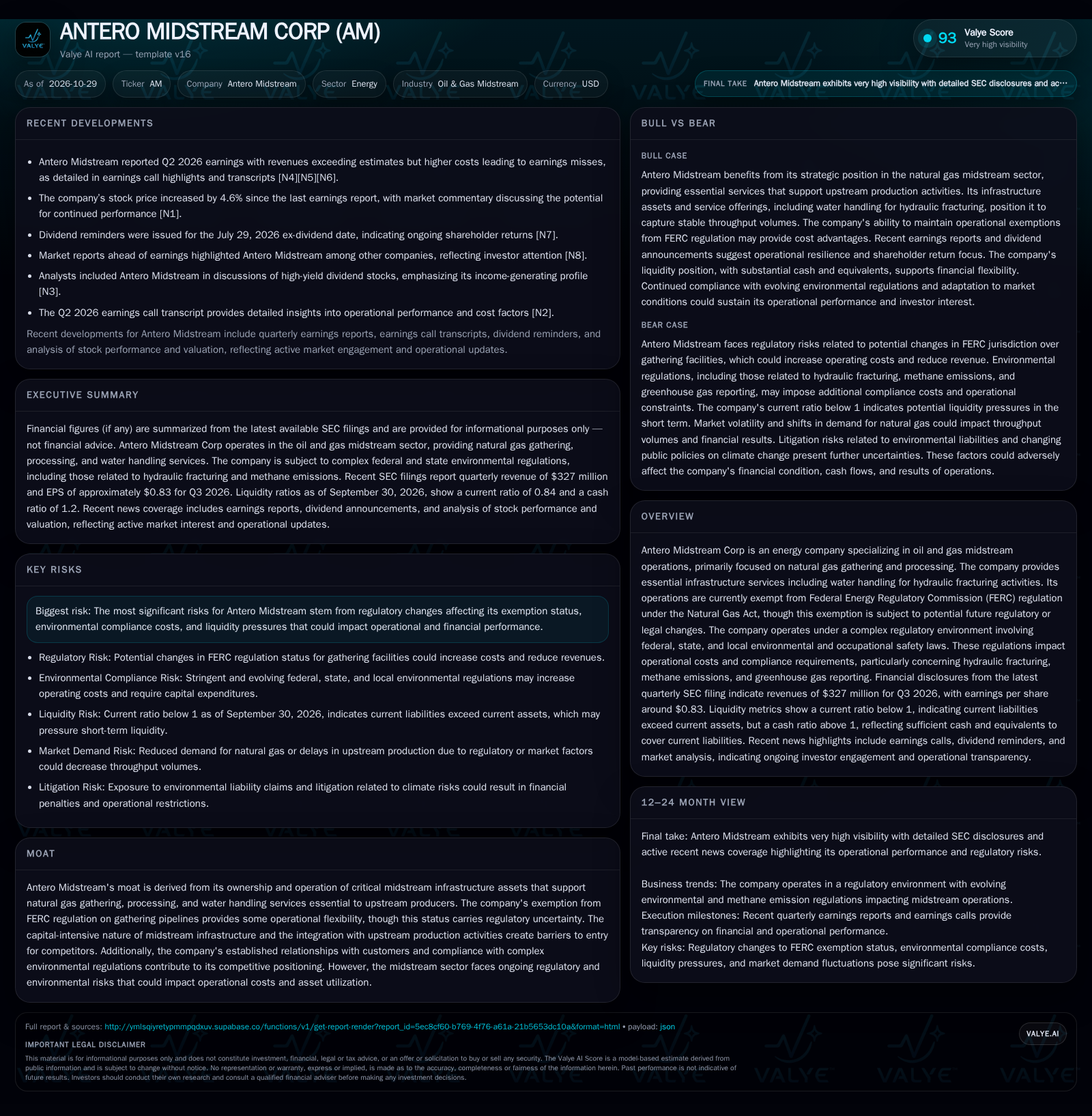
Antero Midstream’s Q3 2026 results show steady revenue and cash reserves, but a current ratio below 1 signals short-term liquidity pressure. The company’s exemption from FERC regulation provides cost advantages but is not guaranteed, leaving it vulnerable to regulatory shifts. Environmental compliance and market demand for natural gas will shape throughput and margins in coming quarters. [S2] [N1] [N7]
Antero Midstream operates at the strategic intersection of natural gas production and infrastructure, providing gathering, processing, and water handling services that are essential to upstream development. With regulatory uncertainty looming over its FERC exemption and environmental compliance costs rising, Antero Midstream’s trajectory will depend on its ability to maintain cost-effective throughput, adapt to regulatory changes, and sustain investor confidence through disciplined capital management. [S2] [N1] [N7]
Recent Results Highlight Revenue Stability Amid Liquidity Pressures
Antero Midstream reported $327 million in revenue for Q3 2026, with diluted earnings per share of $0.82. These figures underscore a core business that continues to deliver steady cash flows, even as cost pressures have led to earnings misses in recent quarters. The cited source reports dividend-related activity; that disclosure alone does not establish dividend-policy continuity, management confidence, or a material constraint on capital flexibility. The company’s gathering operations remain exempt from FERC oversight, but this status is explicitly at risk of change. These facts collectively frame a business with ongoing operational momentum but exposed to short-term liquidity constraints and regulatory uncertainty. [S2] [N1] [N7]
How Antero Midstream’s Asset Base Drives Cash Flow—And Where Costs Could Creep In
Antero Midstream’s economics are anchored in fee-based contracts for gathering, processing, and water handling services that support upstream natural gas production. The company’s infrastructure—pipelines, processing plants, and water logistics—requires high upfront capital investment but offers stable throughput-based revenues once operational. Fixed costs are significant due to asset intensity, but incremental volumes can yield substantial operating leverage, assuming capacity utilization remains high.
Variable costs are tied to maintenance, labor, environmental compliance, and energy inputs. The company’s ability to manage these expenses is critical, especially as regulatory demands around methane emissions and water management increase. If regulatory exemptions are lost or environmental requirements tighten, compliance costs could rise materially, compressing margins. The cited source reports dividend-related activity; that disclosure alone does not establish dividend-policy continuity, management confidence, or a material constraint on capital flexibility.
In addition to fixed and variable cost considerations, Antero Midstream’s capital allocation strategy significantly influences its economic resilience. The timing and scale of capital expenditures to expand or maintain infrastructure must balance expected throughput growth against the risk of underutilized capacity. If upstream production volumes fluctuate or decline, the company faces the challenge of absorbing depreciation and fixed costs without commensurate revenue increases, which could pressure margins. Conversely, disciplined capital spending aligned with confirmed customer commitments can enhance return on invested capital and strengthen cash flow predictability. Furthermore, the company’s ability to optimize operational efficiencies—such as through automation or enhanced asset monitoring—may mitigate some cost pressures, especially if regulatory compliance demands intensify.
Barriers to Entry, Customer Stickiness, and the Threat of Regulatory Overhang
Antero Midstream’s moat is built on its ownership of strategically located midstream assets that are critical for upstream producers, particularly in the Appalachian basin. Asset integration with key customers—often under long-term relationships—creates switching frictions and high replacement costs for both parties. The capital intensity and regulatory complexity of building new midstream infrastructure further deter new entrants.
However, this competitive position is not unassailable. Regulatory risk is a major counterforce: should FERC jurisdiction extend to its gathering assets, Antero Midstream could face rate regulation that limits pricing flexibility and reduces returns. Environmental activism and evolving climate policy could also increase compliance costs or limit new infrastructure development. Competition from other midstream providers is structurally limited by asset location, but technological shifts (such as electrification or alternative fuels) may gradually erode long-term natural gas demand, affecting throughput volumes.
Throughput Growth and Regulatory Continuity Could Unlock Margin Expansion
If natural gas production in the company’s service area accelerates—driven by favorable commodity prices or regional demand growth—Antero Midstream could see higher throughput across its existing infrastructure, amplifying operating leverage and driving margin expansion. Continuation of the current FERC exemption would preserve pricing flexibility and limit regulatory compliance costs, allowing more revenue to drop to the bottom line.
Evidence that would confirm this scenario includes sequential growth in throughput volumes, stable or rising EBITDA margins, additional customer commitments, and explicit regulatory guidance preserving the FERC exemption. A positive inflection in natural gas demand from industrial or export markets would further validate the upside case.
Steady Volumes, Incremental Cost Pressures, and Regulatory Drift Define the Middle Ground
The most plausible path is one where Antero Midstream maintains stable throughput volumes as upstream activity remains steady but does not accelerate meaningfully. Revenue and cash flow remain predictable, but incremental increases in environmental compliance costs—driven by new methane or water-handling regulations—gradually erode margins. The FERC exemption remains intact for now, but ongoing regulatory uncertainty requires elevated compliance spending and management focus.
Signs of regulatory review or litigation would reinforce the persistent risk overhang.
Regulatory Shock or Upstream Slowdown Could Imperil Margins and Liquidity
The bear case materializes if there is a sudden regulatory change—such as the loss of FERC exemption for gathering assets—or a sharp increase in environmental compliance costs tied to methane or water regulations. Such shocks would likely reduce pricing flexibility, increase operating expenses, and compress EBITDA margins. If upstream producers scale back drilling in response to lower gas prices or regulatory delays, throughput volumes could drop, exacerbating fixed-cost absorption challenges.
This scenario would be confirmed by regulatory announcements extending FERC jurisdiction, material increases in legal or compliance spending, declining throughput and revenue, and the need to suspend or reduce dividend payments to preserve liquidity.
Tracking the Pivotal Dynamics Shaping Antero Midstream’s Value Proposition
Quarterly throughput volumes and capacity utilization rates, as reported or if disclosed, to gauge asset efficiency and revenue visibility.
Explicit disclosures or regulatory updates regarding the status of FERC exemption for gathering assets.
Trends in environmental compliance costs—including methane emissions charges and water management expenses—as a percentage of operating expenses.
Sustained ability to pay dividends without drawing down cash reserves or increasing leverage.
Changes in the current ratio or other liquidity metrics that would indicate growing financial pressure or improvement.
Material upstream customer announcements—such as changes in drilling activity or production forecasts—that could affect midstream volumes.
Announcements of new regulatory actions, investigations, or litigation related to environmental or climate matters.
Disclaimer: This is research-only, informational analysis and not investment advice. It may include AI-generated interpretation and general industry context. Always verify important details using primary sources.

Comments