
BigBear.ai: Defense AI Expansion, Acquisitions, and the Quest for Profitable Scale
BigBear.ai’s recent acquisitions and surging government AI demand are driving revenue growth, but persistent operating losses and a substantial goodwill impairment spotlight the difficulties of scaling profitably in a competitive, contract-driven environment.
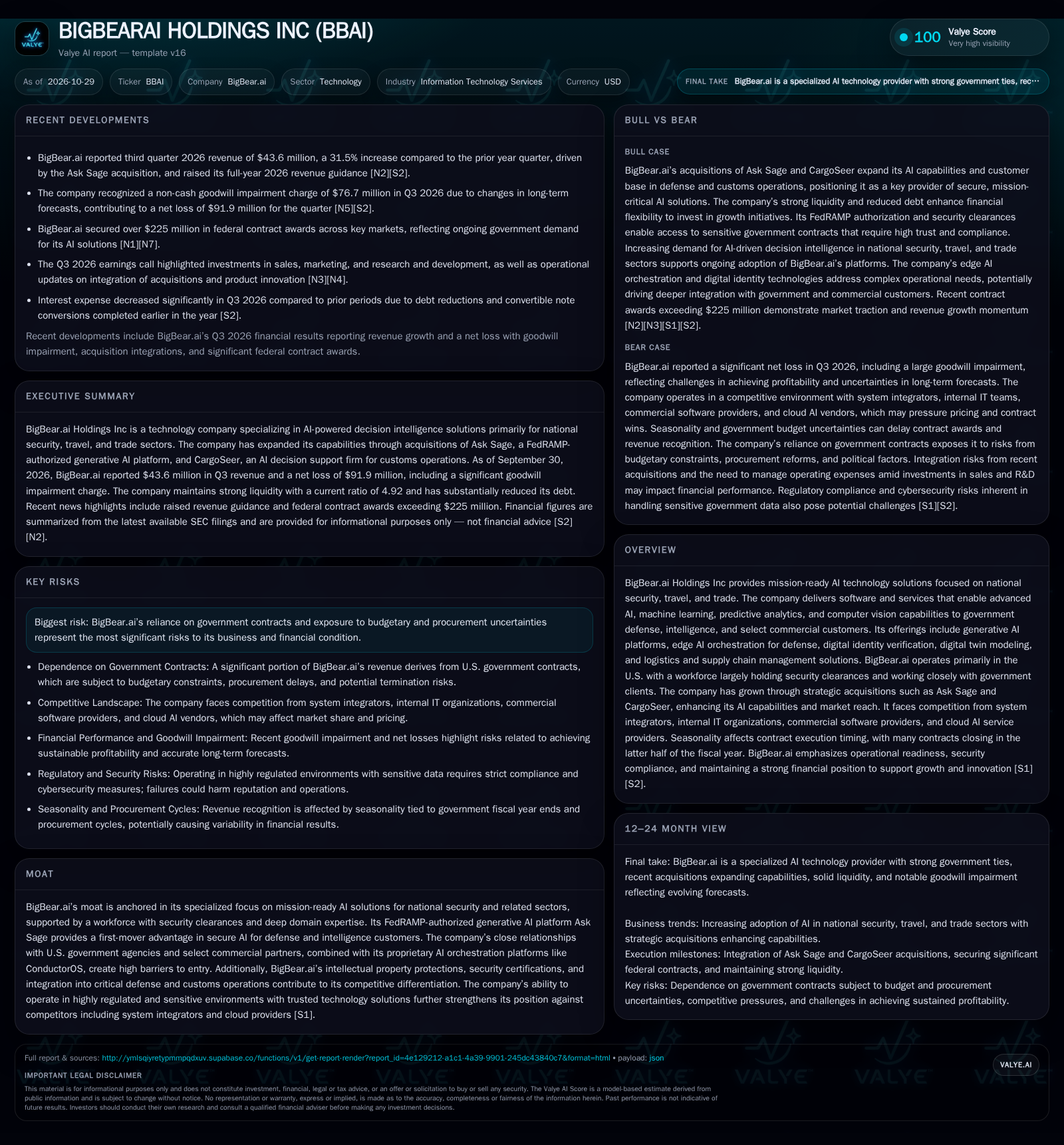
BigBear.ai posted a sharp Q3 2026 revenue increase, fueled by acquisitions and heightened government AI demand, but remains unprofitable after a significant goodwill impairment. The core question is whether BigBear.ai can convert its expanding platform and customer base into sustainable profits before competitive and procurement headwinds erode its edge. [S2] [N5]
BigBear.ai stands at a pivotal juncture: after a year of aggressive acquisition-fueled growth and a sharp reduction in debt, the company now boasts expanded AI capabilities and a stronger balance sheet. Yet, the path to sustainable profitability remains elusive, as a substantial goodwill impairment and persistent net losses underscore the challenges of integrating acquisitions and scaling complex, compliance-intensive solutions for government customers. The core question for investors is whether BigBear.ai’s platform breadth and government relationships will translate into durable, profitable growth before competitive and procurement headwinds catch up.
BigBear.ai’s Recent Acquisitions and Revenue Growth Redefine Its Path
BigBear.ai reported Q3 2026 revenue of $43.6 million, a 31.5% year-over-year increase, with management attributing the growth in part to the Ask Sage acquisition and rising adoption of AI-powered intelligence solutions in government markets. The company’s full-year revenue guidance was raised, suggesting management’s confidence in the expanded platform’s commercial traction. The company reported cash and liquidity metrics for the period; these figures do not by themselves establish operating runway, investment capacity, financial flexibility, or financing capacity. The company’s liquidity is notable, with $77.1 million in cash and a current ratio of 4.92 as of September 30, 2026, alongside a dramatic reduction in total debt to $17.7 million post-year-end. These developments collectively mark a period of commercial expansion and capital structure improvement, but also highlight the challenge of scaling profitably in a contract-driven, integration-heavy environment. [S2] [N5]
Financial Impact of Contract Reliance and Acquisitions on BigBear.ai
BigBear.ai’s core business economics are defined by project- and platform-based software and services, primarily for U.S. government defense, intelligence, and border agencies. Revenue is recognized as contracts are executed, with seasonality skewed toward the second half of the year due to government procurement cycles. The company’s offerings range from generative AI (Ask Sage) and edge AI orchestration (ConductorOS) to identity verification and digital twin modeling, each with varying mixes of software, integration, and professional services revenue.
Acquisitions like Ask Sage (FedRAMP-authorized, serving over 16,000 government teams and 2,500 companies) and CargoSeer broaden BigBear.ai’s addressable market and recurring potential, but also introduce integration complexity and upfront costs. The company’s cost structure is heavily weighted toward technical talent and compliance, with a majority of employees in security-cleared roles—supporting high-value contracts but limiting near-term margin flexibility.
Operating leverage may emerge if the company can shift more revenue toward scalable software subscriptions and reduce integration/overhead costs post-acquisition. However, the significant Q3 goodwill impairment signals that management’s long-term growth and profitability assumptions have been revised downward, at least temporarily. Future large-scale contract wins or platform investments could require renewed funding.
Competitive Landscape: Defense AI Barriers and Cloud Integrators’ Rising Influence
BigBear.ai’s competitive moat is rooted in its deep government relationships, security credentials, and focus on mission-critical AI for national security and border operations. Its FedRAMP-authorized Ask Sage platform provides a first-mover advantage in secure generative AI, which is difficult for commercial cloud or generic SaaS providers to replicate quickly due to compliance and trust requirements. The company’s close integration with government procurement, technical workforce with security clearances, and domain-specific AI platforms (such as ConductorOS for edge inference) create high switching costs for certain defense and intelligence customers.
However, the landscape is intensifying: system integrators, internal IT organizations, commercial software vendors, and major public cloud providers are all targeting federal AI budgets. These competitors often have scale, broader product portfolios, and deep pockets for R&D and sales enablement. Price competition, procurement reforms, and rapid advances in generic AI could erode BigBear.ai’s differentiation if it cannot sustain technical and compliance leadership or deepen integration with critical government workflows. The acquisition of CargoSeer and expansion into customs and border use cases may help diversify the customer base, but the company remains vulnerable to shifts in government priorities and procurement cycles. [S1]
Path to Profitable Scale via Platform Integration and National Security Demand
In a favorable scenario, BigBear.ai successfully integrates Ask Sage and CargoSeer, shifting a growing share of revenue to higher-margin, recurring software and data services across multiple government agencies. Demand for AI-driven decision intelligence in national security, customs, and border operations accelerates, with BigBear.ai’s FedRAMP authorization and security credentials positioning it as a preferred partner for sensitive, large-scale deployments.
Evidence supporting this outcome would include sustained double-digit revenue growth without commensurate increases in operating expenses, margin expansion as software outpaces professional services, and a pipeline of multi-year, renewal-heavy government contracts. Additional indicators would be successful cross-selling between acquired platforms, new contract wins in adjacent sectors (such as digital identity for commercial clients), and a return to positive operating cash flow. Falsification would come from persistent margin compression, stalled integration, or customer attrition following new competitor entry.
Incremental Gains from Integration and Government Contracts Amid Margin Challenges
The most plausible near-term path is one of continued revenue growth—driven by the expanded platform and robust government AI demand—but with profitability remaining elusive as integration and customer delivery consume resources. BigBear.ai leverages its security clearances and domain expertise to secure new and renewed contracts, especially in the defense and customs sectors. However, price competition, procurement delays, and the need to invest in technical talent and compliance keep margins thin.
Validation of this scenario would include steady, mid-teens revenue growth, periodic large contract announcements, and modest improvements in adjusted operating margins as integration costs abate. However, recurring operating losses, continued reliance on government procurement cycles, and limited commercial diversification would signal the persistence of structural challenges. A reversal—such as a sudden drop in contract wins, significant customer churn, or another material impairment—would falsify this middle path.
Growth Risks from Procurement Fluctuations and Integration Complexities
In a negative scenario, BigBear.ai faces delays or cancellations in key government contracts due to budgetary constraints or shifting procurement priorities. Integration frictions from recent acquisitions lead to customer dissatisfaction, cost overruns, or slower go-to-market execution. The competitive landscape intensifies, with larger integrators or cloud vendors winning share by undercutting on price or offering bundled solutions with greater scale and support.
This scenario would be confirmed by revenue stagnation or contraction, further goodwill impairments, rising customer churn, and a return to higher operating losses despite cost-cutting. Signs would also include missed milestones in integrating acquired platforms, inability to convert pilots into multi-year production contracts, or regulatory/cybersecurity setbacks. If government clients shift toward more generic, lower-margin AI solutions, BigBear.ai’s moat could erode rapidly, leading to a strategic reset or the need for additional capital.
Factors That Will Separate Sustainable Growth from Short-Term Gains at BigBear.ai
Sustained growth in software/subscription revenue as a share of total sales—if disclosed—would indicate successful platform leverage and margin potential.
Successful integration and cross-selling of Ask Sage and CargoSeer capabilities, reflected in new contract wins or expanded deployments with existing customers.
Pipeline and closure rate of large, multi-year government contracts, especially in defense, customs, and digital identity verticals.
Operating margin trends, particularly improvement in gross and adjusted operating margins as integration investments normalize.
Retention and renewal rates for core government customers—if disclosed—would provide insight into switching costs and platform stickiness.
Evidence of commercial (non-government) customer traction in digital identity or AI decision support, signaling diversification beyond federal contracts.
Material changes in government AI procurement policy or budget allocations, which could impact demand or contract timing.
Disclaimer: This is research-only, informational analysis and not investment advice. It may include AI-generated interpretation and general industry context. Always verify important details using primary sources.

Comments