
Sanfilippo & Son: Scaling Bar Innovation Amid Retail Dependence and Sourcing Volatility
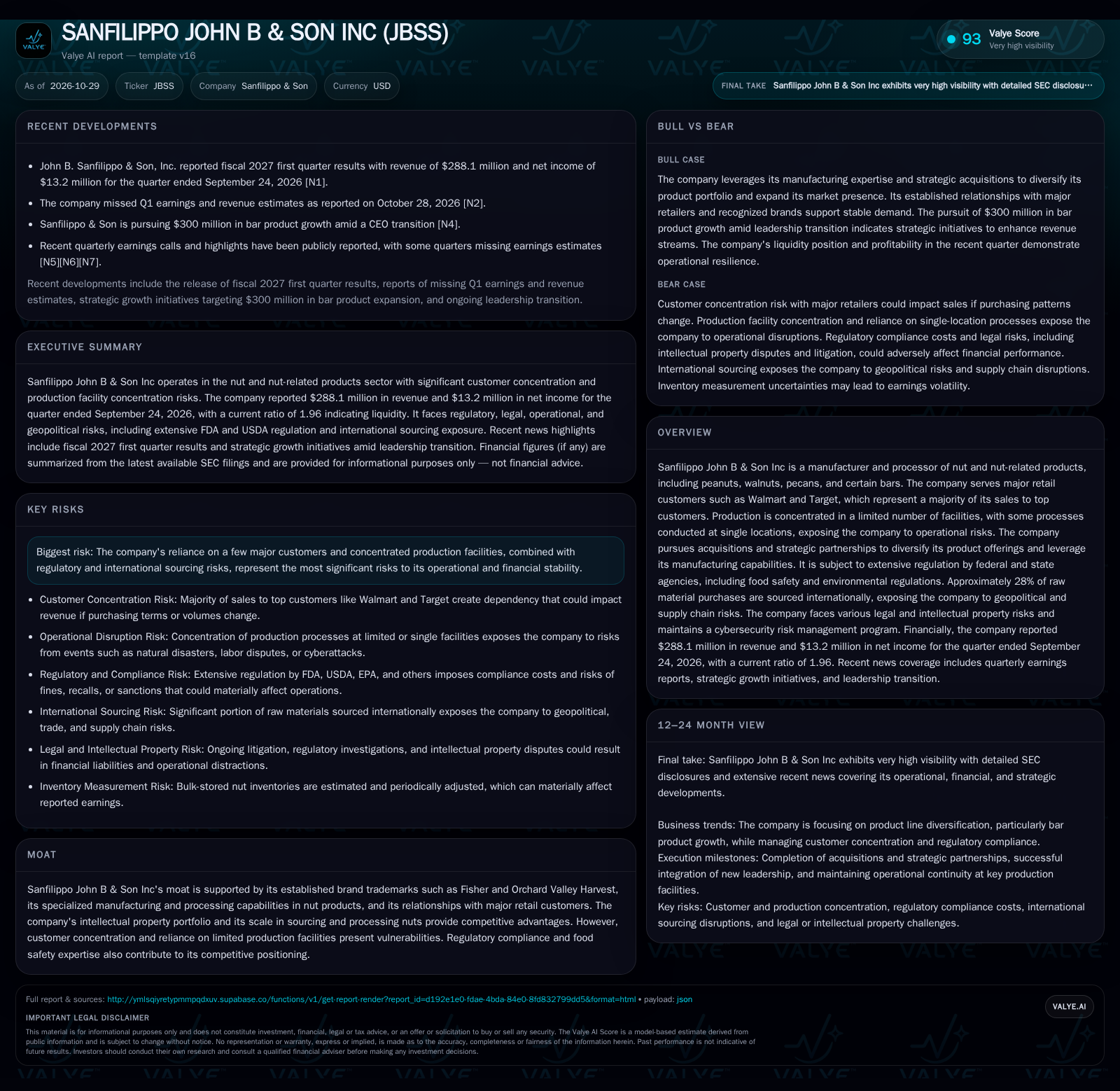
Sanfilippo John B & Son Inc is pushing for $300 million in bar product growth while navigating missed earnings, a CEO transition, and the persistent risks of concentrated retail relationships and international supply chains. The company’s future economics hinge on its ability to diversify both product and customer base, while operational resilience and inventory management remain crucial.
Sanfilippo & Son is executing a major bet on bar product expansion and leadership transition after missing recent earnings estimates. Its fortunes are closely tied to a few large retailers and globally sourced raw materials, making diversification and operational reliability central to its medium-term outlook. The company's economics will depend on its ability to broaden its customer mix, mitigate operational bottlenecks, and sustain brand value under regulatory and legal scrutiny. [N2] [N4]
Sanfilippo John B & Son Inc, a leading processor of nuts and nut-based snacks, is at a strategic crossroads. The company’s aggressive push for $300 million in bar product growth coincides with a CEO transition and recent earnings disappointments. With the majority of its sales concentrated among a handful of major retailers and a sizeable portion of its raw materials sourced internationally, Sanfilippo faces both significant upside potential and acute operational risks. How the company navigates customer concentration, supply chain volatility, and production bottlenecks will determine whether its growth ambitions translate into durable shareholder value. [N2] [N4] [S2]
Recent Misses, Bar Growth Ambitions, and Leadership Changes Shape the Near-Term Landscape
Sanfilippo & Son missed Q1 2027 earnings and revenue estimates, continuing a pattern of some quarters falling short of expectations. This underlines ongoing margin and operational pressures, especially as the company enters a period of leadership transition. At the same time, Sanfilippo is pursuing a $300 million bar product growth initiative, signaling a strategic shift toward higher-value, on-trend snack offerings. These developments are set against the backdrop of continued dependence on major retail customers—Walmart and Target account for a majority of sales to the company’s five largest customers. The company’s production remains concentrated, with certain processes conducted at single facilities, amplifying vulnerability to operational disruptions. International sourcing accounts for about 28% of core inputs, exposing Sanfilippo to geopolitical and supply chain shocks. [N2] [N4] [S2]
How Sanfilippo Makes—and Could Lose—Money: Pricing, Volume, and the Leverage of Diversification
Sanfilippo’s core economics are built on high-volume, low-to-moderate margin processing of nuts, with value added through roasting, seasoning, and packaging for both private label and branded products. Major retail customers likely exert substantial pricing pressure, limiting margin upside and leaving the company vulnerable to shifts in retailer procurement strategies. The push into bar products suggests a search for higher-margin, differentiated offerings, as bars can command premium pricing and potentially offer stronger brand loyalty if innovation aligns with consumer health and convenience trends.
Operating leverage is significant: production is capital-intensive, and facility utilization rates strongly influence profitability. The concentration of certain processes at single locations introduces both scale benefits and the risk that any disruption could sharply reduce output and revenue. Inventory management is complex, as bulk-stored nuts are subject to periodic remeasurement and adjustment, which can create earnings volatility. On the sourcing side, roughly 28% of key inputs are bought internationally, which could expose the company to currency swings, trade policy shifts, and logistical disruptions—affecting both gross margin and working capital needs. [S2]
Capital requirements are ongoing for equipment, food safety compliance, and potential expansion or diversification moves. The company reported cash and liquidity metrics for the period; these figures do not by themselves establish operating runway, investment capacity, financial flexibility, or financing capacity. [S2]
Brand Equity, Retailer Ties, and Facility Scale: Competitive Advantages and Vulnerabilities
Sanfilippo’s competitive strengths include long-established brands (notably Fisher and Orchard Valley Harvest), deep processing expertise, and preferred supplier status with major retailers. Intellectual property in the form of trademarks helps defend shelf space and price points, particularly in branded segments. Scale in sourcing and processing provides procurement and cost advantages over smaller rivals, while established food safety and regulatory compliance capabilities can serve as a barrier to entry.
However, the company’s heavy reliance on a handful of dominant retailers is a double-edged sword: while it guarantees volume, it also amplifies the risk of contract renegotiation, de-listing, or margin compression as retailer power grows. Facility concentration creates operational leverage but also single points of failure—competitors with more distributed production footprints may be less exposed to catastrophic disruption. Private label competition, specialty/niche brands, and alternative snack formats (such as plant-based or protein-rich bars from insurgent food startups) all represent credible substitutes, especially if consumer preferences shift or if retailers push for more store-brand penetration.
If Bar Innovation and Customer Diversification Succeed, Margin and Growth Could Outpace Expectations
The most favorable outcome for Sanfilippo would be a successful scale-up of its bar product line, capturing significant share in the growing healthy snack market. If the $300 million bar growth initiative delivers strong sales—especially through branded channels or new retail partners—overall gross margin could expand, reducing dependency on bulk nut commodity pricing and the negotiating leverage of a few large retailers. Successful product innovation could also create cross-selling opportunities and help defend shelf space.
In this scenario, confirmation would come through accelerating bar revenue, improved mix-driven gross margin, and evidence of new customer wins or expanded distribution beyond the traditional big-box retail channel. If disclosed, metrics such as bar segment contribution margin, growth rates, and retailer/channel diversification would provide tangible signs of progress. Falsification would occur if bar sales stall, margins stagnate, or customer concentration remains unchanged.
Steady Volume, Persistent Concentration: What Continuity Looks Like for Sanfilippo
The most plausible medium-term outcome is that Sanfilippo maintains steady volume growth in core nut products, with incremental gains from bar innovation but without fundamentally altering its customer or margin structure. Retailer concentration remains high, and the company’s negotiating position does not materially improve. Margins fluctuate within a historical range, subject to raw material cost swings and periodic inventory adjustments.
Evidence supporting this scenario would include modest revenue growth, continued reliance on Walmart and Target for the bulk of sales, and stable but unremarkable gross margins. If the bar initiative fails to gain traction or is offset by margin compression in core products, growth may be limited to inflation and category expansion. Signs that would falsify this scenario include a sudden drop in retailer concentration, a step-change in segment profitability, or major new distribution partnerships.
Operational Disruption or Retailer Retrenchment Could Drive Earnings Volatility
The most adverse scenario for Sanfilippo is the materialization of one or more key risks: a major operational disruption at a single-site facility, a significant shift in procurement by a dominant retailer, or a supply chain shock affecting international inputs. Any such event could quickly reduce output, trigger contract penalties or lost shelf space, and force margin-eroding price competition to recover volume.
This scenario would be confirmed by sharp revenue or margin declines, public disclosures of production outages, or loss of key customer contracts. Inventory writedowns, legal disputes, or regulatory actions related to food safety or supply chain integrity would reinforce the downside thesis. The scenario would be falsified if the company demonstrates operational redundancy, quickly replaces lost volume, or secures new diversified customer relationships.
Milestones That Will Define Whether Sanfilippo’s Growth Ambitions Are Realized
Quarterly bar product sales volume and revenue growth—if disclosed—would directly test the success of the $300 million bar initiative.
Gross margin trends, particularly the mix effect between legacy nut products and new bar offerings, will clarify whether diversification is driving profitability.
Customer concentration ratios (e.g., share of revenue from top five customers)—ongoing disclosures here will show if the company is reducing retailer dependence.
Facility utilization rates and any reported production disruptions—evidence of operational resilience or vulnerability.
Raw material cost trends and the impact of international sourcing disruptions, especially in cashews, pecans, and sunflower oil.
Inventory remeasurement impacts on earnings—periodic adjustments could affect reported profitability.
Progress in executing acquisitions or joint ventures that broaden the product portfolio or customer base, as disclosed in filings or earnings commentary.
Any regulatory, legal, or recall notices that materially affect operations or brand reputation.
Disclaimer: This is research-only, informational analysis and not investment advice. It may include AI-generated interpretation and general industry context. Always verify important details using primary sources.

Comments