
EQT’s $50 Billion Natural Gas Ambition: Scale, Integration, and the Challenge of Execution
EQT is poised to become a dominant force in U.S. natural gas through its transformative acquisition of Range Resources, but the path ahead is defined by integration complexity, capital intensity, and the volatile economics of the energy transition.
EQT’s pending all-stock acquisition of Range Resources will create a $50B natural gas leader, expanding scale and pipeline reach amid rising AI-driven power demand. The combined entity’s success will hinge on integration execution, regulatory approvals, and the ability to translate scale into durable cash flow advantages in a competitive, capital-intensive market.
EQT Corporation is at a transformative crossroads, leveraging the pending all-stock acquisition of Range Resources to form a $50 billion natural gas powerhouse. This strategic leap aims to capitalize on surging demand for natural gas—driven in part by data center and AI infrastructure buildouts—while extending EQT’s footprint across production, midstream, and storage. Yet, the combination brings significant integration risks, capital requirements, and exposes the business to ongoing regulatory and commodity price volatility. The company’s ability to translate scale into sustainable cash flows and realize merger synergies will define its next chapter.
Strategic Acquisition and Financial Backdrop Define EQT’s Near-Term Outlook
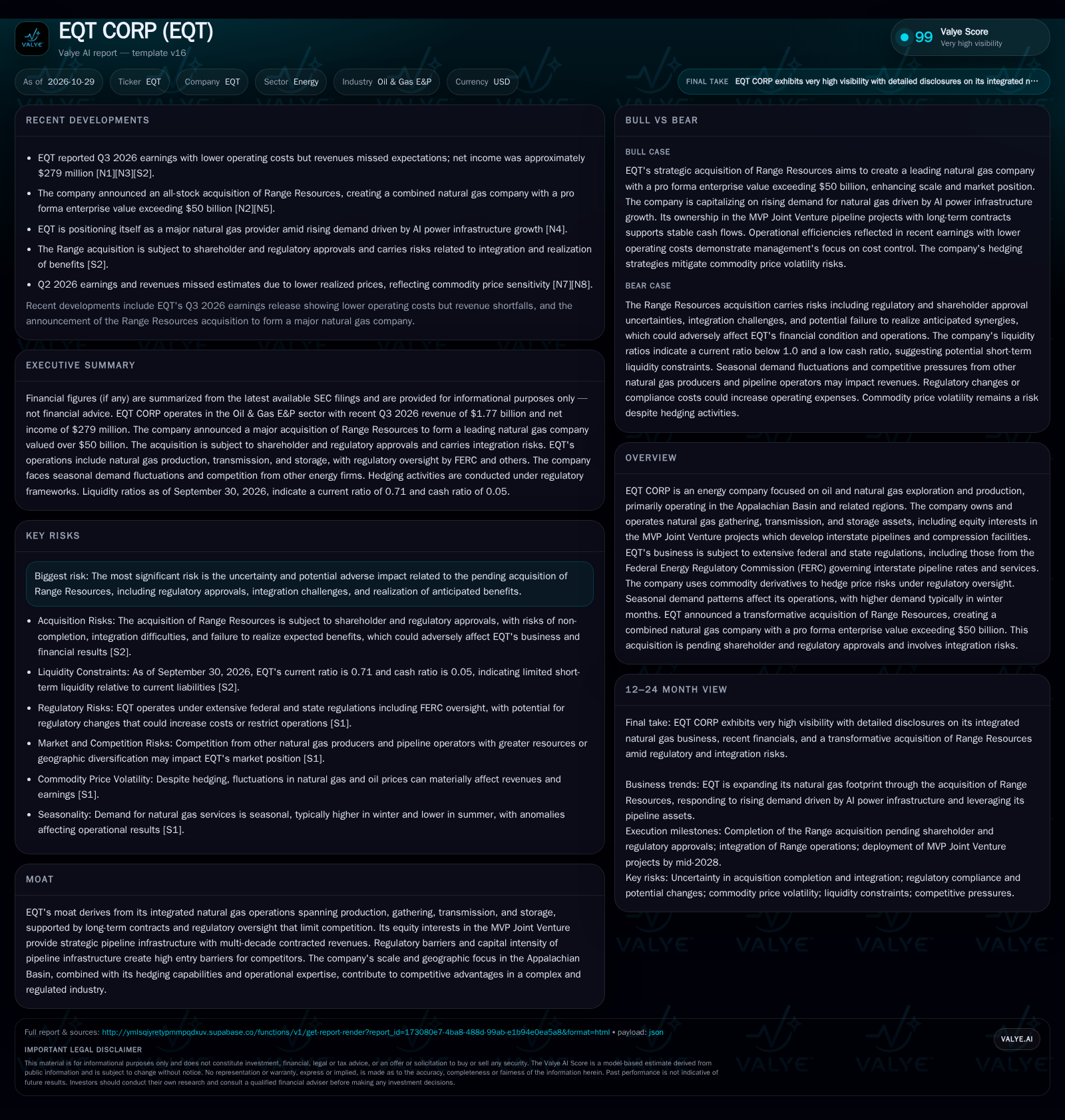
The most material recent development for EQT is its announced all-stock acquisition of Range Resources, which will create a combined natural gas company with a pro forma enterprise value exceeding $50 billion. This transaction, still subject to shareholder and regulatory approvals, would substantially increase EQT’s production scale, reserves, and midstream infrastructure [N2] [N5].
For Q3 2026, EQT reported revenue of $1.77 billion and net income of $279 million, with lower operating costs partially offsetting a revenue miss relative to expectations [S2] [N1]. The company reported a current ratio of 0.71 for the period. [S2]
EQT’s thesis is increasingly tied to natural gas demand growth from power-hungry AI and data center infrastructure, positioning the company as a critical supplier to this secular trend [N4]. The outcome of the Range acquisition, and the subsequent integration of operations, will shape EQT’s competitive position and financial trajectory for years to come.
How EQT’s Integrated Model Could Unlock Operating Leverage—Or Strain Capital
EQT’s business model spans natural gas production, gathering, transmission, and storage, with a heavy emphasis on Appalachian Basin operations and equity interests in major pipeline joint ventures. This integrated approach, if managed well, offers potential advantages in cost control, asset utilization, and market access. The company’s revenue is fundamentally tied to natural gas prices and volume, while a significant portion of costs are fixed due to the capital-intensive nature of upstream and midstream assets.
The pending Range acquisition aims to create scale-driven efficiencies—through shared infrastructure, procurement leverage, and rationalized drilling programs. However, the realization of these synergies is uncertain and depends on successful integration of operational systems and corporate cultures. The combined entity will likely see increased fixed costs and capital expenditure requirements, especially as it funds ongoing pipeline projects such as MVP Southgate and MVP Boost, with major phases expected in service by mid-2028 [S1].
EQT employs derivatives to hedge commodity risks, which can dampen near-term earnings volatility but do not eliminate exposure to sustained price swings. [S2]
Scale, Infrastructure, and Regulatory Barriers: EQT’s Edge—But Not Without Rivalry
EQT’s moat rests on its integrated natural gas operations, pipeline infrastructure, and scale in the Appalachian Basin. Ownership stakes in the MVP Joint Venture projects, including the in-service MVP Mainline and mid-2028 targeted MVP Southgate, provide critical access to interstate markets and support multi-year contracted revenue streams [S1].
Regulatory oversight (primarily by FERC) and the capital intensity of both production and midstream infrastructure create formidable entry barriers for new competitors. However, EQT faces ongoing rivalry from other large-scale natural gas producers and pipeline operators, some with greater geographic diversification or access to lower-cost basins [S1].
The acquisition of Range would further consolidate EQT’s regional dominance, but execution risk remains high. Customer switching costs in commodity markets are generally low, although long-term pipeline contracts and physical infrastructure can create stickiness in certain segments. The pace of energy transition, regulatory changes, and the emergence of renewable substitutes add long-term uncertainty to the competitive landscape.
If Integration Succeeds, Scale Could Drive Margins and Market Share
In the favorable scenario, EQT completes the Range Resources acquisition on schedule, integrates operations smoothly, and achieves meaningful cost and capital synergies. The combined entity leverages its scale to optimize drilling schedules, reduce per-unit operating costs, and extract greater value from its pipeline and midstream assets. Strong execution on MVP Southgate and Boost project timelines unlocks new markets and contracted cash flows by mid-2028, enhancing revenue visibility.
Rising demand for natural gas—driven by AI data center and power infrastructure buildouts—translates into higher realized prices and sustained volume growth. Hedging strategies effectively buffer short-term volatility without sacrificing upside. Successful integration and synergy delivery would be confirmed by improving operating margins, above-peer cash flow conversion, and visible outperformance versus guidance on production, cost, and capital allocation metrics.
Falsification would come from merger delays, missed integration milestones, or failure to deliver promised cost savings, especially if commodity prices remain volatile or decline.
Execution Risks Temper the Benefits of Scale in a Volatile Market
The most plausible outcome is that EQT secures shareholder and regulatory approvals for the Range acquisition, but integration proves complex and synergies are realized only partially or with delay. The company maintains its leading natural gas production position, but remains exposed to commodity price swings and ongoing capital needs for pipeline projects and maintenance.
Operational performance sees incremental improvement from scale, but cost savings are offset by integration expenses and the need to invest in system upgrades and regulatory compliance. Earnings and cash flow remain tightly linked to market prices, with hedging smoothing some—but not all—of the volatility.
Confirmation of this scenario would include steady, but not dramatic, margin improvement, timely progress on MVP projects, and no major operational or financial shocks. Falsification would be signaled by either outsized synergy realization (upside) or significant integration/operational setbacks (downside).
Integration Failure or Regulatory Setbacks Could Erode Value
In an adverse scenario, the Range Resources acquisition faces delays or fails to close due to regulatory or shareholder opposition. Alternatively, the merger is completed but integration challenges lead to operational disruptions, cost overruns, and missed synergy targets. EQT is forced to divert management attention and capital to address merger fallout, undermining its ability to execute on pipeline projects and core production activities.
Commodity price declines or continued volatility exacerbate these challenges, compressing margins and straining liquidity. Regulatory changes or compliance costs increase operating expenses, while competition from other producers erodes market share.
This scenario would be confirmed by merger delays, cost escalations, asset impairments, or guidance cuts, especially if accompanied by negative cash flow trends or covenant pressures.
Milestones That Will Define EQT’s Post-Acquisition Trajectory
Progress toward closing the Range Resources acquisition, including updates on regulatory and shareholder approvals.
Disclosed integration milestones and synergy targets, with detail on realized versus promised cost savings and operational improvements.
Updates on the MVP Southgate and MVP Boost project timelines and capital commitments, especially progress toward the mid-2028 in-service target.
Quarterly trends in realized natural gas prices, production volumes, and operating costs per unit—especially versus pro forma guidance.
Liquidity and funding developments, including any new credit facilities, debt refinancings, or equity issuances.
Hedging effectiveness, exposure to margin calls, and any changes in derivative strategies if disclosed.
Any changes in regulatory landscape or compliance costs that could materially alter the economics of EQT’s core business.
Disclaimer: This is research-only, informational analysis and not investment advice. It may include AI-generated interpretation and general industry context. Always verify important details using primary sources.

Comments