
VICI Properties: Inflation-Protected Cash Flows, Strategic Expansion, and the Limits of Gaming Real Estate Scale
VICI Properties’ portfolio of iconic gaming and experiential assets—anchored by long-term, inflation-linked triple-net leases—offers rare visibility into cash flow and growth, but scale brings new questions about tenant concentration, capital allocation, and the durability of sector-specific demand.
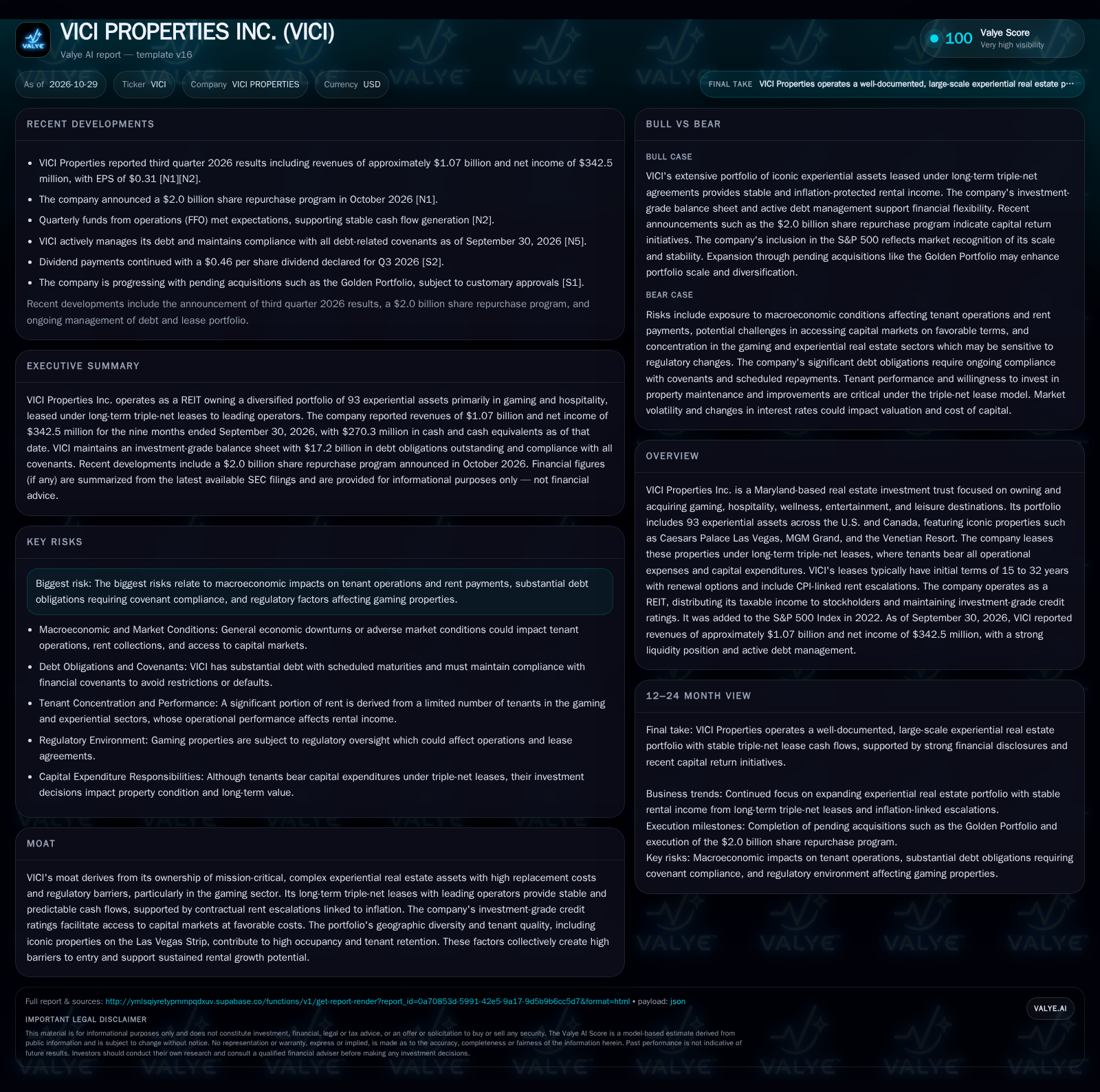
VICI Properties owns 93 experiential assets, including major Las Vegas casinos, all leased under long-term triple-net contracts with inflation-linked escalators and full tenant responsibility for property costs. Revenues for the first nine months of 2026 reached $1.07 billion, with net income of $342.5 million and $17.2 billion in debt outstanding. VICI’s $2.0 billion share repurchase program and pending acquisitions signal a shift from pure accumulation to active capital return and portfolio management, while maintaining investment-grade ratings. The durability of its cash flows depends on tenant health, regulatory stability, and the company’s ability to redeploy capital without overexposing itself to sector or operator risk. [S1] [S2] [N1]
VICI Properties has assembled one of the most formidable portfolios in experiential real estate, with 93 assets—including the likes of Caesars Palace and the Venetian—anchored by long-term, inflation-linked triple-net leases. This structure, with tenants shouldering all property-level costs and capex, creates highly visible cash flows and a capital-light model for the REIT. Yet as VICI pivots toward capital return and additional acquisitions, the company faces classic scale challenges: maintaining tenant quality, managing leverage, and ensuring that growth adds genuine diversification rather than merely more of the same risk. The next phase will test whether VICI’s model can deliver both stability and incremental value.
Recent Moves Reshape VICI’s Growth and Capital Return Profile
VICI Properties’ core business model remains anchored by its 93 experiential assets—spanning 54 gaming and 39 other leisure properties—leased on long-term triple-net terms. As of September 30, 2026, the entire portfolio was fully leased, with a weighted average lease term of nearly 40 years, and the majority of leases featuring CPI-linked rent escalators. For the first nine months of 2026, VICI generated $1.07 billion in revenue and $342.5 million in net income, supported by $270.3 million in cash and $17.2 billion in debt. The company announced a $2.0 billion share repurchase program in October 2026, signaling a deliberate shift in capital allocation from acquisition-driven growth to capital return and portfolio optimization. Pending acquisitions, such as the Golden Portfolio, remain on the horizon and could further scale and diversify the asset base. [S1] [S2] [N1]
How Triple-Net Leases Drive Predictable, Capital-Light Economics
VICI’s economics are fundamentally shaped by the triple-net lease model: tenants are responsible for all property-level operating costs, maintenance, insurance, taxes, and capital expenditures. This structure insulates VICI from most variable property expenses and major capex, allowing the company to capture a high proportion of rental income as operating profit. The leases, often running 15–32 years with renewal options and CPI-linked escalators (subject to caps), offer rare rental visibility and built-in inflation protection for the landlord.
Revenue growth is driven primarily by contractual rent increases and, to a lesser extent, portfolio expansion through acquisitions. Because VICI operates as a REIT, it distributes nearly all net taxable income as dividends, limiting retained earnings but supporting a recurring yield for shareholders. Operating leverage is high: once portfolio-level G&A and financing costs are covered, incremental rent flows through at attractive margins. However, growth is capital-intensive, requiring debt and/or equity to fund acquisitions. With $17.2 billion in debt as of September 2026 and investment-grade ratings, VICI’s cost of capital and access to financing are crucial to its ability to continue accretive growth. [S1] [S2]
Barriers and Counterforces in Experiential Real Estate
VICI’s competitive position is underpinned by its ownership of high-profile, irreplaceable assets—especially on the Las Vegas Strip—and the complexity and regulatory burden of gaming real estate. These factors create high barriers to entry, as new development is capital- and approval-intensive. The long-term, triple-net lease structure with leading operators further supports tenant retention and occupancy stability.
However, VICI faces sector-specific concentration risks. The bulk of rental income comes from a limited roster of large gaming and hospitality tenants, making the company sensitive to tenant health, industry cycles, and regulatory changes affecting gaming operations. While the inflation-linked escalators provide some protection against real value erosion, they are typically capped, and tenant financial stress could limit the ability to pass through rent increases. Competing REITs, private equity, and sovereign wealth funds are also active in experiential and gaming real estate, sometimes driving up acquisition prices and compressing yields. The question is whether VICI can continue to source accretive deals or must increasingly pivot to internal capital returns.
What an Accretive Expansion and Capital Return Cycle Could Unlock
A favorable scenario for VICI sees the successful completion of pending acquisitions like the Golden Portfolio, further diversifying the tenant base and adding assets with long-term, CPI-linked lease structures.
Evidence for this scenario would include swift regulatory approval and integration of new assets, continued 100% lease occupancy, and a rising proportion of rent from non-gaming or diversified tenants. Successful deployment of the $2.0 billion buyback program—without a material increase in leverage or a hit to credit ratings—would signal disciplined capital management. Falsification would come from deal delays, tenant distress, or inability to maintain investment-grade status following expansion. [N1] [S1]
Sustaining Visible Cash Flows While Managing Concentration and Growth Limits
The most plausible near-term path for VICI is continued stable rental income from its existing portfolio, supported by long-term leases and CPI-linked escalators, but with incremental growth slowing as acquisition opportunities become less frequent or more expensive. The company maintains dividend payments and selectively repurchases shares, while keeping leverage in check and staying within investment-grade parameters.
This scenario would be confirmed if quarterly FFO remains consistent, the occupancy rate stays at or near 100%, and the company continues to meet all debt covenants. Modest increases in rent from escalators would offset, but not fully outpace, inflation or rising financing costs. Portfolio additions would occur, but at a slower pace, and the mix would remain heavily weighted toward gaming assets. Falsification would be signaled by a decline in occupancy, tenant payment issues, or a need to issue equity at unfavorable prices to fund acquisitions. [S1] [S2] [N2] [N5]
How Tenant Distress or Regulatory Shocks Could Disrupt the Model
A negative scenario emerges if macroeconomic stress, industry disruption, or regulatory changes impair tenant ability to meet rent obligations. With a concentrated tenant base, even a single major operator’s distress could pressure VICI’s cash flows and trigger covenant concerns. Regulatory tightening in major gaming markets, or a sharp downturn in consumer discretionary spending, could force renegotiation of lease terms or result in tenant defaults.
This scenario would be evidenced by a spike in rent deferrals, downward lease renegotiations, or a drop in occupancy. A downgrade of VICI’s credit rating or breach of debt covenants would further constrain growth and capital return, potentially forcing asset sales or dilutive equity issuance. Lack of progress on pending acquisitions, or overpayment for assets with weaker tenants, would also undermine the business case. [S1] [S2] [N5]
Testing the Durability of VICI’s Inflation-Protected Cash Flows and Growth Ambitions
Progress and final terms on the Golden Portfolio and other pending acquisitions, including cap rates, diversification impact, and tenant profile, would help test the thesis.
Weighted average lease term and percentage of leases with uncapped CPI escalators, if disclosed, to measure long-term inflation protection.
Tenant concentration metrics—such as the proportion of rent from top three tenants—would clarify exposure to specific operator risk.
Credit rating actions and debt covenant compliance trends, especially following major acquisitions or capital return events.
Actual pace and price of share repurchases under the $2.0 billion program, and any impact on leverage or credit metrics.
Any rent deferrals, lease renegotiations, or changes in occupancy rates, as early warning signs of tenant or sector stress.
External regulatory developments affecting gaming operations in key jurisdictions, particularly the Las Vegas Strip and major regional markets.
Disclaimer: This is research-only, informational analysis and not investment advice. It may include AI-generated interpretation and general industry context. Always verify important details using primary sources.

Comments