
Equinix: Durable Infrastructure Moat Meets the Demands of AI and Cloud Transformation
Equinix’s robust Q3 2026 results underscore its central role in global digital infrastructure, but the pace and profitability of future growth hinge on hyperscale spending, competitive dynamics, and execution in capital-intensive expansion.
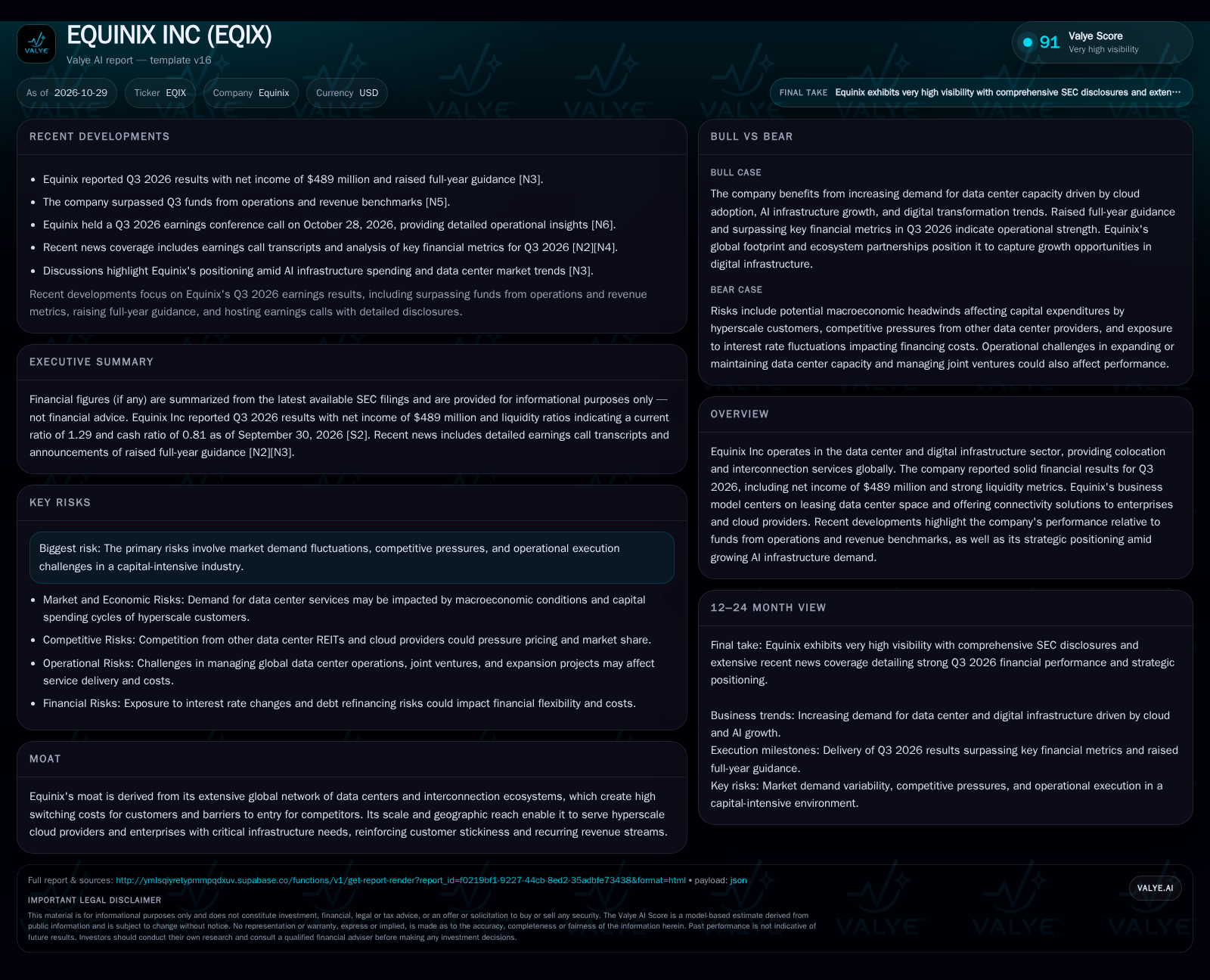
Equinix reported strong Q3 2026 results, including $489 million in net income and outperformance on funds from operations and revenue benchmarks. Its global data center and interconnection network positions the company at the heart of AI and cloud infrastructure growth. While reported liquidity position and scale reinforce its strategic moat, future upside depends on hyperscale demand, pricing discipline, and operational execution amid intensifying competition and macroeconomic uncertainty. Watch for signals in new bookings, margin trends, and expansion project returns to gauge the sustainability of Equinix’s premium positioning. [S2] [N5] [N3]
Equinix sits at the crossroads of global digital infrastructure, enabling cloud, enterprise, and AI workloads through its vast network of interconnected data centers. As demand for AI and cloud computing infrastructure accelerates, the question is whether Equinix can maintain margin discipline and capitalize on its strategic moat, even as competitive and macroeconomic pressures mount.
Q3 2026 Results Highlight Profitability and potential Financial Flexibility
Equinix reported net income of $489 million for Q3 2026, with basic and diluted earnings per share of $4.95 and $4.93, respectively [S2]. This quarter’s performance exceeded funds from operations (FFO) and revenue benchmarks, reinforcing the company’s ability to convert top-line growth into bottom-line results [N5]. As of September 30, 2026, Equinix reported $2.362 billion in cash and $1.235 billion in short-term investments, with a current ratio of 1.29 [S2]. The company reported cash and liquidity metrics for the period; these figures do not by themselves establish operating runway, investment capacity, financial flexibility, or financing capacity. The company’s strong Q3 showing comes at a time when demand for AI and cloud infrastructure is top of mind for both customers and investors [N3].
How Equinix Monetizes Scale and Connectivity
Equinix’s business model centers on leasing colocation space—physical data center real estate—and providing interconnection services that allow enterprise, cloud, and network customers to exchange data at high speeds and low latency. Revenues are primarily recurring, with multi-year contracts and high retention rates typical for the industry, though the precise contract structure is not disclosed in current filings. Pricing is influenced by location, power density, and service mix, while volume is driven by new customer additions and expansion from existing tenants. The interconnection ecosystem, where networks and clouds meet, enables Equinix to charge premium rates and creates notable switching friction.
The economics are capital-intensive: new data center builds require significant upfront investment, but once operational, fixed costs are spread over a large customer base, offering substantial operating leverage. Variable costs include utilities, maintenance, and personnel, but the margin profile is sensitive to energy prices and local regulatory regimes. The company’s ability to generate funds from operations above expectation suggests effective cost management and utilization rates, but future margin expansion will depend on pricing discipline and project execution as competition intensifies.
Network Density and Global Reach: Moat or Margin Pressure?
Equinix’s competitive advantage stems from its global footprint—hundreds of data centers across major metros—and its dense interconnection ecosystem, which attracts both enterprises and hyperscale cloud providers. This network density creates high switching costs for customers who would face significant disruption and expense in relocating infrastructure. The aggregation of cloud, network, and enterprise tenants in the same facilities creates a virtuous cycle: more participants increase the value of the ecosystem, reinforcing customer stickiness.
However, competition from other global data center REITs and infrastructure providers is intensifying, especially as hyperscale customers (large cloud and AI players) seek to negotiate better terms or even build their own facilities. Technology substitution risk—particularly from advances in edge computing, direct cloud connectivity, or more efficient hyperscale builds—could erode pricing power or reduce demand for third-party colocation. The question for Equinix is whether its scale and ecosystem can continue to offset these pressures, especially as new entrants target high-growth AI regions and established peers invest aggressively.
AI Infrastructure Boom Accelerates Utilization and Margins
A favorable scenario for Equinix would see a sustained acceleration in demand for AI and cloud infrastructure, driving both higher occupancy and premium interconnection services. Hyperscale and enterprise customers, unable or unwilling to build their own facilities at scale, could prioritize Equinix’s global reach and network effects, accepting higher prices for access to dense ecosystems and rapid deployment. This would lead to improved utilization rates, strong renewal pricing, and operating leverage as fixed costs are absorbed across a larger revenue base.
Evidence supporting this scenario would include: continued outperformance on FFO and revenue, disclosed increases in average contract length or pricing, high rates of new bookings in AI-centric metros, and expansion project announcements with rapid pre-leasing. Conversely, if hyperscale customers shift more workloads to owned or alternative facilities, or if pricing comes under pressure, this scenario would be challenged.
Demand for Digital Infrastructure Remains Robust, but Margins Face Mixed Signals
The most plausible near-term outlook is that Equinix continues to benefit from secular growth in digital infrastructure—cloud, AI, and network traffic—but faces a more competitive and cost-sensitive environment. While the company maintains high occupancy and recurring revenue, pricing growth may moderate as hyperscale customers exert greater bargaining power and as new capacity comes online from competitors. Operating leverage persists, but margin expansion is incremental, not dramatic.
Confirmation of this trajectory would come from steady but not accelerating FFO/revenue growth, stable utilization rates, and moderate expansion plans. Signs of margin compression or slower pre-leasing on new projects would suggest the competitive environment is intensifying, while robust renewal rates and persistent ecosystem growth would confirm Equinix’s moat remains durable.
Macroeconomic and Competitive Pressures Constrain Growth and Capital Returns
In a less favorable scenario, macroeconomic headwinds—such as a slowdown in enterprise IT spending or reduced hyperscale capital expenditures—combine with aggressive competition to pressure both occupancy and pricing. If energy costs spike or local regulatory barriers delay new projects, Equinix could see margin compression despite its scale. Rising interest rates or debt refinancing challenges could further constrain the company’s ability to respond to shocks, especially given the capital-intensive nature of data center expansion.
Evidence for this scenario would include missed FFO or revenue targets, declining utilization, delayed or scaled-back expansion plans, or disclosure of pricing concessions to retain major customers. An uptick in customer churn or loss of key hyperscale tenants would also be a warning sign that the moat is eroding.
Signals That Will Shape Equinix’s Strategic Edge
Quarterly trends in funds from operations (FFO) and revenue growth relative to guidance and peer benchmarks will test the sustainability of Equinix’s margin profile.
New bookings, renewal rates, and average contract length—if disclosed—would clarify customer retention and pricing dynamics, especially with hyperscale tenants.
Pre-leasing rates and occupancy trends in new expansion projects, particularly in AI and cloud-centric metros, will indicate demand visibility and execution quality.
Capital expenditures and project return metrics, including any disclosed cost overruns or delays, will highlight discipline in deploying capital-intensive infrastructure.
Disclosures around energy cost management and power procurement strategies, given the sensitivity of margins to utility pricing and reliability.
Any changes in customer concentration, such as loss or downsizing of major cloud or AI tenants, would signal competitive or technology substitution risks.
Interest expense trends and debt refinancing activity, especially in a rising rate environment, will affect potential financial flexibility and long-term returns.
Updates on regulatory or permitting risk in key growth regions—such as project delays or new compliance requirements—could impact expansion timelines and costs.
Disclaimer: This is research-only, informational analysis and not investment advice. It may include AI-generated interpretation and general industry context. Always verify important details using primary sources.

Comments