
Antero Resources: Portfolio Realignment and Liquidity Dynamics in a Changing Gas Market
The company’s hedging program, asset base, and access to capital markets support strategic flexibility, yet regulatory and environmental headwinds remain material variables.
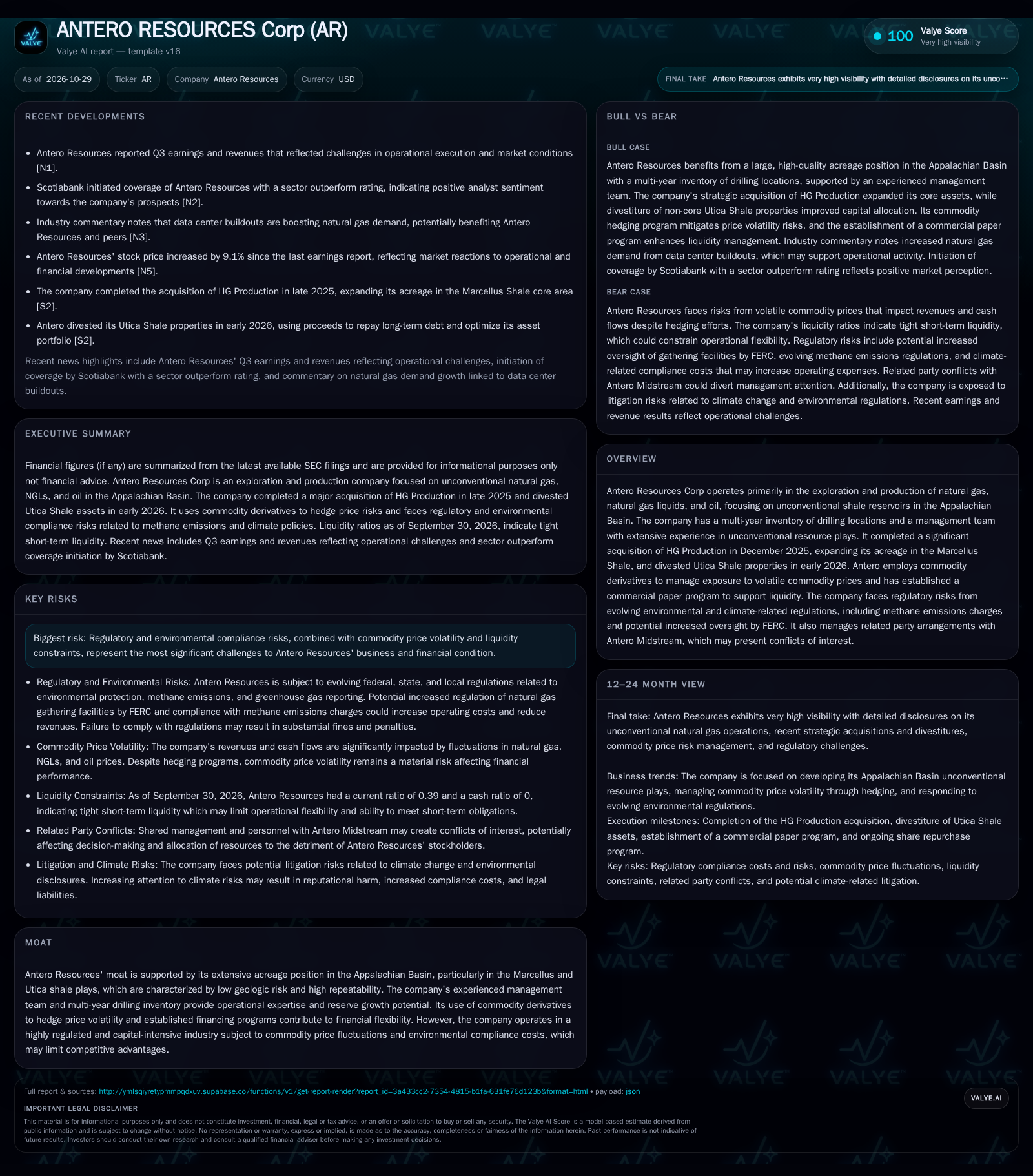
Antero Resources has expanded its Marcellus Shale position through a major acquisition and exited the Utica, reallocating capital and risk. Despite a robust operating cash flow and active hedging, the company faces tight short-term liquidity and heightened regulatory exposure. Future performance will hinge on commodity pricing, integration of new assets, and the ability to manage compliance costs amid evolving climate policies. [S2] [N1] [N3]
Antero Resources stands at a strategic crossroads after a transformative year: the company has deepened its commitment to the Marcellus core through a large-scale acquisition and shed non-core Utica assets, optimizing its portfolio for scale and operational focus. The interplay between these factors will dictate whether Antero’s resource depth and management experience translate into sustainable returns or heightened risk in an evolving gas market.
Recent Portfolio Adjustments and Financial Position Set the Stage
Antero Resources completed the acquisition of HG Production in December 2025, adding approximately 385,000 net acres in the core Marcellus Shale and significantly expanding its unconventional gas resource base. This strategic move was funded through a $1.5 billion term loan and $750 million in senior notes, both of which increased the company’s leverage profile. To partially offset this, Antero divested its Utica Shale properties in early 2026 for $800 million, using the proceeds to pay down long-term debt and sharpen its operational focus on the Marcellus [S2].
For the nine months ended September 30, 2026, Antero reported $1.56 billion in revenue and basic/diluted EPS of $1.19 for Q3. Notably, the company’s short-term liquidity is tight: a current ratio of 0.39 and a cash ratio of 0 reflect a reliance on external liquidity sources and underline the importance of maintaining access to capital markets and operating cash flow [S2].
Antero has hedged approximately 44% of production, tempering some cash flow volatility from swings in natural gas, NGL, and oil prices. However, Q3 earnings and revenue missed estimates—underscoring the operational and market headwinds facing the business [N1].
Overlaying these financial dynamics are regulatory risks, including potential FERC oversight, methane emissions charges, and evolving climate policies, all of which could increase compliance costs and operational complexity [S2].
Economic Impact of Antero’s Asset Mix and Hedging Approach
Antero’s business model is anchored in large-scale, unconventional gas production, where the interplay between realized commodity prices, production volumes, and cost discipline determines cash flow and returns. The core Marcellus acreage—characterized by relatively low geologic risk and repeatable drilling—offers attractive scale and efficiency potential, but also requires substantial upfront capital for drilling, completion, and infrastructure.
Revenue streams are highly sensitive to natural gas and NGL prices, with NGL pricing often tied to oil benchmarks and regional supply/demand imbalances. The company’s use of commodity derivatives to hedge 44% of production helps stabilize near-term cash flows, but leaves meaningful exposure to unhedged volumes and basis differentials, especially in periods of price dislocation [S2].
On the cost side, Antero faces variable expenses such as lease operating, gathering, processing, and production taxes that scale with output. Fixed costs—such as acreage maintenance and corporate overhead—create operating leverage, amplifying the impact of commodity price swings on profitability.
Capital intensity is structurally high: even after the Utica divestiture, sustaining and growing production from shale wells requires ongoing drilling and completion spending. The company’s recent financing activities—including the $1.5 billion term loan, $750 million senior notes, and establishment of a $1.65 billion commercial paper program—signal a need for flexible access to both operating and growth capital [S2].
Positioning and Vulnerabilities in the Appalachian Gas Sector
Antero’s competitive positioning is anchored in its scale and contiguous acreage in the Marcellus, which can confer cost efficiencies in drilling, completion, and infrastructure utilization. This scale is valuable in a basin where large, repeatable drilling inventories and established gathering systems drive lower per-unit costs and operational flexibility.
The company’s experienced management team and multi-year drilling inventory provide a degree of execution reliability, while its hedging program and asset portfolio realignment (via the HG Production acquisition and Utica exit) demonstrate strategic agility. However, Antero operates in a commodity business with limited pricing power: natural gas and NGL markets are subject to macroeconomic, seasonal, and regional forces outside company control.
Peer competition includes other Appalachian-focused gas producers, as well as national E&Ps with diversified portfolios and midstream integration. While Antero benefits from a long-term relationship with Antero Midstream for gathering and processing, related party arrangements may create conflicts of interest and limit independence in strategic decision-making [S2].
Regulatory risks—particularly around methane emissions, FERC oversight, and climate-driven restrictions—are shared across the peer group but may be more acute for scale operators with large infrastructure footprints.
Potential Cash Flow Growth from Rising Gas Demand and Integration Benefits
The most favorable scenario for Antero involves a sustained increase in natural gas and NGL prices, driven by secular demand growth (e.g., data centers, LNG exports, industrial recovery) and constrained supply growth from capital discipline across the industry. In this environment, Antero’s expanded Marcellus footprint would enable efficient volume growth and improved unit economics, while its hedging program would smooth, rather than cap, cash flow upside.
Successful integration of the HG Production assets—achieving targeted synergies in drilling, completion, and gathering—would enhance margins and free cash conversion. A constructive regulatory environment, or at least regulatory stability, would further reduce cost and capex uncertainty. If Antero’s capital markets access remains robust, short-term liquidity constraints could be managed via the commercial paper program and refinancing capacity.
Confirmation of this scenario would require evidence of: (1) sequential production growth and higher realized prices; (2) margin expansion from integration and cost control; (3) stable or improving liquidity metrics; and (4) regulatory or legislative developments that limit new compliance burdens.
Falsification would come from persistently weak gas prices, integration stumbles, or new regulatory costs that offset commodity upside.
Growth Prospects Amid Margin Fluctuations and Regulatory Pressures
The most plausible path forward is one where Antero delivers moderate production growth from its expanded Marcellus base, but faces continued commodity price volatility and incremental regulatory cost pressure. The company manages through short-term liquidity constraints by rotating between operating cash flow, commercial paper, and asset sales as needed, but does not achieve significant deleveraging or margin expansion absent a major uplift in realized prices.
Margins remain exposed to service cost inflation and environmental compliance spending, partially offset by cost efficiencies and hedging. The share repurchase program may be used opportunistically but is likely subordinate to liquidity preservation and debt service.
Falsification would occur if there is a material, sustained move in gas prices (up or down), a regulatory shock, or a significant operational breakdown in integrating new assets.
Risks from Liquidity Strains and Regulatory Developments
The adverse scenario is defined by a combination of depressed commodity prices, cost inflation, and/or an unexpected regulatory or legal event that sharply increases compliance costs or restricts production volumes. In this environment, Antero’s reported cash balance and heavy reliance on external liquidity could force asset sales, curtailment of drilling, or dilutive capital raising.
Operationally, a failure to realize expected synergies from the HG Production acquisition—such as higher-than-expected integration costs or underperforming wells—would further pressure cash generation. Adverse litigation or tighter methane/climate regulations could result in fines, mandated spending, or reputational harm.
Confirmation would come from deteriorating liquidity ratios, negative free cash flow, missed production or cost targets, and/or material new regulatory or legal disclosures. Inability to access commercial paper or credit markets would be a critical stress point.
Falsification would require stabilization or improvement in liquidity metrics, regulatory relief, or a positive commodity price surprise that restores margin and cash generation.
Key Events and Trends Influencing Antero’s Financial Outlook
Quarterly production volumes and realized commodity prices—especially any evidence of volume growth or price capture outperformance versus peers.
Operating cash flow and free cash flow trends, including the impact of integration costs and any incremental regulatory compliance spending.
Progress on cost reduction and synergy realization from the HG Production acquisition; a useful metric would be reported drilling and completion costs per well, if disclosed.
Updates on regulatory, legal, or environmental compliance costs, including methane emission charges and FERC oversight developments.
Utilization of the share repurchase program—whether repurchases accelerate or pause in response to liquidity and leverage dynamics.
Incidence of related party transactions with Antero Midstream, and any new disclosures on potential conflicts of interest or changes to governance arrangements.
Any new asset sales, acquisitions, or capital markets activities that materially alter the company’s leverage or asset base.
Disclaimer: This is research-only, informational analysis and not investment advice. It may include AI-generated interpretation and general industry context. Always verify important details using primary sources.

Comments