
Broadstone Net Lease: How Portfolio Mix and Lease Terms Enhance Resilience in Real Estate
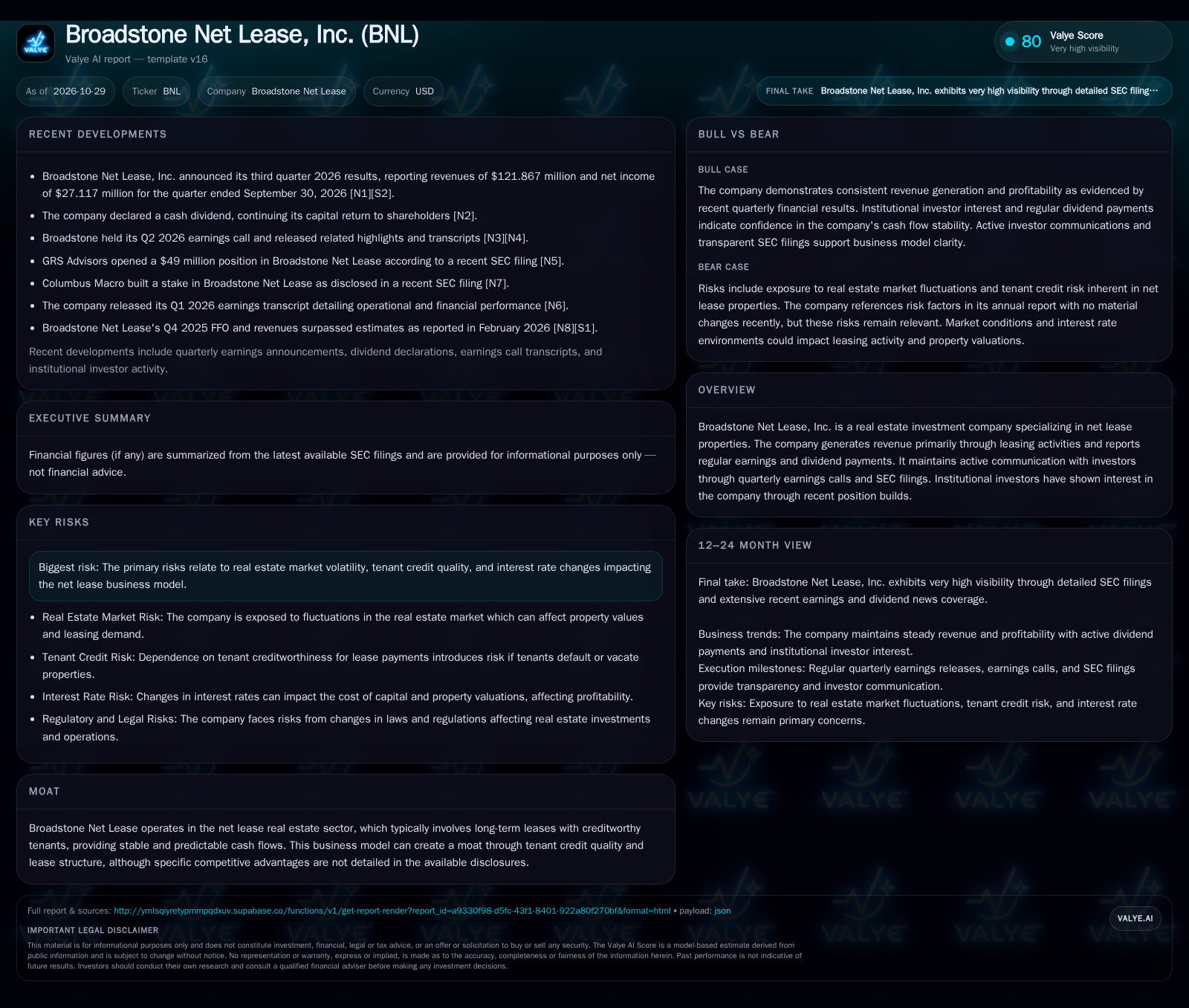
Broadstone Net Lease, Inc. reported $121.9 million in Q3 2026 revenue and maintains a 767-property portfolio across the U.S. and Canada. With a focus on long-term net leases to single tenants and ongoing capital return via dividends, the company’s future hinges on tenant credit quality, lease escalations, and its ability to navigate real estate and interest rate cycles.
Broadstone Net Lease’s Q3 2026 results highlight steady income from a highly diversified, industrial-focused net lease REIT model. The company’s stability rests on its lease structures, portfolio breadth, and tenant creditworthiness, but it remains exposed to macroeconomic and sector-specific risks.
Broadstone Net Lease, Inc. stands out in the net lease REIT sector due to its large, diversified portfolio and disciplined focus on long-term net leases with single tenants. The company’s ability to maintain rent escalations, limit credit losses, and recycle capital into new opportunities will be central to its performance as the real estate landscape evolves.
Recent Results Highlight Scale and Consistent Earnings
Broadstone Net Lease reported Q3 2026 revenue of $121.867 million, net income of $27.117 million, and earnings per share of $0.14. The company’s cash and cash equivalents stood at $12.189 million at quarter-end [S2] [N1]. The portfolio includes 767 properties—760 in the U.S. and seven in Canada—covering approximately 42.3 million rentable square feet and diversified across geography, tenant, and industry [S2].
The cited source reports dividend-related activity; that disclosure alone does not establish dividend-policy continuity, management confidence, or a material constraint on capital flexibility. [N2] Institutional investors such as GRS Advisors and Columbus Macro have recently increased their holdings, signaling confidence in the REIT’s income predictability and asset base [N5] [N7].
While no material changes to disclosed risk factors were reported in the latest filings, the company continues to highlight real estate market volatility, tenant credit risk, and interest rate sensitivity as persistent concerns [S2].
The geographic diversification across the U.S. and Canada not only mitigates localized economic downturns but also exposes the portfolio to varying regional market dynamics, which can influence vacancy rates and rental growth differently. For example, properties situated in economically resilient or rapidly growing metropolitan areas may experience stronger demand and better lease renewal prospects compared to those in slower-growth regions. This spatial dispersion requires sophisticated asset management to optimize leasing strategies and capital allocation, ensuring that underperforming assets are either repositioned or divested to maintain overall portfolio health.
Net Lease Economics Underpin Stable Income and Capital Deployment
Broadstone’s core business model centers on acquiring and managing single-tenant commercial properties under long-term net leases. In these structures, tenants typically assume responsibility for property taxes, insurance, and maintenance, leaving the REIT with predictable rental income and reduced operating expense volatility. This pass-through model can yield relatively high operating leverage and stable cash flows, especially when paired with contractual rent escalations.
Revenue growth may stem from three main levers: embedded same-store net operating income growth (via lease escalations and stable rent collections), development and redevelopment projects (including build-to-suit arrangements), and ongoing acquisitions. The company’s focus on creditworthy tenants and strategic property locations aims to limit credit losses and lease rollovers, supporting earnings visibility.
Capital is allocated among property acquisitions, revenue-generating capex, and development projects, with the investment mix varying as macro conditions shift. The cited source reports dividend-related activity; that disclosure alone does not establish dividend-policy continuity, management confidence, or a material constraint on capital flexibility.
The long-term net lease model inherently shifts operational risks to tenants, but it also places significant emphasis on tenant credit quality and lease covenant strength. If tenants face financial distress, the REIT’s revenue stream could be disrupted despite the contractual protections. Therefore, continuous credit monitoring and proactive lease negotiations become critical components of risk management. Additionally, the timing and magnitude of lease escalations are often contractually fixed, which may limit flexibility in rapidly changing inflationary environments. Consequently, the REIT’s ability to balance fixed escalations with market rent resets during lease renewals will influence income growth trajectories.
Diversified Portfolio and Lease Terms Strengthen Competitive Position
Broadstone’s competitive position is anchored in its portfolio diversification and the structural resilience of the net lease model. By spreading exposure across 767 properties, numerous industries, and multiple geographic regions, the company aims to dampen the impact of individual tenant distress or sector downturns.
The long-term, net lease structure—often with built-in rent escalations—provides a degree of contracted cash flow stability. However, the sector is crowded with other net lease REITs and institutional buyers, which can drive up acquisition prices and compress yields, especially for properties with investment-grade tenants.
Competition also comes from direct property owners, sale-leaseback specialists, and private capital. Substitution risk exists if tenants opt to own rather than lease, particularly in lower-rate environments. Ultimately, Broadstone’s ability to source off-market deals, maintain tenant quality, and manage lease rollover risk are central to its relative advantage.
In a competitive acquisition environment, Broadstone’s ability to identify and secure off-market deals or properties with unique tenant profiles can provide a meaningful advantage. Such opportunities often allow for pricing discipline and enhanced yield capture compared to highly contested auction processes. Moreover, maintaining strong tenant relationships can facilitate lease renewals and reduce downtime between leases, directly impacting net operating income stability. However, the potential for tenant substitution—where tenants choose ownership over leasing—may increase if capital markets offer favorable financing conditions, thereby challenging the REIT’s growth prospects in certain segments.
Lease Escalations Paired with Strong Credit May Boost Performance
A favorable scenario unfolds if Broadstone consistently achieves above-market rent escalations, maintains low credit losses, and successfully recycles capital into higher-yielding acquisitions or developments. Strong tenant retention and minimal lease rollover risk could allow organic earnings growth even if acquisition volumes fluctuate with market cycles.
Upside would be confirmed by sustained growth in same-store net operating income, high rent collection rates, and evidence of accretive new deals that expand the portfolio without diluting return metrics.
Falsification would occur if lease escalations fail to keep pace with inflation, tenant defaults rise, or if the company is forced to compete for assets at yields that compress portfolio returns.
Cash Flow Stability Expected Despite Macro Uncertainties
The most plausible scenario is that Broadstone delivers stable, moderate growth, supported by its existing lease structures and disciplined acquisition approach. Revenue and earnings are likely to remain predictable, with periodic fluctuations driven by tenant events, property churn, and broader real estate cycles.
The base case assumes that interest rate shifts are managed through prudent refinancing and that rent escalations at least partly offset inflationary pressures.
Falsification would be signaled by a spike in tenant turnover, sustained portfolio vacancies, or an inability to source accretive acquisitions as competition intensifies or financing costs rise.
Risks from Tenant Defaults and Market Shifts Could Impact Predictability
A negative chain of events could be triggered by a downturn in tenant industries, leading to payment defaults, lease renegotiations, or property vacancies. If credit losses increase beyond historical norms or if the company faces difficulty re-leasing properties at comparable terms, both cash flow and portfolio valuations would be pressured.
Rising interest rates could further compress acquisition yields and raise financing costs, squeezing spread income and potentially forcing asset sales at unfavorable prices. A severe real estate market correction or sector-specific shocks (such as regulatory changes or tenant bankruptcies) would amplify these risks.
Factors That Could Confirm or Challenge Broadstone’s Durability
Quarterly same-store net operating income growth rates: If disclosed, this would clarify the organic earnings power of the existing portfolio.
Portfolio occupancy and lease rollover statistics: Persistent high occupancy and smooth rollover outcomes would support the stability thesis.
Tenant credit quality distribution and any material tenant defaults: Trends in tenant ratings or defaults would illuminate real credit risk.
Gross and net acquisition yields on new investments: Yield compression or expansion will directly affect future returns.
Cost of capital and refinancing activity: Monitoring changes in financing costs and debt maturity profiles would reveal sensitivity to interest rates.
Dividend coverage ratio (FFO/dividends paid): If disclosed, this metric would test the sustainability of capital returns.
Institutional investor position changes: Ongoing support or reversals by large holders would signal confidence or emerging concerns.
Disclosure of major property sales, write-downs, or asset impairments: These would indicate potential stress or repositioning in the portfolio.
Disclaimer: This is research-only, informational analysis and not investment advice. It may include AI-generated interpretation and general industry context. Always verify important details using primary sources.

Comments