
NextDecade’s LNG Ambitions: Construction Progress, Contractual Visibility, and the Realities of Capital Intensity
The company’s future will likely hinge on its ability to bridge the gap between construction-phase liabilities and the commencement of contracted long-term revenues.
NextDecade is building out the Rio Grande LNG Facility with five trains under construction and long-term sales agreements covering most of its initial capacity. The transition from builder to operator will depend on timely execution, successful financing, and the realization of contracted cash flows, with substantial risks if delays or cost overruns occur.
NextDecade Corporation’s Rio Grande LNG project is a high-profile, high-stakes endeavor in the U.S. LNG export sector. With over 30 MTPA of planned capacity underpinned by long-term sales agreements and Bechtel-wrapped EPC contracts, the company appears to have de-risked many elements of project execution. How NextDecade manages this capital-intensive transition will define whether it emerges as a major LNG exporter or faces prolonged financial strain.
Where the Project Stands: Construction, Contracts, and Liquidity Snapshot
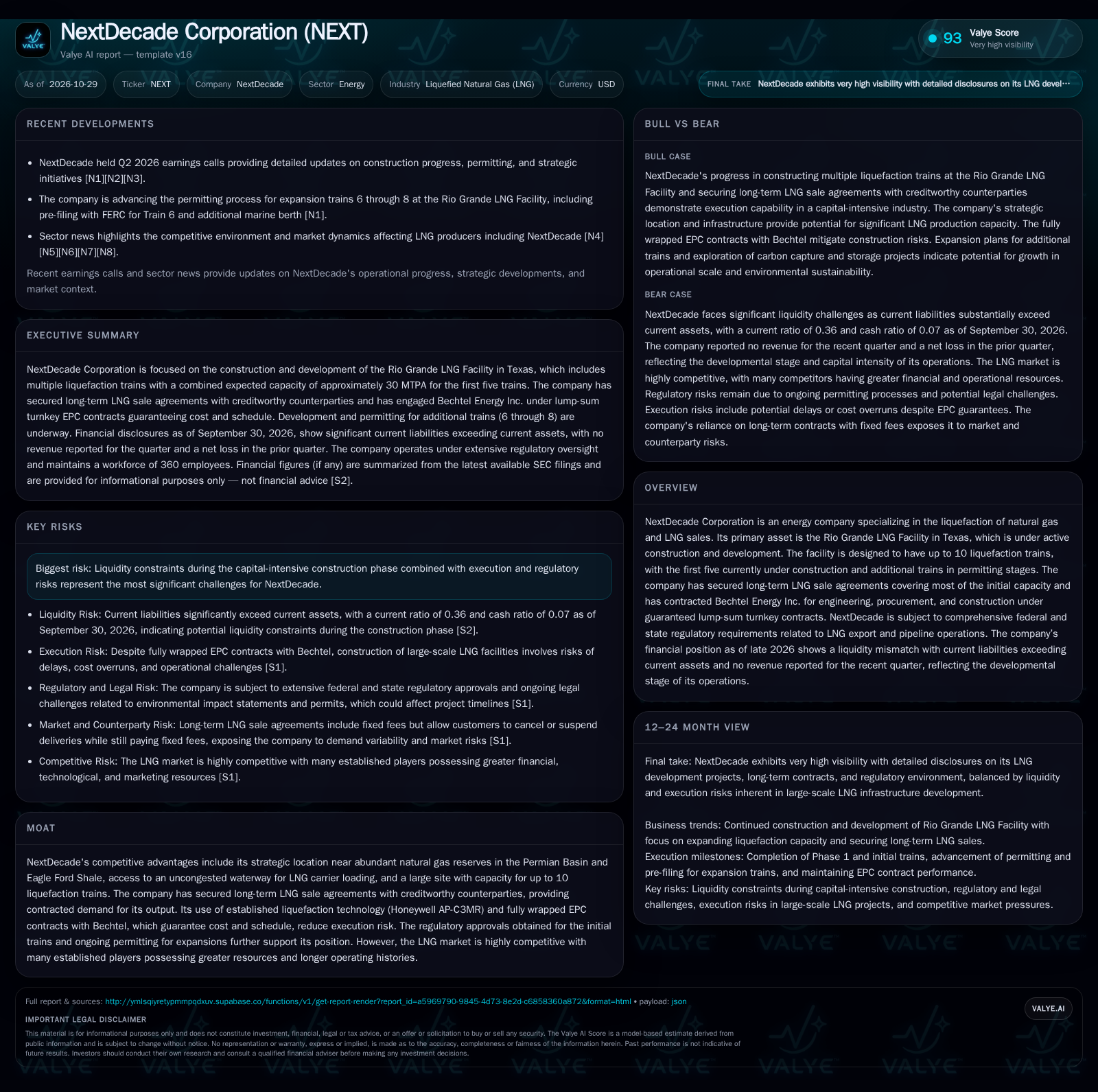
NextDecade is actively constructing the first five liquefaction trains at its Rio Grande LNG Facility in Texas, with combined expected capacity of approximately 30 MTPA [S1]. The company has secured long-term Sale and Purchase Agreements (SPAs) with 14 creditworthy counterparties, covering 25.3 MTPA of output from Trains 1–5; these contracts have a weighted average term of 19.5 years and include fixed and variable fees [S1]. Engineering, procurement, and construction are governed by lump-sum, turnkey contracts with Bechtel Energy Inc., which guarantee cost, schedule, and performance for the initial phases [S1].
Financially, as of September 30, 2026, NextDecade reported cash and equivalents of $129.9 million, current assets of $642.7 million, and current liabilities of $1.805 billion, resulting in a current ratio of 0.36 and a cash ratio of 0.07 [S2]. The company reported no revenue for the recent quarter and a net loss of $195 million in the prior quarter [S2]. This reflects the capital-intensive, pre-revenue construction stage that defines the company’s immediate outlook.
How NextDecade’s Revenue Model and Cost Structure Could Play Out
NextDecade’s business model is predicated on converting large upfront capital investments into long-term, relatively predictable cash flows through contracted LNG sales. Once operational, the company expects to generate revenue from a combination of fixed and variable fees embedded in its SPAs. The fixed fee component is designed to provide baseline cash flow regardless of actual LNG offtake, since customers may suspend deliveries but are still obligated to pay these minimum charges [S1]. Variable fees are structured to cover natural gas and fuel costs, limiting exposure to commodity price fluctuations.
The economics are highly leveraged to volume and utilization: with over 25 MTPA contracted, the facility—if completed on time and within budget—could achieve strong operating leverage as fixed costs are spread over large output volumes. However, the initial stages are profoundly capital-intensive, with Phase 1 construction alone expected to cost $18 billion and each of Trains 4 and 5 budgeted at $6.7 billion [S1]. Financing such outlays typically requires a combination of project-level debt, equity, and possibly future refinancing, all of which add to near-term financial strain.
During construction, fixed costs (debt service, overhead, and minimum EPC payments) dominate, without offsetting operational revenue. Once operational, the shift to high-margin, contracted cash flows could transform the economics, but only if ramp-up is achieved without significant delay or cost overrun.
Strategic Advantages and Competitive Pressures in LNG Export
NextDecade’s competitive advantages stem from its location near prolific natural gas basins (Permian and Eagle Ford), access to an uncongested waterway, and a large site capable of supporting up to 10 liquefaction trains [S1]. The company’s use of established Honeywell liquefaction technology and fully wrapped EPC contracts with Bechtel help mitigate construction and performance risk, which is a differentiator in a sector often plagued by overruns and delays.
However, the global LNG market is crowded with established players possessing deeper balance sheets and longer operating histories. Major peers—ranging from U.S. incumbents to international supermajors—can outcompete smaller entrants on project financing, customer relationships, and marketing muscle. While NextDecade’s long-term SPAs provide visibility, their flexibility (customers can suspend deliveries) means that the company’s ultimate cash flows are not entirely insulated from market cycles or counterparty risk.
Technology substitution risk is present, though for LNG exports the pace of alternative energy displacement is likely gradual. Regulatory and environmental scrutiny, especially around new LNG terminals, remains a persistent barrier to entry and expansion.
If Project Execution Aligns with Contracted Demand: Unlocking Cash Flow and Expansion
The most favorable scenario occurs if NextDecade completes construction of the first five trains on time and on budget, transitions smoothly into operations, and begins collecting the fixed and variable fees from its long-term SPAs. Bechtel’s EPC guarantees reduce the risk of major cost overruns or delays, and the company’s regulatory approvals for Trains 1–5 are already in place [S1].
Evidence that would confirm this scenario includes: timely mechanical completion and commissioning of the initial trains; on-schedule first LNG cargoes; minimal disputes or change orders with Bechtel; and customer adherence to delivery schedules and payment obligations. Announcements of successful debt refinancing or additional equity capital raised on favorable terms would further support the upside thesis.
Construction-Phase Strain Followed by Staged Ramp-Up: Navigating to Steady-State Operations
The most plausible path forward is that NextDecade endures continued financial strain during the construction phase, with periodic needs for additional capital infusions to bridge liquidity gaps. Some delays, cost inflation, or minor permitting setbacks are likely, but Bechtel’s EPC contracts should limit the magnitude of overruns.
Upon completion of the first trains, the company would begin to recognize revenue from the fixed and variable components of its SPAs, gradually improving cash flow and balance sheet stability. However, the ramp-up to full contracted capacity may be phased, with operational hiccups and customer delivery flexibility tempering the speed of cash flow realization.
This scenario would be confirmed by: sequential progress updates showing construction milestones achieved within revised budgets and timelines; evidence of successful financing rounds or debt restructurings; and initial operational results (if disclosed) meeting or approaching contracted output levels.
Liquidity Shortfalls or Delays Trigger Financial and Operational Setbacks
The adverse scenario materializes if construction delays, cost overruns, or regulatory setbacks outpace the company’s ability to secure new financing. With a current ratio of just 0.36 and no revenue as of late 2026, there is little margin for error [S2]. Unanticipated cash drains—such as change orders, legal challenges, or customer contract renegotiations—could force NextDecade to seek expensive bridge financing, dilute shareholders, or slow project progress.
A severe downturn in global LNG demand or a major counterparty default could further erode the value of the long-term SPAs, especially if customers elect to pay fixed fees but suspend deliveries, undermining the operating leverage that underpins the investment case.
Downside confirmation would include missed construction milestones, negative covenant triggers, forced asset sales, or public disclosures of financing distress. Regulatory or environmental setbacks delaying Train 6–8 expansion would add to the risk.
Milestones and Metrics That Will Define NextDecade’s Transition from Builder to Operator
Progress on construction milestones for each train, including mechanical completion, commissioning, and first LNG cargoes—delays or cost overruns would materially affect the company’s ability to transition to revenue generation.
Updates on additional debt or equity financing secured to bridge the construction-to-operations gap; terms and timing of any refinancing or new capital raises will be critical.
Evidence of customer adherence to SPA delivery schedules and payment obligations; any contract suspensions or renegotiations should be monitored closely.
Status and timing of regulatory approvals, particularly for Trains 6–8 and new marine infrastructure—any legal or environmental challenges could alter expansion prospects.
If disclosed, initial plant utilization rates and operational reliability metrics post-commissioning, which would test the facility’s ability to meet contracted output.
Changes in global LNG demand or pricing that could affect the economics of the company’s long-term SPAs or the willingness of customers to take delivery.
Resolution of any disputes or claims under the Bechtel EPC contracts, as these could impact both cost and schedule.
Disclaimer: This is research-only, informational analysis and not investment advice. It may include AI-generated interpretation and general industry context. Always verify important details using primary sources.

Comments