
Cheniere Energy Partners: Contractual Foundations, Expansion Ambitions, and the Evolving LNG Landscape
Cheniere Energy Partners, owner of the Sabine Pass LNG terminal, is navigating a period of expansion, contract backlog growth, and shifting global demand. As it pursues major capacity increases and manages commodity price risks, the partnership’s cash flow stability and capital allocation priorities stand at the center of its long-term value proposition.
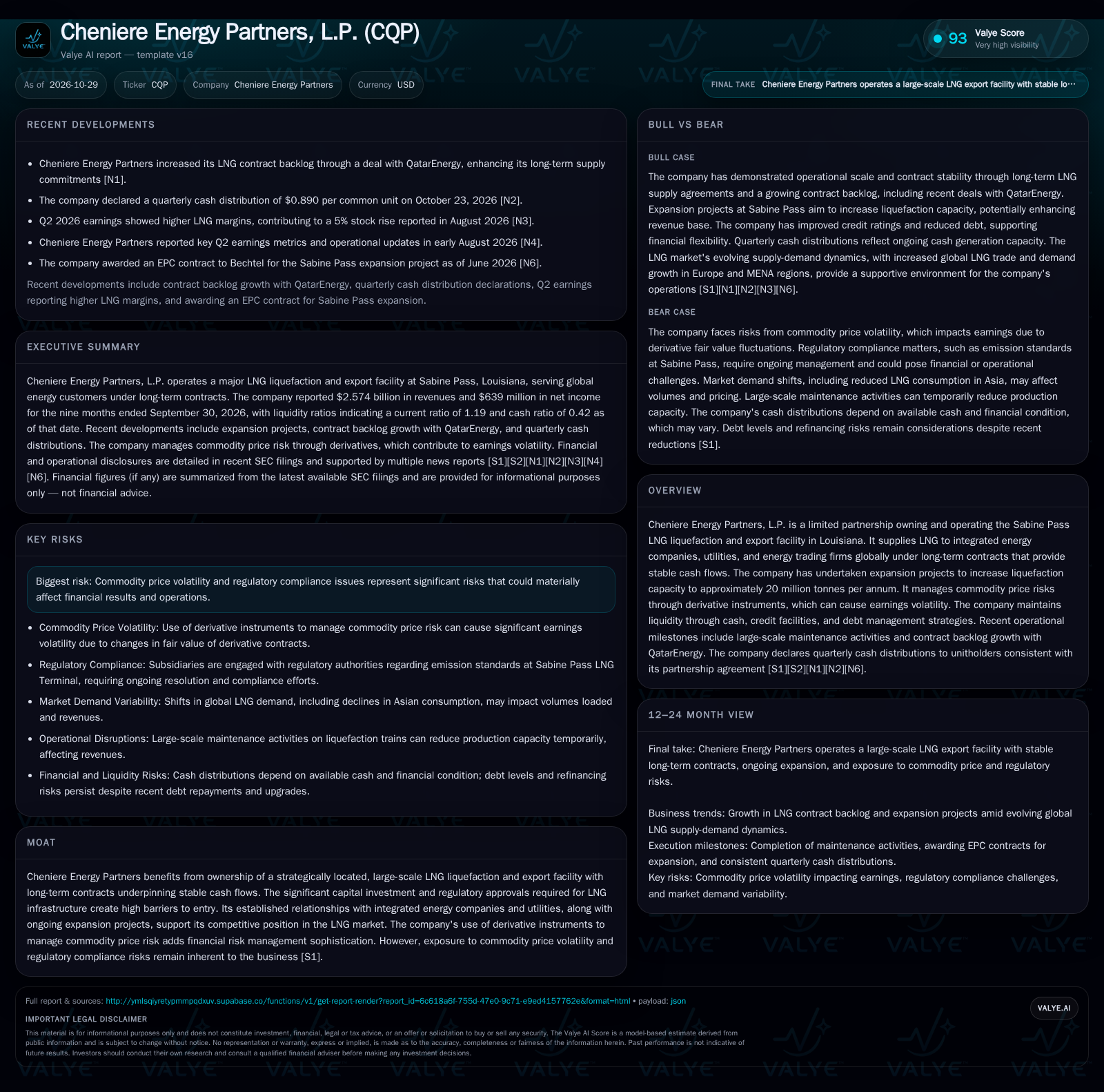
Cheniere Energy Partners operates the Sabine Pass LNG export facility, anchoring revenues with long-term contracts while expanding capacity and growing its contract backlog, highlighted by a recent deal with QatarEnergy. The company’s financials reflect strong recent profitability and ongoing distributions, but earnings volatility from commodity derivatives and regulatory compliance remain key risks. The critical questions are whether expansion can be executed on time and on budget, and if demand growth—especially outside Asia—will absorb new capacity at attractive margins. [S1] [N1] [N2]
Cheniere Energy Partners stands as a pivotal player in the U.S. LNG export market, leveraging the scale and location of its Sabine Pass terminal to anchor long-term supply contracts with global energy companies. Recent developments—chief among them a larger contract backlog with QatarEnergy and a major expansion project—signal both operational momentum and heightened execution demands. As the company manages commodity price swings and regulatory oversight, the interplay between expansion, contract structure, and shifting global LNG demand will shape its ability to generate durable cash flows and sustain distributions.
Recent Milestones: Expansion, Contract Backlog, and Financial Performance
Cheniere Energy Partners increased its LNG contract backlog through a significant new agreement with QatarEnergy, reinforcing its position as a long-term supplier to major global counterparties. The company is moving forward with a two-phased expansion at Sabine Pass, targeting approximately 20 million tonnes per annum (mtpa) of additional LNG capacity, and recently awarded the EPC contract for this project to Bechtel in June 2026. For the nine months ended September 30, 2026, Cheniere reported $2.574 billion in revenues and $639 million in net income, with a current ratio of 1.19 and a cash ratio of 0.42. The company continues to declare quarterly cash distributions, most recently $0.890 per common unit as of October 2026. [S1] [S2] [N1] [N2] [N6]
How Cheniere Monetizes LNG: Contracts, Capacity, and Cost Structure
Cheniere Energy Partners’ business model is centered on monetizing its liquefaction and export infrastructure by entering into long-term contracts, typically with integrated energy firms, utilities, and energy traders. These agreements often provide fixed or capacity-based fees, which anchor a substantial portion of revenues and reduce direct exposure to spot LNG price swings. However, the company retains some exposure to commodity price movements, both through uncontracted volumes and the use of derivatives for risk management, which can introduce earnings volatility.
The economics of the business are heavily capital-intensive: constructing, expanding, and maintaining liquefaction trains requires substantial upfront investment, with high fixed costs amortized over long contract lives. Once operational, incremental variable costs are comparatively low, so additional volumes or margin expansion can drive significant operating leverage, especially as new capacity comes online. Cash distributions to unitholders are funded from distributable cash flow, which depends on both contracted fee streams and the timing of maintenance, expansion expenditures, and debt service.
Cheniere’s ongoing expansion at Sabine Pass, if delivered on schedule and budget, could materially increase revenue potential—though it will also require disciplined capital allocation and careful management of construction and financing risks. The company’s recent debt refinancing and credit rating upgrades may lower future interest expense, but new borrowings to fund expansion will influence future distribution capacity and leverage metrics. [S1] [S2]
Barriers to Entry and the Dynamics of LNG Export Competition
Cheniere’s competitive edge is rooted in its ownership of a strategically located, large-scale LNG export facility with established infrastructure, regulatory approvals, and deepwater access. High capital requirements and complex permitting processes create formidable barriers to entry, limiting the number of credible new entrants in the U.S. LNG export space. The company’s long-term contracts with blue-chip customers provide revenue visibility and can discourage counterparty switching, especially when combined with the logistical and commercial friction of renegotiating global LNG supply chains.
However, the broader LNG market is becoming more competitive as global supply grows, with new export projects coming online in the U.S., Qatar, and Australia. While Cheniere benefits from being an early mover and having a built-out customer base, it faces indirect competition from other LNG suppliers and alternative fuels, particularly as buyers seek flexible contract terms and greater diversification. The ability to secure additional long-term contracts for new capacity—rather than relying on potentially volatile spot sales—will be critical to maintaining its competitive position and margin stability.
Regulatory scrutiny, particularly around emissions and environmental impact, also shapes the competitive landscape, as non-compliance could delay projects or increase costs. Counterparties may increasingly scrutinize the carbon footprint of LNG supply, potentially affecting contract terms or market access.
Expansion Delivers: Margin Accretion and Distribution Growth
In the favorable scenario, Cheniere completes its Sabine Pass expansion on time and on budget, bringing approximately 20 mtpa of new liquefaction capacity into service. The company successfully secures additional long-term contracts—potentially with European and MENA buyers seeking supply diversification—at attractive fixed fees, which further anchor cash flows and reduce reliance on volatile spot markets.
This scenario could see incremental revenues and margins from new capacity significantly outpace incremental costs, resulting in higher distributable cash flow and supporting both increased quarterly distributions and further deleveraging. The improved scale could also enhance Cheniere’s negotiating leverage with suppliers and contractors, while a larger contract backlog would be viewed favorably by credit agencies, potentially enabling more favorable refinancing terms.
Evidence that would confirm this scenario includes: successful progress updates on construction milestones; announcements of new long-term contracts for expanded capacity; rising contract backlog; distribution increases; and continued positive credit rating actions. Conversely, delays, cost overruns, or difficulty in contracting new volumes would falsify the thesis.
Stable Operations with Execution Risk and Market Volatility
The most plausible outcome is that Cheniere maintains stable operations anchored by its current contract base, while expansion progresses with typical large-project risks—some delays or cost adjustments, but no major disruptions. The company continues to generate substantial revenues and distributable cash flow, supporting ongoing quarterly distributions and modest debt reduction. Some new capacity is contracted at reasonable terms, but a portion may be exposed to shorter-term or spot pricing, introducing margin variability.
Earnings and cash flow remain subject to swings in commodity prices due to both uncontracted cargoes and the mark-to-market effects of derivatives. Regulatory compliance costs and periodic maintenance may create intermittent headwinds. The company’s ability to maintain investment-grade credit ratings and access capital markets remains intact, but further distribution growth is paced by the timing of new project cash flows and prudent balance sheet management.
Confirmation would come from steady financial reporting, distribution continuity, and regular progress on expansion milestones, while evidence of significant contracting shortfalls, regulatory setbacks, or elevated commodity-driven volatility would serve as early warning signs.
Demand Shifts, Regulatory Delays, and Margin Compression
In an adverse scenario, global LNG demand growth underwhelms—particularly if Asian demand remains weak or Europe accelerates renewables adoption—leading to oversupply and pressure on spot and contract pricing. Cheniere may struggle to secure long-term offtake agreements for its expanded capacity, forcing greater reliance on the spot market and resulting in lower realized margins and cash flow volatility.
Regulatory hurdles, such as stricter emissions standards or permitting delays, could increase project costs or postpone expansion, disrupting revenue growth and impairing return on invested capital. Commodity price volatility, if not effectively hedged, could further destabilize reported earnings due to the mark-to-market impact of derivatives, while elevated debt from expansion spending could constrain future distributions or trigger covenant pressure.
This scenario would be confirmed by announcements of project delays, cost overruns, lack of progress on new contracts, distribution reductions, or negative credit rating actions. Early warnings could include rising regulatory or environmental scrutiny, increased spot exposure, and persistent earnings volatility.
Benchmarks for Testing Cheniere’s Expansion and Cash Flow Durability
Progress on Sabine Pass expansion: Announcements regarding construction milestones, budget adherence, and projected in-service dates will be crucial for assessing execution risk.
Growth in contract backlog: Disclosure of new long-term offtake agreements, customer diversification, and average contract duration—if provided—will help gauge revenue visibility and demand for new capacity.
Distribution coverage ratio: If disclosed, trends in distributable cash flow relative to declared distributions will provide insight into payout sustainability.
Commodity price exposure: Detailed breakdowns of contracted versus uncontracted volumes, and the impact of derivative positions on earnings, would clarify risk management effectiveness.
Regulatory developments: Updates on emissions compliance, permitting, or environmental litigation that could affect operations or expansion timelines.
Maintenance and downtime: Frequency, cost, and operational impact of scheduled or unscheduled maintenance on liquefaction trains would help model near-term cash flow swings.
Global demand trends: External indicators of LNG demand in Europe, MENA, and Asia, as shifts here influence contract pricing and utilization rates.
Disclaimer: This is research-only, informational analysis and not investment advice. It may include AI-generated interpretation and general industry context. Always verify important details using primary sources.

Comments