
FTI Consulting: Diversified Demand, Margin Pressures, and the Strategic Cost of Talent
FTI Consulting’s ability to capture broad-based demand across advisory segments is offset by rising costs and competitive pressure, spotlighting the delicate balance between growth, profitability, and capital allocation as the consulting cycle matures.
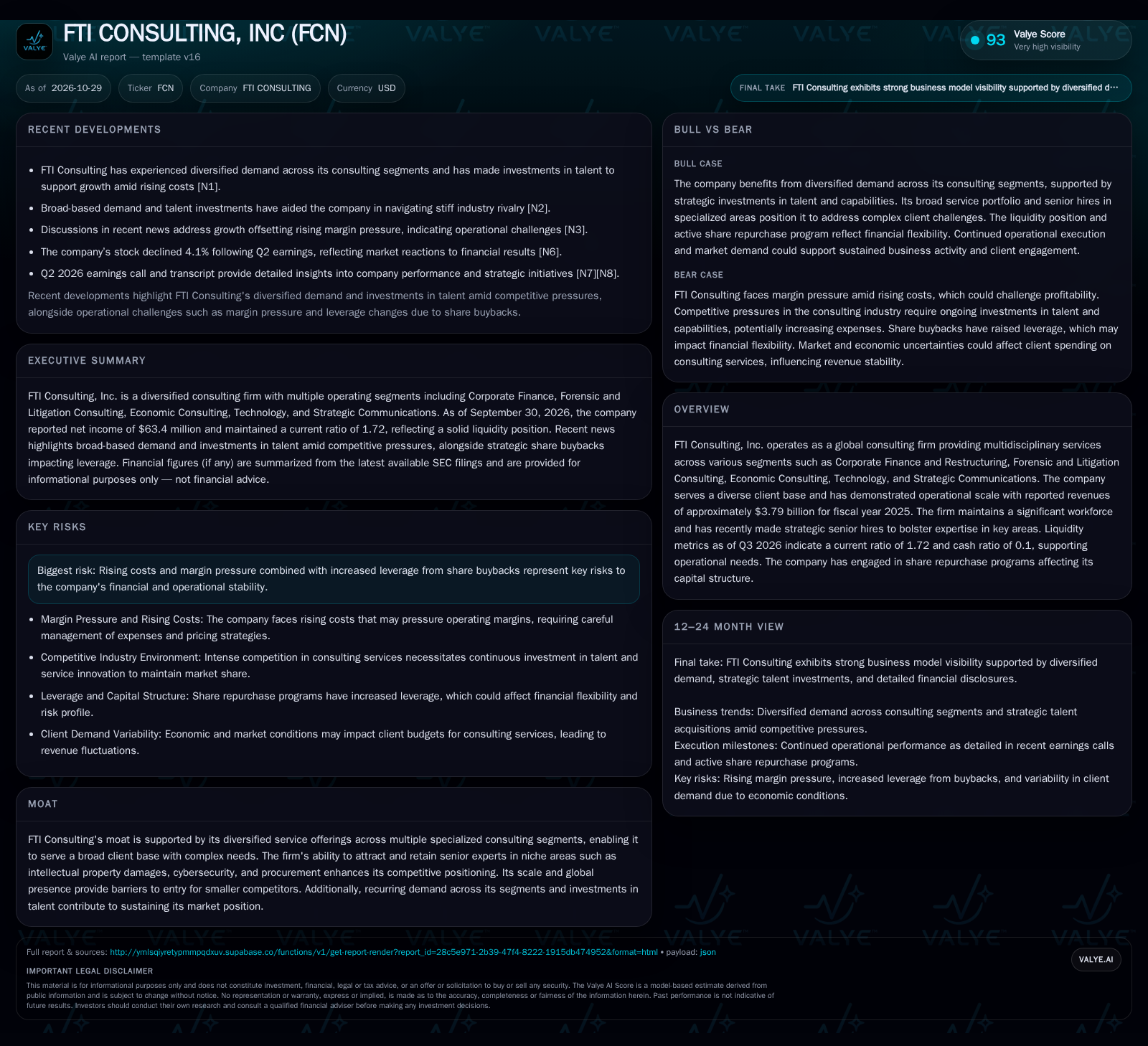
FTI Consulting enters late 2026 with diversified demand across Corporate Finance, Forensic, Economic, Technology, and Communications segments, but faces margin pressure from rising costs and ongoing investments in senior talent. Recent share buybacks have increased leverage, sharpening scrutiny on capital efficiency and operational discipline. [S2] [N1] [N2] [N3]
FTI Consulting’s recent operating results highlight a classic consulting industry crossroads: strong, diversified client demand and expanded capabilities are driving top-line growth, yet rising costs—particularly for high-value talent—are squeezing margins. As the company leans into strategic hiring and invests in specialized practices, competitive intensity and a tightening labor market force tradeoffs between growth, profitability, and capital allocation.
Recent Results Reflect Growth and the Cost of Talent
The company reported a cash ratio of 0.1 for the period. [S2] Operationally, FTI is experiencing broad-based demand across its core consulting segments, with recent news highlighting investments in senior hires across procurement, IP damages, cybersecurity, and communications [N1] [N2]. Despite these positives, the company is facing margin pressure as cost inflation—especially for top-tier talent—outpaces some revenue gains [N3]. Recent share buyback activity has also increased leverage, raising questions about future capital flexibility [N6].
Consulting Economics: Pricing Power vs. Cost Inflation
FTI’s revenue model is built on billing for specialized expertise—either as project-based fees, recurring advisory retainers, or value-based engagements. The core economic lever is the utilization rate of high-billing consultants: maximizing the percentage of billable hours while maintaining premium pricing. As the company expands into high-value domains (e.g., intellectual property, cybersecurity), it may be able to command higher rates, but this is offset by rising compensation expectations for senior talent and specialists.
Fixed costs are relatively modest (office infrastructure, core support staff), while variable costs—primarily salaries and bonuses—scale with headcount and client demand. This structure allows for operating leverage in periods of strong demand, but also exposes the firm to margin compression if wage inflation outpaces pricing power or if utilization dips. Engagement mix matters: complex, urgent projects command higher margins, while commoditized work is more price-sensitive.
An additional layer of complexity in consulting economics arises from the evolving client expectations around outcome-based engagements. While traditional time-and-materials billing remains prevalent, there is a growing shift toward value-based pricing models that tie fees to measurable client outcomes. This trend can enhance revenue predictability and client alignment but also transfers some performance risk to the consultant. For FTI, successfully navigating this shift requires robust project scoping, precise resource allocation, and the ability to demonstrate clear ROI. Failure to manage these elements could compress margins further if projects underdeliver or require unanticipated effort.
Moreover, geographic and sectoral diversification impact cost and pricing dynamics. Consulting rates and labor costs vary significantly across regions, with developed markets commanding premium fees but also higher wage inflation. FTI’s global footprint may provide some natural hedging against localized economic downturns or cost spikes, but it also introduces complexity in managing cross-border talent deployment and compliance. Sector-specific demand cycles—such as regulatory changes or technological disruption—can create pockets of accelerated growth or contraction, influencing utilization rates and pricing power in ways that require agile resource management and forecasting.
Defending Share in a Fragmented, Talent-Driven Market
FTI’s competitive moat is rooted in its breadth of service offerings, global reach, and the reputational capital of its senior experts. The consulting industry remains highly fragmented, with global giants, boutiques, and niche specialists all competing for client wallet share. The ability to attract and retain top-tier talent is both a differentiator and a vulnerability—star consultants can drive client relationships and premium pricing, but are costly and mobile.
Competitive pressure is most acute in areas with lower switching costs or where expertise is commoditized. FTI’s recent senior hires in procurement, IP, and cybersecurity suggest a focus on defending and expanding share in high-growth, high-margin niches [N2]. However, as more competitors target these same domains, the risk of wage escalation and client price sensitivity rises. Technology enablement (e.g., analytics, digital forensics) could provide some differentiation, but it is not clear from current disclosures whether FTI is capturing technology-driven margin expansion or simply meeting table stakes.
Specialized Talent and Platform Depth Drive Margin Expansion
If FTI can successfully leverage its recent senior hires and investments in specialized practices to win more high-value, complex mandates, it could see both revenue acceleration and margin improvement. This upside scenario hinges on the firm's ability to translate domain expertise into premium pricing, while maintaining high consultant utilization and limiting wage inflation through selective hiring and retention strategies.
Evidence supporting this scenario would include a rising average revenue per consultant, improved segment-level margins (especially in Forensic, Economic, or Technology consulting), and client wins in complex, non-commoditized areas. Additional confirmation would come from management commentary or disclosures indicating that technology investments are enabling higher-value service delivery, or if the company is able to modestly grow its cash balance and reduce leverage despite ongoing buybacks. Conversely, if margin expansion does not materialize or if wage costs continue to outpace revenue growth, this scenario would be challenged.
Balancing Growth and Margin in a Competitive Cycle
The most likely outcome is that FTI maintains steady growth across its diversified segments, with moderate revenue gains offset by ongoing margin pressure from talent costs and competitive pricing. The company is likely to continue investing in senior hires to defend and grow share, but wage inflation and client budget scrutiny will limit the ability to expand margins meaningfully.
This scenario would be confirmed by continued broad-based demand, stable or slightly compressed operating margins, and periodic share repurchases. Utilization rates and average billable rates would remain steady, but not significantly outpace cost growth. If the consulting cycle weakens or if competitors aggressively undercut on price, FTI may need to further calibrate its talent investments and capital allocation strategy.
Cost Escalation and Leverage Undermine Resilience
A negative scenario unfolds if wage inflation and cost escalation significantly outpace FTI's ability to raise prices, leading to sustained margin compression and weaker profitability. If client demand softens—whether from macroeconomic slowdown or shifting client priorities—utilization rates could fall, amplifying the margin impact of fixed and semi-variable costs.
In this case, recent increases in leverage from share buybacks would further constrain potential financial flexibility, potentially forcing a pause in repurchases or even necessitating capital raises. Evidence for this scenario would be a declining operating margin, deteriorating net income, and rising debt metrics. Negative working capital trends, lower cash balances, or guidance revisions would further validate the downside, especially if accompanied by management commentary about cost-containment or restructuring.
Testing FTI’s Thesis: Talent, Margins, and Capital Discipline
Monitor segment-level revenue and margin trends, especially in Forensic, Economic, and Technology consulting, for signs of mix shift or pricing power.
Track average billable rates and consultant utilization, as disclosed, to assess whether talent investments are translating into higher productivity or pricing.
Watch for changes in compensation expense as a percentage of revenue—a rising ratio would signal intensifying margin pressure.
Follow cash balance and leverage metrics in subsequent filings to see if capital discipline is maintained amid ongoing buybacks.
Listen for management commentary on the competitive environment, client demand trends, and pricing strategy in earnings calls and transcripts.
Look for disclosures or news on new marquee client wins or multi-year mandates that could drive visibility and segment growth.
A useful metric would be the revenue contribution from new senior hires or specialized practice areas, if disclosed, to test the return on talent investments.
Assess any evidence of technology investment payoffs, such as digital forensics or analytics, that could support margin expansion or service differentiation.
Disclaimer: This is research-only, informational analysis and not investment advice. It may include AI-generated interpretation and general industry context. Always verify important details using primary sources.

Comments