
EMCOR Group: Data Center Demand, Acquisition Integration, and the Economics of Complex Construction Services
EMCOR Group’s record 2025 revenue reflects both robust end-market demand—especially for data center infrastructure—and the impact of its acquisition strategy, but the company’s long-term margin profile will depend on effective integration, project execution, and navigating segment-specific headwinds in building and industrial services.
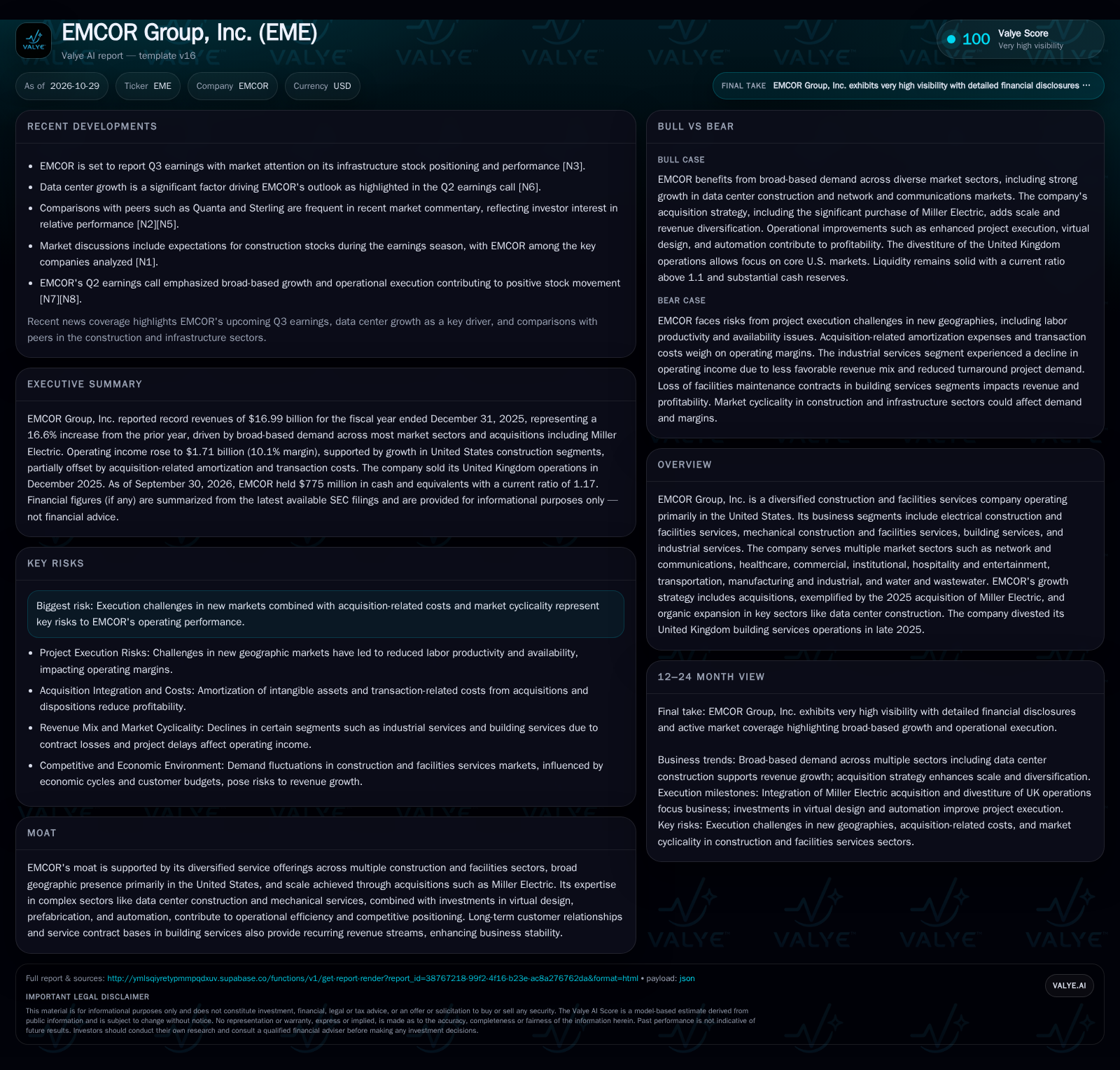
EMCOR Group’s 2025 revenue of $16.99 billion, up 16.6% year-over-year, was driven by broad-based growth, notably in data center construction, and bolstered by the Miller Electric acquisition. Operating income rose to $1.71 billion, but margin expansion remains constrained by acquisition-related costs and the integration of new businesses. Segment results reveal strengths in U.S. electrical and mechanical construction, offset by softness in industrial services and contract losses in building services. The company’s future economics hinge on continued demand in high-growth sectors and its ability to maintain project discipline amid cyclical and execution risks. [S1] [S2] [N3] [N6] [N7] [N8]
EMCOR Group, Inc. posted record 2025 results, underpinned by robust demand across U.S. construction and facilities services markets, especially in sectors like data centers and communications infrastructure. The acquisition of Miller Electric amplified revenue scale and sector reach, while divestiture of the U.K. building services unit signals a renewed focus on domestic operations. However, the company’s operating margin profile is shaped by both the benefits and costs of its acquisition-driven growth, and challenges remain in segments exposed to project timing and contract churn. The critical question is whether EMCOR can sustain double-digit margins and sector-leading growth as end-market demand evolves and integration challenges persist. [S1] [S2] [N6] [N7] [N8]
Record Revenues, Segment Divergence, and Strategic Refocusing
For the fiscal year ended December 31, 2025, EMCOR Group reported revenues of $16.99 billion, a 16.6% increase over 2024, with operating income of $1.71 billion (10.1% margin) and net income of $1.27 billion. This growth was broad-based, but especially pronounced in sectors such as network and communications—driven by data center construction—alongside healthcare, commercial, and institutional markets. The U.S. electrical construction segment delivered $5.07 billion in revenue, up $1.73 billion year-over-year, with $1.11 billion attributed to the acquisition of Miller Electric in February 2025. Meanwhile, the mechanical construction segment achieved $7.05 billion in revenue, including $145 million from acquisitions. [S1] [S2]
The company divested its U.K. building services segment in December 2025, which had contributed $471 million in revenue that year. Building services in the U.S. saw modest growth in mechanical services, offset by contract losses in site-based maintenance. Industrial services revenues declined slightly, reflecting lower turnaround project demand and the completion of a major renewable fuel project. As of September 30, 2026, EMCOR held $775 million in cash and had a current ratio of 1.17. [S2]
Dissecting EMCOR’s Revenue Streams and Margin Drivers
EMCOR’s business model is built around providing specialized construction and facilities services, primarily to private and public sector clients in the U.S. The company’s economics hinge on a mix of project-based revenues (large-scale construction, data centers, infrastructure) and recurring services (maintenance, HVAC retrofits, automation, and repair). Project-based work typically brings higher absolute revenue volumes but carries lumpiness and execution risk, while service contracts can provide some revenue visibility and smoother cash flows.
The 2025 results illustrate the impact of both organic demand and acquisition-driven expansion. The Miller Electric acquisition notably boosted scale in electrical construction, which tends to offer relatively attractive margins due to technical complexity and client demand for integrated solutions. However, integration costs, amortization of intangibles, and transaction expenses associated with acquisitions and divestitures diluted overall margin gains. Operating leverage is evident in the construction segments, where incremental revenue from large projects can scale efficiently if project execution remains strong and cost overruns are minimized.
Building services—especially mechanical divisions—offer a more stable, recurring revenue base, but are sensitive to contract renewals and customer retention. Industrial services tend to be cyclical, with margins heavily influenced by project mix, timing, and end-market dynamics such as energy or process industry capital budgets. Capital requirements are moderate compared to asset-heavy industrials, but working capital needs can spike with project scale and seasonality. The company reported cash and liquidity metrics for the period; these figures do not by themselves establish operating runway, investment capacity, financial flexibility, or financing capacity. [S2]
How Scale, Technical Breadth, and Project Complexity Shape EMCOR’s Moat
EMCOR operates in a highly fragmented and competitive market for construction and facilities services, facing both national and regional players across its segments. Its competitive advantages derive from scale, technical expertise—especially in complex projects like data centers and healthcare facilities—and the breadth of its service offering. The Miller Electric acquisition further consolidated its position in electrical contracting, a space where few peers can match EMCOR’s national footprint or ability to undertake large, integrated projects.
Investments in virtual design, prefabrication, and automation may support project execution efficiency and margin stability, but these advantages can erode if competitors catch up technologically or if execution on new, larger projects falters. The company’s recurring service contracts in building services provide some customer stickiness, particularly in mechanical/HVAC and automation, but contract renewal cycles and pricing pressures limit the extent of true switching costs. The divestiture of U.K. operations reduces geographic diversification, making EMCOR more exposed to U.S. market cycles but potentially allowing deeper focus and efficiency in its core market.
Substitution risk comes from smaller specialist firms in local projects and from large engineering, procurement, and construction (EPC) firms in megaprojects. Technology-driven disruption—such as modular construction or advanced automation—could reshape the competitive landscape, but EMCOR’s scale and integration capabilities may provide a buffer if the company continues to invest in these areas.
If Data Center and Infrastructure Demand Remain Elevated, Margin Expansion Could Follow
A favorable scenario for EMCOR would see sustained or accelerating demand in high-growth sectors such as data centers, network infrastructure, and healthcare facilities. If the company continues to win large-scale, technically complex projects—especially where its integrated electrical and mechanical capabilities are differentiators—revenues could outpace market averages. Successful integration of Miller Electric and any future acquisitions would be key to realizing both revenue synergies and cost discipline.
Margin expansion could materialize if EMCOR leverages its scale to negotiate better subcontractor terms, improves project execution through digital tools and automation, and increases its mix of higher-margin service contracts. Signs that would confirm this scenario include rising backlog in data center and healthcare sectors, stable or increasing operating margins above 10%, and evidence of cross-selling or bundled service wins across segments.
Falsification would come from project execution setbacks, integration difficulties leading to margin compression, or a sharp slowdown in end-market demand for high-growth sectors. [S2] [N6] [N7] [N8]
Steady Execution Anchored by Sector Diversification but Margin Volatility Persists
The most plausible path is that EMCOR continues to grow in line with underlying U.S. construction and facilities services markets, with sector mix providing a buffer against volatility in any single end market. Electrical and mechanical construction segments are likely to remain the primary growth engines, underpinned by secular demand for data centers, healthcare, and infrastructure upgrades. Building services should deliver modest, recurring growth, though contract turnover will continue to cause quarterly noise.
Margins are likely to fluctuate in the 9–11% range, reflecting both operational improvements and the drag from acquisition-related costs and project mix. Confirmation would come from sustained revenue growth in core segments, stable operating margins, and absence of major integration or execution mishaps. Weakness in industrial services, contract losses in building services, or an uptick in project overruns would challenge this base case. [S2]
Execution Missteps and Market Cyclicality Could Pressure Revenue and Profitability
A negative scenario could unfold if EMCOR encounters significant project execution issues—such as labor shortages, cost overruns, or delays—in new geographies or with newly acquired businesses. Such missteps, especially in large projects with thin margins, could erode profitability quickly. Additionally, if end-market demand for data centers, commercial buildings, or industrial projects weakens due to macroeconomic downturns or sector-specific slowdowns, revenues could decline sharply.
The building services segment remains vulnerable to customer churn and contract renewal risk, while the industrial services segment is exposed to cyclical downturns in energy and process industries. Acquisition-related amortization and transaction costs could further compress margins if integration fails to deliver expected synergies. Evidence confirming this scenario would include declining backlog, rising project cost write-downs, sequential margin erosion, and negative trends in service contract retention. [S2]
What Will Determine EMCOR’s Ability to Sustain Growth and Margins?
Backlog growth and composition by sector—especially the proportion tied to data center, healthcare, and infrastructure projects—would help test the durability of demand and the mix of higher-margin work, if disclosed.
Operating margin trends at both the consolidated and segment level, particularly in electrical and mechanical construction, will reveal whether scale and integration are translating into sustainable profitability.
Acquisition integration progress, including realized synergies and cost savings from Miller Electric and any future deals, should be monitored through management commentary and segment margin changes.
Service contract renewal and retention rates in the building services segment—if disclosed—would help assess the stability of recurring revenue streams and customer stickiness.
Industrial services project pipeline and revenue mix, especially exposure to cyclical end markets, will indicate vulnerability to downturns and margin pressure.
Quarterly working capital swings and cash flow conversion, as large projects ramp or wind down, could flag stress points or underappreciated balance sheet risk.
Management’s commentary on labor availability, supply chain conditions, and inflationary pressures will provide forward-looking signals on project execution risk.
Disclaimer: This is research-only, informational analysis and not investment advice. It may include AI-generated interpretation and general industry context. Always verify important details using primary sources.

Comments