
Pediatrix Medical Group: Profitability, Patient Volume Pressures, and the Economics of Scale in Neonatal Care
Pediatrix Medical Group enters late 2026 with visible operational profitability, robust cash resources, and active share repurchases—but faces persistent headwinds from fluctuating patient volumes and sector-wide margin pressures. The company’s ability to leverage scale, maintain clinical relevance, and manage cybersecurity risks will define its capacity for durable value creation.
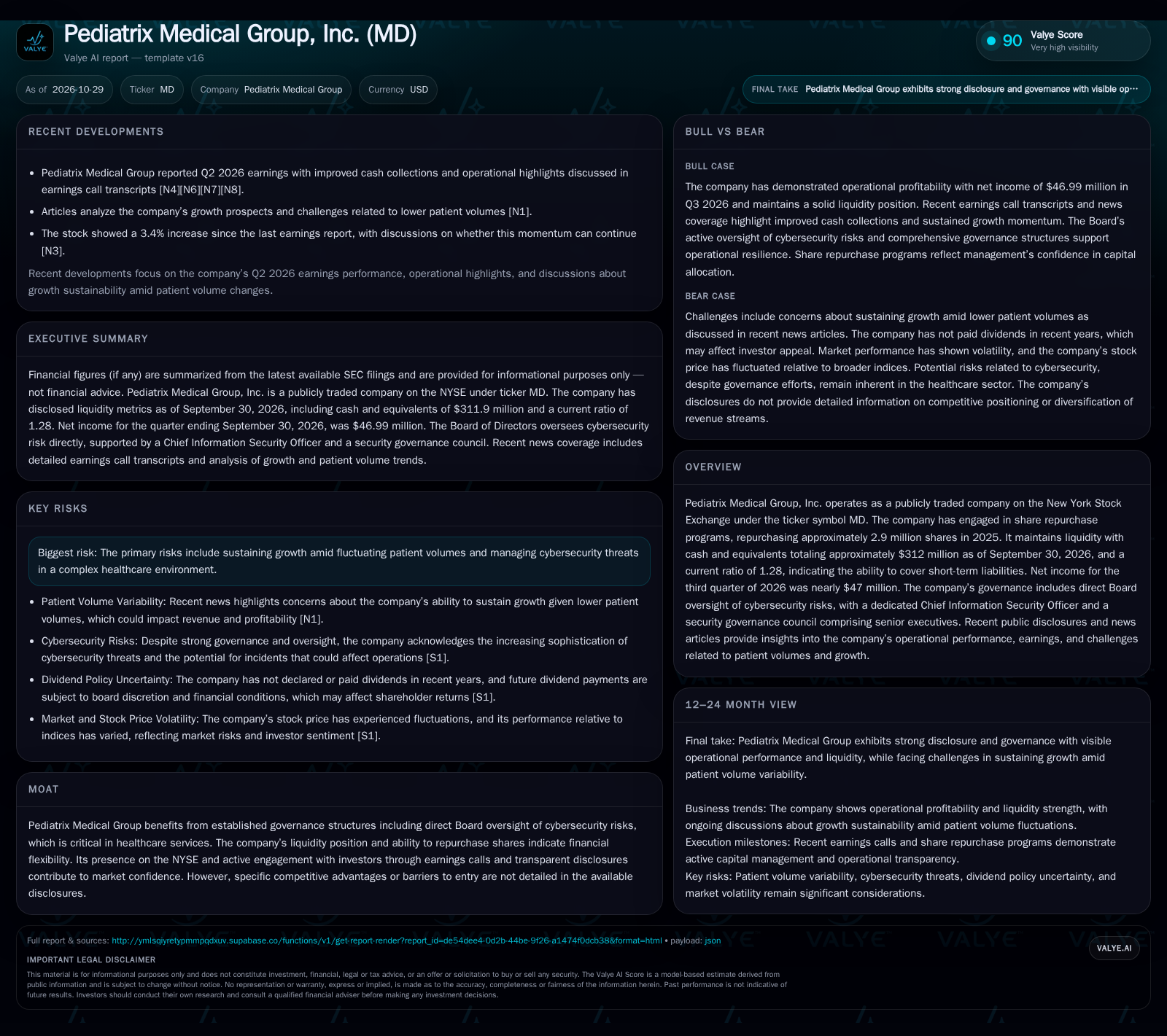
Pediatrix Medical Group reported nearly $47 million in net income for Q3 2026 and held $311.9 million in cash as of September 30, 2026. Despite this profitability and active share buybacks, the company faces ongoing challenges from lower patient volumes and the resulting pressure on growth. Its governance structure emphasizes cybersecurity oversight, but long-term earnings power will likely hinge on Pediatrix’s ability to adapt its operating model to evolving healthcare demand dynamics. [S2] [N1]
Pediatrix Medical Group, a prominent provider of neonatal and pediatric specialty care, is navigating a complex operating environment in late 2026. Yet, the core growth challenge remains: patient volume variability continues to cloud forward visibility. As the healthcare landscape shifts—driven by demographic trends, payer pressures, and technology adoption—Pediatrix’s ability to adapt its business model and defend its economic moat will be central to determining its long-term value proposition.
Recent Profitability and Balance Sheet Strength Stand Out, but Growth Remains Under Scrutiny
Pediatrix Medical Group reported $46.99 million in net income for the quarter ending September 30, 2026, confirming ongoing operational profitability in a period marked by sector-wide volatility. The company reported cash and liquidity metrics for the period; these figures do not by themselves establish operating runway, investment capacity, financial flexibility, or financing capacity. Capital allocation has included repurchasing approximately 2.9 million shares in 2025, a signal of management’s willingness to return capital to shareholders. However, despite these strengths, the sustainability of growth is in question, as recent news coverage has emphasized concerns about lower patient volumes and their impact on future performance. [S2] [N1]
How Pediatrix Generates Value: Margin Pressures and the Scale Equation in Pediatric Care
Pediatrix’s core economics are driven by providing neonatal, maternal-fetal, and pediatric subspecialty services—typically billed on a fee-for-service basis to commercial and government payers. Revenue growth is highly sensitive to patient volumes, payer mix, and reimbursement rates. Variable costs are tied to physician compensation and clinical staffing, while fixed costs include administrative overhead and information systems. This structure creates operating leverage: incremental patient volume can drive outsized profit gains, but volume declines compress margins quickly.
Capital requirements are modest compared to asset-heavy healthcare models, as the company’s primary assets are its clinical workforce and network relationships. Cash flow is influenced by billing cycles and payer mix, with government reimbursement often lagging commercial. Share repurchases suggest management views Pediatrix as undervalued relative to its earnings power. However, the absence of recent dividends and the focus on buybacks may point to limited reinvestment opportunities or a cautious approach to capital outlays amid sector uncertainty.
The recent improvement in cash collections, highlighted in Q2 2026, may indicate operational tightening or successful renegotiation of payer contracts, but persistent sector-wide reimbursement pressure and labor cost inflation could limit further margin expansion. If Pediatrix can leverage its scale to negotiate better rates with payers or optimize clinical staffing, operating margins could stabilize, but these gains are not assured.
Defending Share in a Fragmented and Margin-Compressed Healthcare Landscape
Pediatrix competes primarily with regional physician groups, hospital-employed practices, and other specialty management companies. Its national scale and established relationships with hospital systems provide a degree of negotiating leverage and operational efficiency, particularly in specialized neonatal and pediatric care. However, barriers to entry are moderate: while recruiting and retaining subspecialist clinicians is challenging, local competitors can often undercut on price or bundle services with larger hospital contracts.
Technology substitution is a gradual threat—telehealth and remote monitoring could shift some neonatal and maternal-fetal care away from traditional hospital settings, though the most acute cases will likely remain in-person for the foreseeable future. Payer consolidation and value-based care models are exerting downward pressure on reimbursement, favoring providers that can demonstrate outcomes and cost efficiency. Pediatrix’s governance focus on cybersecurity reflects both regulatory compliance requirements and the rising risk of operational disruption from cyber incidents, which could impact reputation and contract renewals.
Overall, Pediatrix’s competitive position is defensible but not unassailable. Its scale and clinical specialization offer some insulation, but commoditization pressures, clinician turnover, and technology-driven care model changes are persistent counterforces.
If Demand Recovers and Cost Controls Hold, Operating Leverage Could Drive Earnings Expansion
The most favorable scenario for Pediatrix hinges on a rebound in patient volumes—driven by demographic tailwinds (such as a modest uptick in birth rates), successful expansion into adjacent pediatric specialties, or improved referral flows from hospital partners. If management can control clinical labor costs and maintain efficient cash collections, the company’s inherent operating leverage would allow incremental revenue growth to translate into higher net income and free cash flow.
Evidence confirming this scenario would include sustained increases in patient encounters, stable or improving revenue per encounter, and expanding operating margins. Announcements of new hospital partnerships, successful integration of telehealth offerings, or favorable payer contract renegotiations would further validate the upside case.
Stagnant Volumes and Margin Stability Define the Most Likely Near-Term Trajectory
The most plausible outcome is that Pediatrix maintains modest profitability, with patient volumes remaining flat or only slightly improving. In this scenario, ongoing cost discipline and incremental operational improvements (such as better cash collections or administrative efficiencies) offset some reimbursement pressure, but revenue growth is constrained by broader healthcare utilization trends.
Confirmation would come from steady net income figures quarter-over-quarter, stable cash balances, and limited change in the number of hospital contracts or service lines. If management continues share repurchases but avoids large-scale expansion or capital-intensive projects, it would support the view that Pediatrix is prioritizing stability over aggressive growth. However, persistent lack of volume growth or further pressure on payer reimbursement rates would be early signals of downside risk.
Prolonged Volume Declines and Cost Inflation Could Erode Profitability and Strategic Options
The primary risk is that patient volumes decline further—due to demographic contraction, loss of key hospital contracts, or competitive displacement by lower-cost providers. If labor costs rise faster than Pediatrix can adjust, or if payers cut reimbursement rates in response to cost-containment pressures, operating margins could compress sharply. In this scenario, the company’s profitability would erode, limiting capacity for share repurchases or strategic investments.
Evidence supporting this downside would include sequential declines in patient encounters, shrinking net income, rising clinical staff turnover, or negative surprises in reimbursement settlements. A deterioration in cash flows or the need to draw on credit facilities could signal more acute financial stress. Adverse cybersecurity incidents—despite strong governance—could also disrupt operations or damage Pediatrix’s reputation with hospital partners.
What Will Determine Pediatrix’s Long-Term Value Creation and Resilience?
Quarterly trends in patient volumes and revenue per encounter—if disclosed—will be the clearest indicator of demand-side momentum.
Updates on hospital partnership renewals, contract wins, or expansion into new service lines would help gauge Pediatrix’s competitive relevance.
Operating margin trends and clinical labor cost ratios, if provided, would clarify the company’s ability to manage through sector inflation.
Cash collections efficiency and days sales outstanding—metrics often discussed in earnings calls—would signal billing discipline and payer relationship health.
Disclosures about cybersecurity incidents, regulatory compliance, or major IT investments will help assess operational risk and resilience.
Share repurchase activity and any shift in capital allocation priorities (such as dividend initiation or M&A) would indicate management’s view on value and reinvestment opportunities.
Payer mix evolution—such as changes in the proportion of commercial versus government reimbursement—would materially affect margin outlook.
Clinician recruitment and retention statistics, if disclosed, would offer insight into Pediatrix’s ability to sustain its clinical workforce and service quality.
Disclaimer: This is research-only, informational analysis and not investment advice. It may include AI-generated interpretation and general industry context. Always verify important details using primary sources.

Comments