
NovoCure’s Tumor Treating Fields: Scaling in Oncology Amid Profitability and Adoption Crossroads
NovoCure continues to expand its Tumor Treating Fields (TTFields) platform across multiple cancer indications, reporting record Q3 2026 revenue but remaining in net loss territory. The company’s future pivots on broadening clinical adoption, reimbursement expansion, and demonstrating sustainable operating leverage as it approaches EBITDA break-even.
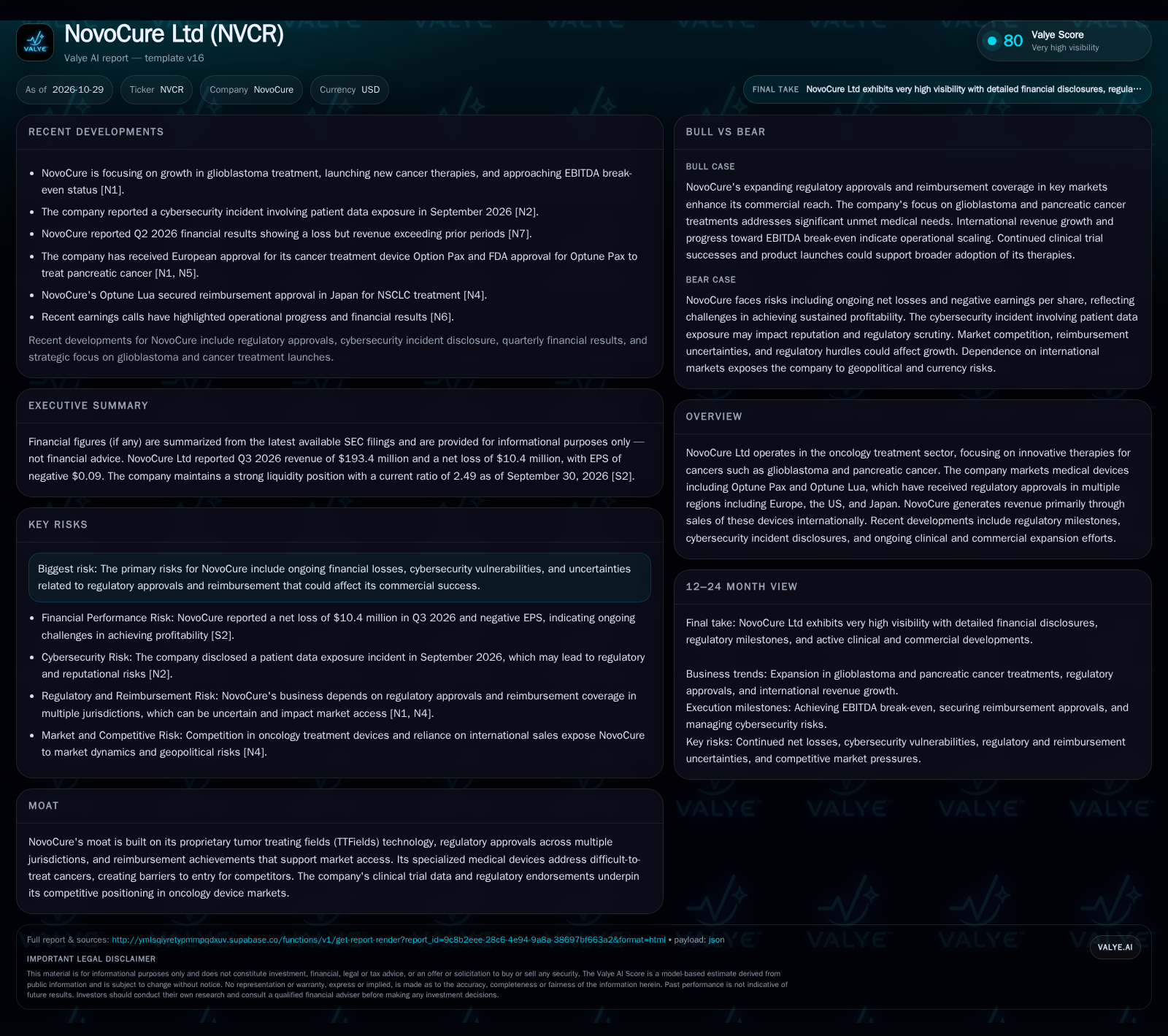
NovoCure reported Q3 2026 revenue of $193.4 million and a net loss of $10.4 million, with negative EPS and a current ratio of 2.49. Its TTFields device portfolio targets hard-to-treat cancers like glioblastoma and pancreatic cancer, with international commercial reach. The company’s near-term trajectory depends on scaling clinical adoption, reimbursement, and disciplined cost management to reach profitability. Cybersecurity, global economic conditions, and competitive pressures remain key risks. [S2]
NovoCure, a pioneer in the field of oncology medical devices, continues to push its Tumor Treating Fields (TTFields) therapy into new clinical and commercial territory. The company’s Q3 2026 results underscore a pattern familiar in medtech innovation: robust revenue growth paired with ongoing net losses as NovoCure invests in pipeline expansion, international market penetration, and operational scale. While its FDA- and CE-approved devices address critical unmet needs in aggressive cancers such as glioblastoma and pancreatic cancer, the path to sustained profitability hinges on broader adoption, payer coverage, and the ability to manage costs as the company nears EBITDA break-even. The next phase will test NovoCure’s ability to convert clinical progress and regulatory milestones into durable business performance.
Strong Revenue Growth, Persistent Losses, and Expanding Indications Define the Present
NovoCure reported Q3 2026 revenue of $193.4 million and a net loss of $10.4 million, translating to a negative $0.09 EPS for the period ending September 30, 2026. As of that date, NovoCure held $96.7 million in cash and cash equivalents, with current assets of $673.5 million against current liabilities of $270.7 million, resulting in a current ratio of 2.49. The company’s TTFields device portfolio continues to receive regulatory approvals across the US, EU, Japan, and other markets for indications including glioblastoma, NSCLC, malignant pleural mesothelioma, and pancreatic cancer. The operational focus remains on scaling these indications, particularly in glioblastoma, while also addressing cybersecurity risks following a patient data exposure incident in September 2026. [S2] [N1] [N2]
How NovoCure’s Model Converts Clinical Progress into Revenue
NovoCure’s primary revenue engine is the sale of its TTFields therapy devices, which are used in conjunction with standard chemotherapies to treat aggressive cancers. The commercial model likely combines direct sales and recurring revenue streams from device usage or rentals, although the precise contract structures and reimbursement dynamics are not fully disclosed in the supplied evidence. Pricing power is typically constrained by the need for payer reimbursement, which means revenue scale depends not only on clinical adoption but also on navigating complex healthcare systems and securing favorable coverage decisions.
Operating leverage is a key variable: as market penetration increases, NovoCure could see fixed costs (including R&D and regulatory investment) spread over a larger revenue base, improving margins. However, ongoing net losses suggest that either gross margins are pressured by manufacturing, distribution, or reimbursement limitations, or that R&D and commercial investments remain elevated as new indications are pursued. The company reported cash and liquidity metrics for the period; these figures do not by themselves establish operating runway, investment capacity, financial flexibility, or financing capacity.
Specialization, Clinical Barriers, and the Challenge from Adjacent Oncology Technologies
NovoCure’s main competitive advantage lies in its proprietary TTFields technology, which is backed by regulatory approvals and addresses late-stage, hard-to-treat cancers. The company’s first-mover status in TTFields for glioblastoma and other indications creates initial barriers to entry, as new entrants would need to demonstrate comparable clinical efficacy and navigate complex regulatory pathways.
However, competitive pressure is persistent in oncology. Adjacent modalities—such as immunotherapies, targeted drugs, radiation, and emerging device-based therapies—pose substitution risks. Large pharmaceutical and medtech companies could leverage broader commercial infrastructure or pursue combination strategies. The extent of NovoCure’s moat depends on continued demonstration of clinical benefit, expansion into new indications, and the ability to secure and defend intellectual property. The specialized nature of TTFields, with device management and patient adherence requirements, may also limit rapid substitution but can create friction in physician and patient adoption.
Broader Reimbursement and Clinical Adoption Unlock Operating Leverage
If NovoCure secures broad reimbursement for its TTFields devices across key markets and indications, the company could see a step-change in adoption. The causal chain would involve expanded payer coverage, accelerated physician uptake, higher patient volumes, and improved device utilization rates. As fixed costs are leveraged, NovoCure could approach or surpass EBITDA break-even, with margin expansion following revenue growth.
Evidence that would confirm this scenario includes: announcements of major new reimbursement approvals, a marked increase in device placements or active patients, rising gross margins, and a clear move into positive operating or free cash flow. Additional validation would come from successful clinical trial readouts in new indications, further regulatory approvals, and increased international sales contribution. Conversely, failure to expand reimbursement or weak clinical adoption would falsify the upside thesis.
Incremental Progress Amid Persistent Investment and External Headwinds
The most plausible near-term path is continued incremental revenue growth from existing and recently approved indications, with ongoing net losses as NovoCure invests in R&D, commercial expansion, and regulatory processes. Margins may improve modestly if device utilization increases and cost discipline is maintained, but profitability remains elusive in the absence of a breakthrough in payer coverage or a dramatic shift in clinical adoption patterns.
This scenario would be confirmed by stable or gradually rising revenue, continued net losses or small operating improvements, and ongoing commentary on pipeline progress and reimbursement efforts. Evidence against the base case would include a sharp inflection in profitability, major commercial setbacks, or unexpected regulatory or reimbursement denials.
Operational Risks, Reimbursement Challenges, and Competitive Erosion
NovoCure could face a negative spiral if reimbursement expansion stalls, clinical adoption plateaus, or competitive therapies gain traction. Net losses could widen if revenue growth slows while fixed costs remain high, or if the company is forced to increase commercial spending to defend market share. Cybersecurity incidents, like the September 2026 patient data exposure, could further erode trust with providers and patients, increasing regulatory scrutiny and operational costs.
Evidence for this scenario would include revenue stagnation or decline, increasing net losses, negative developments in reimbursement or regulatory status, heightened cybersecurity or legal expenses, and a loss of share to alternative oncology treatments. A material deterioration in liquidity or a need for dilutive capital raises would further reinforce the downside case.
Milestones That Could Reshape NovoCure’s Oncology Trajectory
Quarterly revenue growth rates segmented by indication and geography, especially for recently launched devices and new markets, would help test the scalability of TTFields.
Gross margin progression, if disclosed, as an indicator of manufacturing efficiency, pricing power, and reimbursement dynamics.
Updates on payer reimbursement approvals or denials in major markets, as these directly impact adoption rates and revenue visibility.
Number of active patients or device placements, if disclosed, to gauge real-world clinical penetration and utilization.
Progress toward EBITDA break-even or positive operating cash flow, as a milestone for business sustainability.
Regulatory milestones for pipeline indications, including clinical trial results, FDA or CE mark submissions and approvals.
Incidence and impact of cybersecurity or data privacy events, along with associated regulatory or reputational fallout.
R&D and SG&A expense trends relative to revenue, to track NovoCure’s ability to manage operating leverage and scale profitably.
Disclaimer: This is research-only, informational analysis and not investment advice. It may include AI-generated interpretation and general industry context. Always verify important details using primary sources.

Comments