
IDACORP’s Evolving Utility Footprint: Regulated Growth, Asset Repositioning, and the Next Phase of Customer Demand
IDACORP’s core regulated utility, Idaho Power, faces a pivotal period marked by rising customer demand, a strategic asset sale, and mounting regulatory complexity. The company’s ability to balance stable returns with capital allocation and operational adaptation will define its trajectory as energy markets shift and customer needs evolve.
IDACORP, through its Idaho Power subsidiary, is navigating a mix of stable regulated returns and new growth opportunities as it sells Oregon assets and responds to rising customer demand.
IDACORP stands at an inflection point as it seeks to balance the stability of its regulated electric utility business with the need to adapt to changing market dynamics and customer expectations. The cited source reports dividend-related activity; that disclosure alone does not establish dividend-policy continuity, management confidence, or a material constraint on capital flexibility. The interplay between capital investment, regulatory outcomes, and evolving demand will shape IDACORP’s ability to sustain shareholder value and operational resilience over the coming years.
Strategic Moves and Financial Signals in the Utility Core
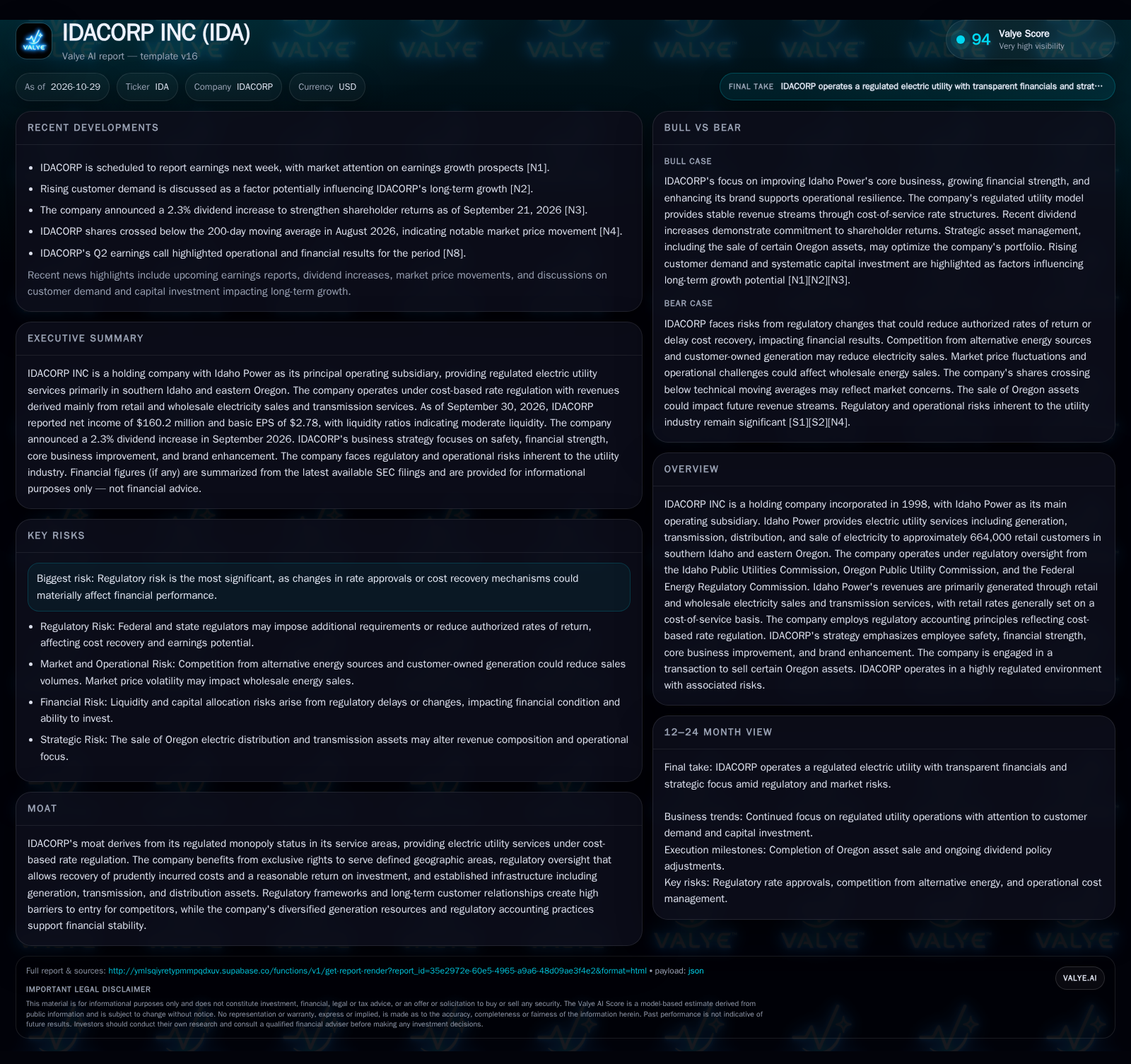
IDACORP’s Q3 2026 net income of $160.2 million and basic EPS of $2.78 underscore the underlying profitability of its core regulated utility operations [S2]. This financial performance is accompanied by a reported liquidity position, with $187.8 million in cash and a current ratio of 1.18 as of September 30, 2026 [S2]. The company’s announcement of a 2.3% dividend increase in September 2026 further signals a focus on returning value to shareholders [N3]. Most notably, IDACORP is executing a definitive agreement to sell its Oregon electric distribution business and certain transmission assets—a move that may streamline its service territory and operational focus [S1]. Rising customer demand and ongoing capital investment are cited as factors influencing the company’s long-term growth potential [N1] [N2]. Collectively, these developments point to a company seeking to reinforce its regulated utility base while adapting its portfolio for the future.
How IDACORP’s Regulated Model Shapes Cash Flows and Capital Needs
IDACORP’s economics are fundamentally shaped by its status as a regulated electric utility. Retail rates are generally set on a cost-of-service basis, allowing the company to recover prudently incurred expenses plus a regulated rate of return on invested capital [S1]. This framework typically results in stable, predictable revenue streams and cushions the business from short-term market volatility. However, it also means that profitability is tightly linked to regulatory approval, and any significant capital expenditures—such as new generation, grid upgrades, or environmental compliance—must be justified before regulators to secure cost recovery.
Fixed costs dominate the utility’s expense structure, given the capital intensity of generation, transmission, and distribution infrastructure. As such, incremental volume growth from rising customer demand may provide operating leverage, but only if allowed returns and rate structures keep pace with rising costs. Variable costs, such as fuel and purchased power, are sometimes subject to regulatory pass-through mechanisms, further stabilizing margins.
The sale of Oregon assets could reduce future capital requirements and focus resources on Idaho, potentially improving efficiency but also reducing the asset base over which fixed costs are spread. The cited source reports dividend-related activity; that disclosure alone does not establish dividend-policy continuity, management confidence, or a material constraint on capital flexibility.
Defending Monopoly Territory While Facing New Pressures
IDACORP, through Idaho Power, enjoys a regulated monopoly in its core service area, protected by exclusive rights to serve defined geographies and supported by established transmission and distribution infrastructure [S1]. Regulatory frameworks and long-standing customer relationships create high barriers to entry, and cost-based rate regulation provides a degree of earnings visibility not available to unregulated peers.
However, the utility landscape is evolving. Distributed energy resources (DERs), such as rooftop solar and customer-owned generation, present a plausible long-term threat to traditional volumetric sales, potentially eroding demand and complicating load forecasting. Competitive pressures from alternative energy providers—though still limited in most regulated markets—may intensify as technology and policy evolve. Meanwhile, regulatory bodies may increasingly scrutinize rate requests or impose new requirements for grid modernization, decarbonization, or resiliency investments.
The company’s decision to divest Oregon assets may be aimed at consolidating market position in Idaho, where regulatory relationships and operational scale are strongest. Still, the need to adapt to changing customer preferences, policy mandates, and technological disruption remains an undercurrent in the utility’s competitive calculus.
Accelerated Demand and Constructive Regulation Drive Earnings Expansion
In a favorable scenario, IDACORP benefits from sustained growth in customer demand—driven by population increases, economic expansion in Idaho, and electrification trends such as electric vehicles or heat pumps. If regulators approve timely and adequate rate adjustments, the company could achieve both cost recovery and incremental margin expansion, especially if capital investments in grid and generation assets are rewarded with attractive allowed returns.
The sale of Oregon assets could further streamline operations, reduce complexity, and enable a sharper focus on core Idaho markets. Successful execution of targeted capital investments may improve system reliability and customer satisfaction, supporting constructive regulatory outcomes and brand strength.
Regulatory filings showing timely rate case approvals and minimal disallowances would further support the thesis.
Stable Returns Amid Incremental Growth and Regulatory Balancing
The most plausible trajectory for IDACORP is steady, regulated earnings from its core Idaho Power operations, with incremental growth tied to moderate customer demand increases and ongoing capital investment. Rate cases proceed on a predictable schedule, with regulatory commissions generally allowing recovery of prudent costs but scrutinizing large capital projects and return-on-equity requests.
The Oregon asset sale modestly reduces operational scope but does not materially alter the company’s earnings profile, as the Idaho market remains the primary profit engine.
Evidence for this scenario would be continued stable net income and EPS in line with historical trends, a consistent regulatory cadence, and capital expenditures that keep pace with system needs but do not spike dramatically. Any deviation—such as delayed rate approvals or unexpected cost overruns—would challenge this base case.
Regulatory Delays and Disruptive Demand Trends Pressure Returns
A negative scenario emerges if regulatory bodies become less accommodating—delaying or denying cost recovery for major projects, reducing allowed returns, or imposing new requirements that increase costs without commensurate revenue. Such outcomes could squeeze margins and force the company to defer or scale back critical investments, ultimately impacting reliability and customer satisfaction.
Simultaneously, a rapid acceleration in distributed energy adoption or customer-owned generation could reduce net load growth, undermining the operating leverage benefits of rising demand. Should the Oregon asset sale result in a loss of scale or unforeseen transition costs, the impact could compound financial pressures.
Downside confirmation would come from regulatory filings showing significant disallowances or protracted rate case timelines, declining retail sales volumes, or material increases in unregulated competition.
Signals That Will Shape IDACORP’s Utility Value Proposition
The pace and outcome of regulatory rate case approvals, including allowed return on equity and cost recovery for capital projects.
Trends in retail customer demand by segment (residential, commercial, industrial), especially post-Oregon asset sale.
Capital expenditure levels and the extent to which new investments are incorporated into the regulated rate base.
Progress and financial impact of the Oregon distribution and transmission asset sale, including any transitional costs or regulatory adjustments.
Dividend growth rate relative to earnings and free cash flow generation.
Adoption rates of distributed energy resources and customer-owned generation within Idaho Power’s service territory—a useful metric would be net metering or interconnection requests, if disclosed.
Changes in liquidity and leverage metrics following portfolio adjustments and capital investment cycles.
Updates to regulatory frameworks or policy mandates that could alter cost recovery mechanisms or require new investment.
Disclaimer: This is research-only, informational analysis and not investment advice. It may include AI-generated interpretation and general industry context. Always verify important details using primary sources.

Comments