
ProPetro’s Power Growth and Service Expansion Reshape Oilfield Cycle Dynamics
ProPetro Holding Corp. reported Q3 2026 results that exceeded expectations and underscored its reported liquidity position and diversified oilfield service platform. As the company invests in power generation and expands its PROPWR segment with the Targa deal, the interplay between capital intensity, service integration, and oil price cyclicality will define its ability to sustain profitable growth.
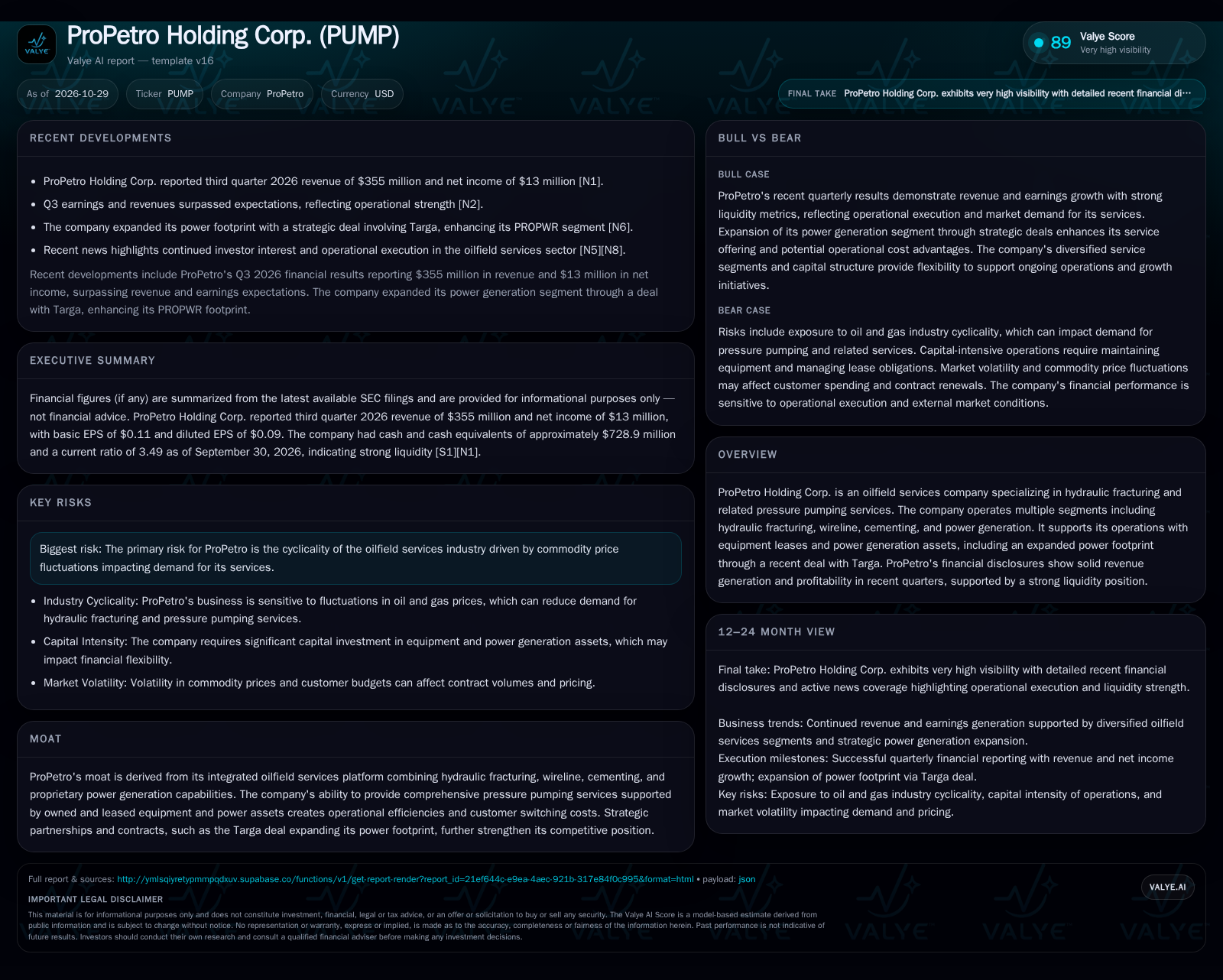
ProPetro delivered Q3 2026 revenue of $355 million and net income of $13 million, exceeding consensus estimates and highlighting robust operational execution. The company’s expansion into power generation via the Targa deal strengthens its PROPWR segment and may enhance operating efficiency.
ProPetro Holding Corp. stands at a juncture where operational diversification, strategic power investments, and reported liquidity position are redefining its profile in the oilfield services sector. With Q3 2026 revenues and earnings beating expectations and a high cash balance, the company is pursuing growth through both its core hydraulic fracturing services and an expanded power generation footprint. The recent Targa deal positions ProPetro to potentially reduce costs and offer more integrated solutions, but the company’s fortunes remain closely tied to the volatile cycles of oilfield activity and the heavy capital demands of its business model.
Financial Gains and Power Asset Investments Shift ProPetro’s Risk Profile
ProPetro reported third quarter 2026 revenue of $355 million and net income of $13 million, surpassing analyst expectations and signaling continued operational execution [N1] [N2]. The company reported cash and liquidity metrics for the period; these figures do not by themselves establish operating runway, investment capacity, financial flexibility, or financing capacity. [S1] Notably, ProPetro expanded its PROPWR segment through a strategic deal with Targa, enhancing its power generation capabilities [N6]. These developments matter because they provide both short-term potential financial flexibility and a potential long-term operational edge, especially as the company seeks to differentiate itself in a capital-intensive, cyclical industry.
The strategic enhancement of ProPetro’s power generation capabilities through the Targa deal also introduces a nuanced shift in the company's risk profile by potentially mitigating exposure to fuel price volatility, a significant cost driver in fracturing operations. By internalizing power production, ProPetro may gain greater control over a key input cost, which traditionally fluctuates with broader energy markets. This control can provide a buffer against sudden cost spikes, improving margin stability during periods of oilfield activity downturns. However, this advantage is contingent on the company’s ability to efficiently manage and scale these power assets without incurring disproportionate capital or operational overheads, which could offset the intended cost benefits.
Service Composition and Capital Strategy Influence Profitability and Exposure
ProPetro’s revenue model is anchored by hydraulic fracturing and related pressure pumping services, complemented by wireline, cementing, and increasingly, power generation. The business is characterized by high fixed costs—driven by equipment, maintenance, and labor—against a backdrop of variable revenue that fluctuates with oilfield activity. When utilization is high, the company can achieve strong operating leverage, as incremental jobs contribute more directly to profit. Conversely, downturns expose the company to margin compression due to underutilized assets and ongoing lease obligations.
The expansion of PROPWR through the Targa deal introduces a potentially valuable cost-control lever: by integrating power generation, ProPetro may reduce third-party fuel and power expenses, improve reliability, and offer bundled services that could command premium pricing or greater customer loyalty. However, these benefits depend on successful execution and customer adoption of integrated offerings.
Capital allocation decisions in ProPetro’s business model are inherently complex due to the interplay between asset intensity and cyclical demand. The timing and scale of investments in both hydraulic fracturing equipment and power generation assets must be carefully calibrated to match expected market cycles. Overinvestment during downturns risks asset idleness and capital write-downs, while underinvestment during upcycles may constrain growth and cede market share. Furthermore, the integration of power generation assets requires balancing fixed cost commitments against variable utilization rates, which could alter the company’s traditional operating leverage dynamics. Success depends on adaptive capital management practices that align asset deployment with evolving customer needs and market conditions.
Integrated Services Offer Competitive Edge Despite Cyclical and Substitution Risks
ProPetro competes in a fragmented oilfield services landscape, where larger diversified players and specialized local providers vie for contracts tied to drilling and completion activity. Its integrated platform—which now includes proprietary power generation assets—may increase switching costs for customers seeking one-stop solutions or greater operational reliability. The Targa deal could further entrench this advantage if it translates to lower costs or unique bundled offerings.
However, barriers to entry remain moderate: capital requirements are high, but customer loyalty is often transactional and price-sensitive. Large oilfield operators can pressure service pricing, and technological shifts (such as electrification, automation, or alternative completion techniques) could erode the value proposition of traditional pressure pumping. Substitution risk exists if operators shift to less service-intensive drilling or alternative energy sources reduce overall hydrocarbon demand.
The integration of proprietary power generation into ProPetro’s service suite may also influence competitive dynamics by raising barriers to entry in certain market segments. While capital intensity remains a hurdle for new entrants, the ability to offer bundled services that reduce operational complexity and improve reliability could shift customer preferences towards integrated providers. However, this advantage is conditional on the company’s ability to maintain technological relevance and operational excellence in both fracturing and power generation domains. Additionally, the potential for disruptive innovation in drilling techniques or alternative energy sources necessitates continuous investment in service innovation to sustain differentiation and counter substitution risks over the medium term.
Margin Growth and Market Share Lifted by Operational Leverage and Power Assets
In a favorable scenario, continued discipline in capital allocation and strong execution of the PROPWR expansion allow ProPetro to lower its per-unit service costs and capture additional wallet share from existing customers. If oil prices remain supportive and drilling activity increases, the company could benefit from higher fleet utilization, translating fixed costs into incremental margin gains. Successful cross-selling of integrated power and pumping services could cement customer relationships, reduce churn, and enable price premiums.
Evidence supporting this scenario would include sustained increases in utilization rates, margin expansion relative to historical averages, and growth in revenue per customer. Additional confirmation would come from customer contract wins explicitly tied to integrated service offerings, as well as improved return on invested capital despite ongoing equipment and power asset investments.
Performance Stability Supported by Service Variety and Reported Liquidity Position
The most plausible trajectory is one where ProPetro maintains steady revenue and profitability by leveraging its diversified service mix and reported liquidity position to navigate ongoing market volatility. The company continues to serve as a preferred partner for operators seeking reliable pressure pumping, wireline, cementing, and power solutions, but faces periodic pricing pressure and utilization swings tied to oil and gas cycles.
In this scenario, incremental gains from the PROPWR expansion help offset cost inflation and competitive intensity, but do not fundamentally alter the cyclicality of demand. Confirmation would include consistent fleet utilization, stable gross margins, and manageable capital expenditures in line with service revenues. Falsification would involve a sharp drop in utilization or margin compression not offset by diversification benefits.
Returns and Capital Control Vulnerable to Commodity Volatility and Asset Underuse
In an adverse scenario, a decline in oil prices or a significant reduction in drilling activity leads to lower demand for pressure pumping and related services. Utilization rates fall, exposing ProPetro to the burden of fixed costs and underused equipment. If the PROPWR investments fail to deliver expected cost savings or customer uptake is slow, the company could face margin erosion and negative operating leverage.
This scenario would be confirmed by declining revenues, sharp drops in fleet utilization, and rising direct operating costs as a percentage of sales. Additional warning signs would be increased write-downs of equipment or power assets, rising debt levels due to cash burn, and management guidance signaling reduced capital spending or workforce reductions.
Factors Shaping ProPetro’s Durability and Future Expansion
Quarterly fleet utilization rates and trends, especially in the hydraulic fracturing segment, as a signal of demand elasticity and operating leverage.
Gross margin evolution, particularly in relation to the integration of power generation and the PROPWR segment’s contribution.
Revenue growth attributable to cross-selling or bundled service contracts, if disclosed, as evidence of customer adoption of integrated offerings.
Capital expenditures versus depreciation, indicating asset reinvestment discipline and the sustainability of the current fleet.
Customer concentration metrics or contract renewal rates, which would help test the stickiness of ProPetro’s integrated service approach.
Cash flow from operations relative to net income, as a measure of earnings quality and ability to self-fund capital needs.
Developments in oilfield activity and commodity pricing, which remain the external variables most closely tied to overall demand.
Disclaimer: This is research-only, informational analysis and not investment advice. It may include AI-generated interpretation and general industry context. Always verify important details using primary sources.

Comments